
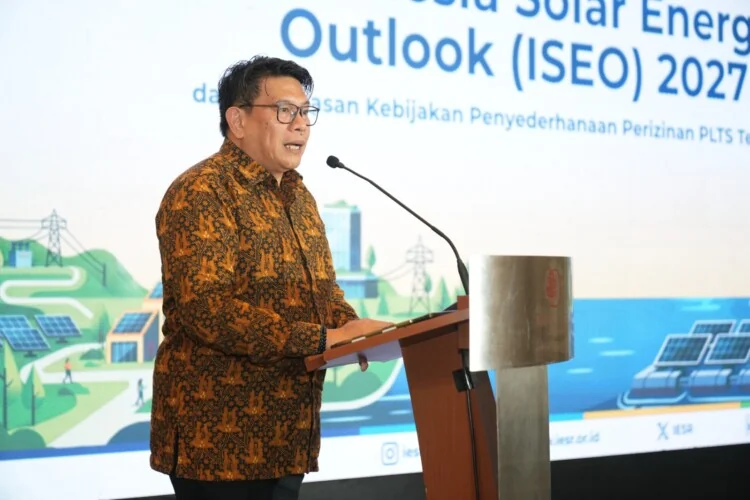
Enviro News Asia, Jakarta — Indonesia needs to accelerate solar power development to meet its ambitious target of installing 100 gigawatt-peak (GWp) of solar capacity by 2029, as installed capacity reached only 1.59 GWp in the first quarter of 2026, according to a new report by the Institute for Essential Services Reform (IESR).
The findings, published in the third edition of the Indonesia Solar Energy Outlook (ISEO) 2027, highlight a significant gap between the government’s renewable energy ambitions and the pace of project development. The report, released on Nov. 18, examines the country’s solar energy progress and its prospects in the coming years.
Indonesia reached 1 GWp of installed solar capacity in 2025, before increasing to 1.59 GWp in the first quarter of 2026. However, solar power still accounted for only around 1.5 percent of the country’s total power generation capacity and 0.3 percent of electricity production.
IESR said the growth remained far below the government’s ambition to make solar power a major pillar of the national energy system through the National Energy Policy and its 100 GWp solar power programme, launched in August.
Rooftop solar installations accounted for the largest share of the country’s installed capacity, reaching 0.90 GWp, or 57 percent of the total. Utility-scale solar plants contributed 0.33 GWp, captive solar installations 0.30 GWp, and remote-area projects around 0.06 GWp.
Despite the increase, solar development continues to face regulatory gaps, uncertainty over procurement and limited access to electricity networks.
IESR Chief Executive Fabby Tumiwa said the 100 GWp ambition must be incorporated into revisions or updates to the 2025–2034 Electricity Supply Business Plan (RUPTL). He called for faster development of utility-scale solar power plants and battery energy storage systems (BESS), the replacement of diesel power plants with solar and storage systems, and wider rooftop solar deployment within the state-owned electricity company PLN’s network.
He said projects needed to become ready for tender or financing at a much faster pace over the next year.
“Of the 14 projects under the 100 GWp programme launched on Aug. 25, 2026, with a combined capacity of around 5.2 GWp, only approximately 526 MWp have a scheduled completion date,” Fabby said.
IESR’s modelling suggests Indonesia could reach nearly 96.7 GWp of solar capacity by 2029 if several development channels progress simultaneously and key regulations are improved.
The proposed expansion includes around 8 GW of projects already planned under the RUPTL and the Mentari GigaOne procurement programme, an additional 56 GW through PLN procurement, and approximately 33 GW from other channels. These include rooftop solar, diesel replacement, rural electrification, captive solar plants and other distributed solar applications that support productive economic activities.
The ISEO 2027 report identifies five key factors that will determine whether Indonesia can accelerate solar development.
First, solar expansion must go hand in hand with wider electrification. Under a high-electrification scenario, Indonesia’s electricity demand in 2035 could be around 160 terawatt-hours higher than under a business-as-usual scenario. Demand growth could come from electric transport, industry, cooling, cooking, data centres and electricity exports.
This direction is also consistent with the “35 by 35” initiative promoted by the Turkish COP31 presidency, which seeks to increase electricity’s share of global final energy consumption to 35 percent by 2035, from around 23 percent currently.
Second, IESR has called for reforms to the rooftop solar quota system, which it says continues to restrict wider adoption. The organisation recommends setting quotas according to the capacity of electricity networks to accommodate additional generation, known as hosting capacity, at the substation level.
Third, solar project procurement needs to become more predictable and transparent. IESR recommends introducing procurement schedules based on technology and developing reverse auctions to accelerate utility-scale solar projects.
The report notes that projects are still frequently tendered individually without a clear procurement calendar. Publishing a regular auction schedule would give developers, financial institutions and equipment suppliers more time to prepare projects and submit competitive bids.
Fourth, electricity transmission networks and energy storage systems must be developed more quickly. The 2025–2034 RUPTL plans for 42.6 GW of renewable energy capacity and 10.3 GW of energy storage. However, several transmission projects needed to integrate solar power are not scheduled for completion until 2030–2034.
IESR also called for regulatory improvements and incentives to make investment in energy storage more attractive.
Fifth, accelerating solar deployment should strengthen domestic manufacturing. Indonesia’s annual solar module production capacity reached around 27 GWp in 2026, while solar cell production capacity stood at approximately 14.3 GWp.
However, domestic demand has grown more slowly than manufacturing capacity. IESR said the 100 GWp programme could provide a stable market for local manufacturers if the government ensures project certainty and consistent policies.
The report also highlights solar power’s potential contribution to national energy security by reducing exposure to international fuel price volatility.
In April 2026, Indonesia’s average crude oil price reached around US$117 per barrel, significantly higher than the government’s budget assumption of US$70 per barrel. If the difference persisted for a full year, energy subsidies and compensation could rise to around Rp470 trillion, potentially contributing to a state budget deficit of up to Rp320 trillion, according to IESR’s estimates.
Solar power, by contrast, does not face fuel price fluctuations once a power plant is operational.
To support implementation, IESR recommends explicitly incorporating the 100 GWp target into the next revisions of the National Electricity General Plan (RUKN) and RUPTL. These plans should include clear procurement pathways, grid readiness measures, the respective roles of distributed solar systems and a legal framework governing project ownership, procurement and financing.
Fabby said the 2027–2029 period would be a crucial test of Indonesia’s ability to turn its solar ambitions into operational projects.
Utility-scale, grid-connected solar capacity could reach around 557 MWp by the end of 2027 and 857 MWp by the end of 2028 if projects with established completion schedules proceed as planned.
Looking further ahead, the challenge will extend beyond building more power plants. By 2035, electricity demand, transmission capacity and energy storage must grow in line with the expansion of solar generation. Power plants, transmission infrastructure, storage, demand, financing and domestic manufacturing therefore need to be planned as an integrated system.
Erick Ta’dung, coordinator for renewable energy business supervision at the Energy and Mineral Resources Ministry’s Directorate General of New, Renewable Energy and Energy Conservation, said the government was working on several regulatory improvements.
These include drafting a presidential regulation on the 100 GWp programme, coordinating its provisions with relevant ministries and agencies, and revising Presidential Regulation No. 112/2022.
IESR said the success of the programme would depend on the entire implementation chain, including clear planning, procurement reform, stronger electricity networks, new sources of demand and a reliable domestic supply chain. Without progress across these areas, faster project development may not translate into operational capacity that meets the government’s target.
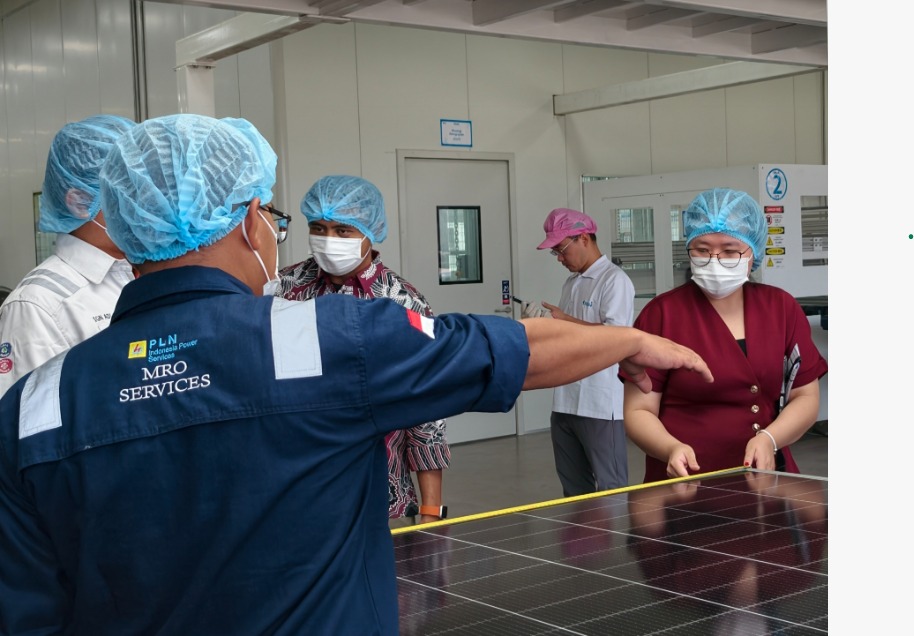
Photo caption: Indonesia aims to expand solar power capacity to 100 GWp by 2029, requiring faster project development, stronger electricity networks and greater investment in energy storage. (*)