Enviro News Asia, Antalya — Indonesia has told world leaders that economic development and climate action must go hand in hand, arguing that environmental protection should remain central to national growth, food and energy security, and public welfare.
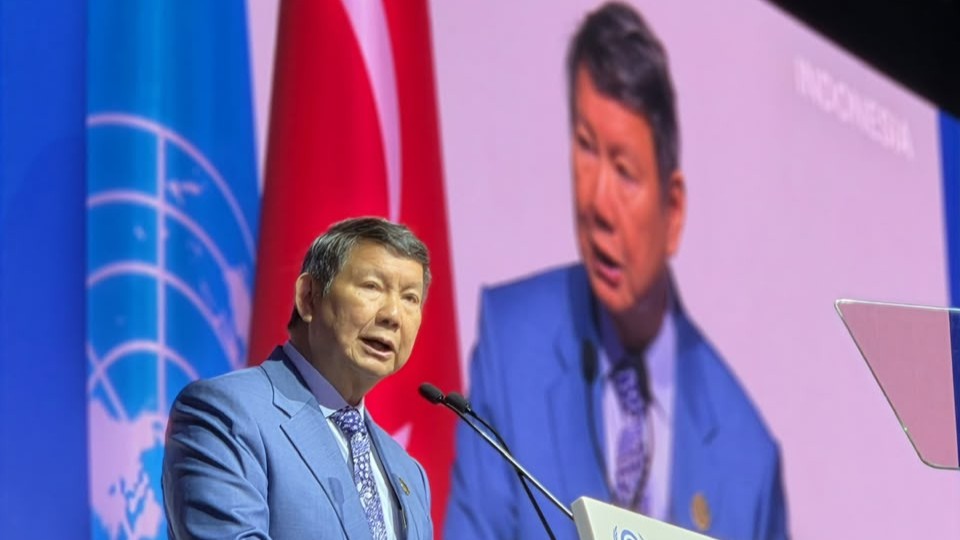
Presidential Special Envoy for Climate and Energy Hashim S. Djojohadikusumo delivered the message at the World Leaders Summit of the 31st United Nations Climate Change Conference (COP31) in Antalya, Türkiye, on Nov. 12, 2026.
Hashim said Indonesia was committed to turning climate pledges into practical action while ensuring that economic growth and environmental sustainability advanced together.
“Indonesia will not choose between development and climate action. President Prabowo Subianto’s vision is clear: we must achieve both,” he said.
As an archipelagic country vulnerable to rising sea levels and extreme weather, Indonesia considers ecosystem protection essential to strengthening food and energy self-sufficiency and creating green jobs.
The government has expanded its forest protection and firefighting workforce from 8,000 to 70,000 personnel, supported by more than 25,000 local residents, as part of efforts to prevent forest and land fires amid prolonged drought risks associated with El Niño.
These measures are also supported by advanced early warning systems and the establishment of the National Peatland and Mangrove Management Agency, which operates directly under the President.
In its efforts to strengthen food security, the government has adopted a policy against expanding agricultural activities into primary forests. Instead, it is prioritizing increased productivity on degraded land.
Indonesia has also expanded community-based forest management through its social forestry programme, which now benefits more than 1.4 million families across 8 million hectares of forest areas.
The government has designated 400,000 hectares as customary forests and aims to increase the total to 1.4 million hectares by 2029.
In the marine sector, Indonesia is strengthening protection of coastal ecosystems that store blue carbon, particularly mangroves and seagrass beds. The country has set a target to conserve 30 percent of its national waters.
Indonesia is also promoting a more equitable clean energy transition through an initiative to develop 100 gigawatts of solar power capacity.
On climate policy, the government is strengthening its emissions reduction strategy through its Second Nationally Determined Contribution (Second NDC), alongside a National Adaptation Plan (NAP) focused on water security, public health, coastal resilience and food security.
Hashim also called for greater financial responsibility from developed countries, urging them to lead efforts to deliver at least US$300 billion annually in climate finance by 2035 under the New Collective Quantified Goal (NCQG).
He further called for implementation of the Baku to Belém Roadmap, which aims to mobilize US$1.3 trillion annually by 2035.
“No country should be held back simply because of limited access to financing or technology,” Hashim said.
Domestically, Indonesia is strengthening its climate financing mechanisms through carbon pricing and the implementation of the National Carbon Unit Registry System (SRUK).
The government said its approach demonstrates that environmental protection and climate action can be integrated into economic development rather than treated as competing priorities, supporting both national prosperity and long-term environmental sustainability. (*)