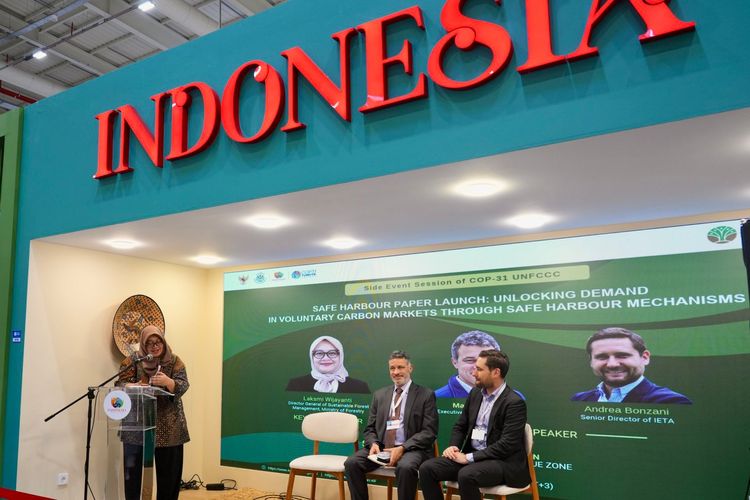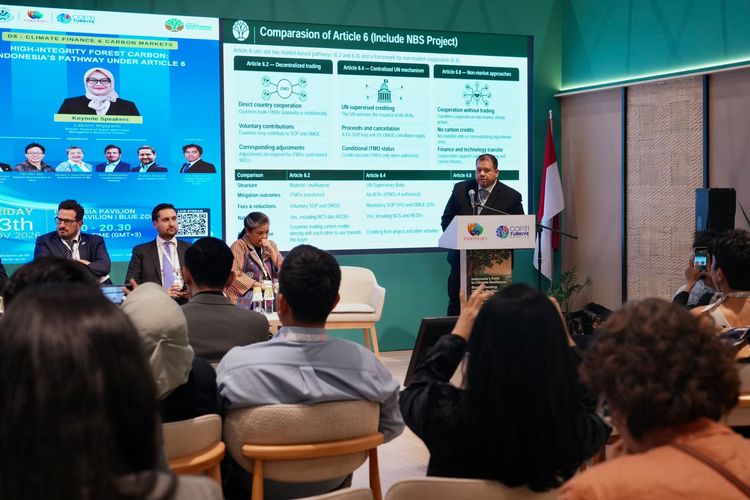
Enviro News Asia, Antalya — Indonesia is strengthening forest governance and supply chain transparency to ensure that forest-based products come from legal and sustainably managed sources, Forestry Ministry officials said during the COP31 climate conference in Antalya, Türkiye, on Nov. 12, 2026.
Laksmi Wijayanti, Director General of Sustainable Forest Management at the Ministry of Forestry, said traceability of raw materials and collaboration among supply chain stakeholders were essential to developing deforestation-free forest products.
“Products cannot be separated from the landscapes where they originate,” Laksmi said during a dialogue at the Indonesian Pavilion titled “Deforestation-Free Forest Products: Building Traceable, Transparent and Responsible Forest-Based Supply Chains.”
She said responsible supply chains must begin with sustainable forest management, ensuring that raw materials come from sources managed in accordance with legal, environmental and social requirements.
“Traceability must therefore start in the forest itself, through clear governance, legal certainty, responsible management practices and effective protection of forest resources,” she said.
Indonesia is strengthening forest governance through its Timber Legality and Sustainability Verification System (SVLK), supported by forest administration, raw material verification, legality documentation and export monitoring.
The National Forest Monitoring System (SIMONTANA) also provides information on forest cover, deforestation and forest resources to improve transparency and oversight.
Laksmi said technology and information systems must be accompanied by inter-agency cooperation and the involvement of businesses and other supply chain participants. She stressed that traceability requirements should be inclusive and should not create barriers for local communities, smallholder farmers or small-scale businesses.
The government’s policy direction includes linking traceability systems with landscape-level monitoring and improving connections between national systems, certification schemes and market requirements. The aim is to ensure that the transition towards more responsible supply chains includes businesses of all sizes.
Diah Suradiredja, Head of Policy, Advocacy and Social Inclusion at WWF-Indonesia, said raw material traceability must be linked to forest protection, biodiversity conservation and community rights.
She said information about the origins of raw materials should be supported by field monitoring and community participation to identify and address environmental and social risks throughout supply chains.
“Local communities and smallholder farmers need access to information and assistance to meet traceability requirements. Their involvement is important to ensure that deforestation-free supply chains also create fair economic opportunities and support long-term forest protection,” Diah said.
Veronika A. Renyaan, Head of Stakeholder Engagement and Advocacy at APP Group, said the company had implemented its Supplier Evaluation and Risk Assessment (SERA), which covers 20 environmental and social indicators, alongside field monitoring and communication with communities.
“Traceability is an important foundation, but sustainable outcomes can only be achieved when effective systems are supported by an understanding of field conditions and consistent collaboration,” she said.
The dialogue also featured Thorsten Arndt, Head of Advocacy at PEFC International, and Christine Spady, Senior Trade Policy Adviser at Natural Resources Canada’s Canadian Forest Service.
Moderated by Dominic Waughray, Executive Vice President of the World Business Council for Sustainable Development (WBCSD), the discussion examined the roles of certification, governance, traceability and collaboration in strengthening forest-based product supply chains.
The discussion took place amid growing global market demands for transparency in raw material origins, product legality and the management of environmental and social risks. (*)