Enviro News Asia, Washington, D.C. — Under the clear spring skies of Virginia, excitement filled the air as the countdown reached its final seconds. On 7 June 2026, an Indonesian team stood alongside dozens of competitors from around the world, preparing to launch a rocket carrying a payload no larger than a soft drink can.
“Ten, nine, eight… three, two, one… go!”
Moments later, the rocket roared into the sky, climbing to an altitude of 714 meters. After the fuel was exhausted, the payload separated and began its descent using a paraglider system. As it approached the ground, a second parachute deployed at an altitude of around 10 meters, slowing its speed and ensuring a safe landing.
Inside the payload, an egg—the mission’s fragile cargo—remained intact. Throughout the descent, sensors recorded altitude, air pressure, and GPS coordinates, while two onboard cameras captured the entire journey. All data were transmitted in real time to a command station located three kilometers away.
The mission was a complete success.
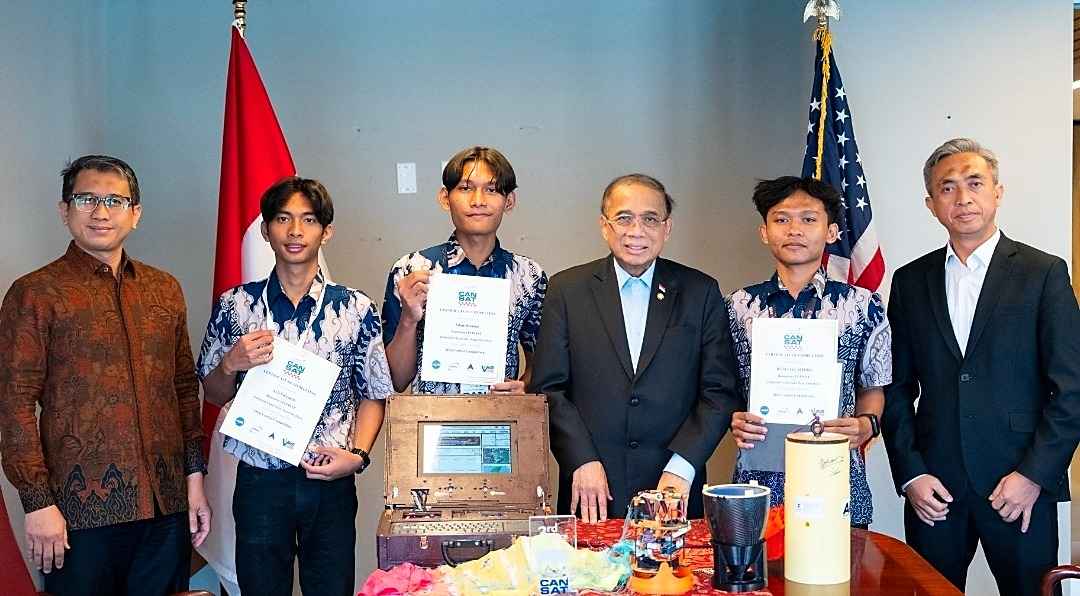
The achievement earned Indonesia’s Bamantara EEPISAT team from the Electronic Engineering Polytechnic Institute of Surabaya (PENS) third place in the prestigious CanSat 2026 competition, surpassing teams from more than 40 countries.
The Indonesian team consisted of Adam Kandias, Rafida Azis Al Habib, Ax’l Nurrahim, Lintang Arum Sari, Fatma Aliea Wibowo, Muhammad Tsaqif Mukhayyar, Muhammad Rizky, Immanuel Valentino Wibowo, Tsania Zahira Soffa, and Callista Salsabila Sugianto.
CanSat is an international competition organized by the American Astronautical Society (AAS) in collaboration with the National Aeronautics and Space Administration (NASA). Since 1999, the program has challenged university students to design, build, and launch miniature satellites the size of a 350-milliliter soda can.
Participants are required to integrate all the essential subsystems of a real satellite, including communications, sensors, power supply, and recovery mechanisms. More than a competition, CanSat provides students with hands-on experience throughout the entire lifecycle of a space mission, from concept and design to launch and data analysis.
Teams from countries including India, Turkey, Mexico, Poland, Argentina, and Indonesia regularly participate in the event.
For Bamantara EEPISAT, the latest achievement continues a remarkable track record. The team secured third place at CanSat USA 2022 and improved to second place at CanSat USA 2023 in Blacksburg, Virginia, competing against 40 international teams. Their success once again demonstrated the ability of Indonesian students to compete on the global stage of satellite technology.
Beyond academic achievement, the experience is expected to encourage innovation and create opportunities for future aerospace technology startups based on CanSat platforms.
The team is now preparing for another international challenge, with plans to participate in a rocket launch competition in Germany in 2027.
Indonesian Ambassador to the United States, Indroyono Soesilo, welcomed the achievement and praised the students’ spirit of innovation.
He emphasized that the creativity and inventiveness of Indonesia’s young generation must continue to be nurtured and shared with others, noting that the country’s future lies in the hands of young people who are capable of competing with the best talents around the world. (*)