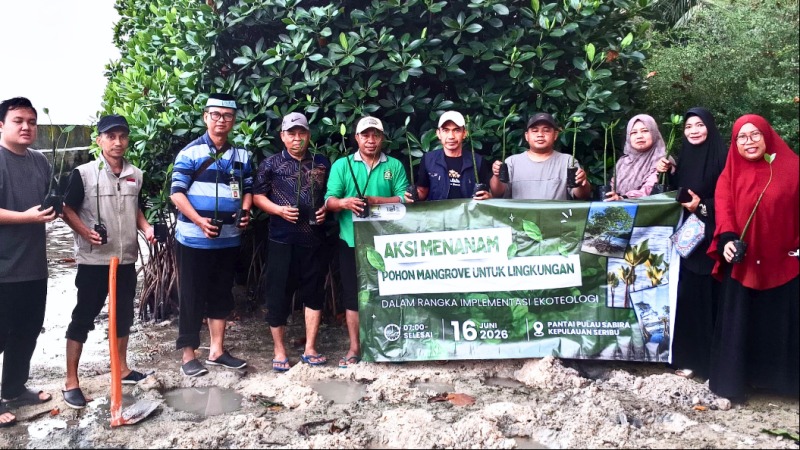
Enviro News Asia, Jakarta — The Religious Affairs Office of Indonesia’s Seribu Islands Regency has strengthened its environmental commitment by carrying out a mangrove planting campaign on Sabira Island as part of the Ministry of Religious Affairs’ Ecotheology program aimed at fostering environmental awareness and climate action.
The initiative, held on June 16, brought together local religious officials and Islamic counselors to demonstrate how faith-based values can support ecosystem conservation and sustainable development.
Nasruddin, head of the Religious Affairs Office of Seribu Islands Regency, led the activity alongside Head of Islamic Community Guidance Achmad Mastur, Head of Islamic Education Sutama, and Islamic religious counselors from North Seribu Islands District.
Nasruddin said environmental protection should be regarded as a shared responsibility and a form of worship, emphasizing that ecotheology teaches people to develop a relationship with nature based on stewardship rather than exploitation.
He said planting mangroves represents more than a conservation effort, describing it as an act of cultivating awareness, hope, and lasting benefits for future generations. According to him, the Ministry of Religious Affairs launched the Ecotheology program to strengthen public understanding of environmental and climate issues through spiritual values.
Nasruddin added that religious teachings promote balance between humanity and nature, making environmental protection an expression of gratitude and a practical manifestation of faith.
The mangrove planting took place along the coast of Sabira Island, an area that plays a crucial role in maintaining coastal ecosystems. Mangrove forests help prevent coastal erosion, protect shorelines from waves, provide habitats for marine species, and absorb carbon that contributes to climate change mitigation.
The activity also served as an educational platform to raise public awareness about the importance of long-term environmental stewardship. Participants learned that protecting nature is both a moral and spiritual responsibility that should be passed on to future generations.
Community members and officials worked together throughout the event, preparing seedlings and planting them at designated sites along the island’s coastline.
Achmad Mastur, head of Islamic Community Guidance, called on all sectors of society to make environmental protection a continuous collective movement rather than relying solely on appeals or theoretical discussions.
He expressed hope that the newly planted mangroves would thrive and become a lasting environmental investment benefiting local communities.
Through the initiative, the Religious Affairs Office of Seribu Islands Regency aims to strengthen public awareness of environmental conservation and demonstrate that religious values can be translated into practical actions that promote harmony between people and nature. The ministry said the Ecotheology program will continue encouraging initiatives that reinforce both spiritual life and the preservation of the planet for future generations. (*)