Enviro News Asia, Bogor – The journalist workshop themed “Strengthening the Role of Media in Supporting Indonesia’s FOLU Net Sink 2030 Agenda” officially concluded on Saturday (May 17, 2025), marked by a closing speech from Krisdianto, Head of the Public Relations and International Cooperation Bureau at the Ministry of Forestry.
In his remarks, Krisdianto emphasized the central role of the media as a communication bridge between government policy and public awareness in support of the national climate agenda.
“Journalists are not merely reporters—they are part of the solution ecosystem. Through accurate, balanced, and constructive reporting, the media helps ensure that the FOLU Net Sink 2030 agenda is not only understood but also widely supported by the public,” said Krisdianto.
The two-day workshop, held from May 16–17, 2025, was initiated by the Ministry’s Public Relations and International Cooperation Bureau with support from the Climate Promise initiative of the United Nations Development Programme (UNDP). The event was attended by more than 20 journalists from various national and local media outlets.
The workshop was opened a day earlier by the Secretary-General of the Ministry of Forestry, Mahfudz, who stressed the significance of the FOLU Net Sink 2030 as a key pillar of Indonesia’s climate change mitigation strategy.
In his presentation, Mahfudz explained that Indonesia aims to reduce emissions by up to -140 million tons of CO₂e from the forestry and other land use (FOLU) sector by 2030. This target forms part of Indonesia’s broader Nationally Determined Contribution (NDC), which includes a 31.89% reduction in emissions through domestic efforts and up to 43.2% with international support.
To achieve this, the government has outlined four key strategies: preventing deforestation, promoting sustainable forest management, protecting peatland ecosystems, and rehabilitating forests and degraded lands.
Mahfudz also highlighted the need for significant investment—around USD 14 billion—which can only be met through cross-sector collaboration.
In addition to sessions with multi-sectoral speakers—including representatives from the FOLU Secretariat Team, business actors, academics, NGOs, and senior journalists—the participants took part in a field visit to a key project site.
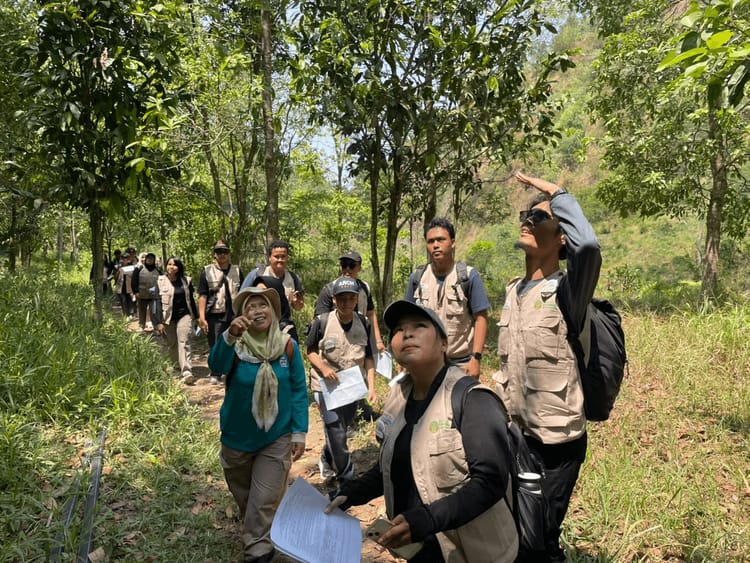
The first day concluded with an in-depth discussion on the FOLU Net Sink 2030 and effective public communication strategies on climate issues. The second day featured a visit to the Rumpin Nursery in Bogor, one of the largest modern nurseries in Indonesia.
At the Rumpin Nursery, participants observed the seedling production process and the crucial role of forest rehabilitation in supporting carbon absorption.
Speakers from the Citarum-Ciliwung Watershed Management Agency, the FOLU Secretariat, and environmental communication experts elaborated on the tangible contributions of tree planting to the FOLU Net Sink agenda.
The site served as a concrete example of nature-based climate solutions being implemented in earnest.
During the closing session, Krisdianto expressed his appreciation for the enthusiasm and active participation of the journalists.
He encouraged all participants to produce news articles that are informative, solution-oriented, and capable of raising public awareness.
“Good reporting is not just about presenting facts, but about how those facts inspire hope. This workshop marks the beginning of a long-term collaboration between the government and the media to support Indonesia’s climate agenda,” he concluded.
The workshop ended with the awarding of participation certificates and a reflection session, during which participants shared their insights on how the two-day experience had enriched their perspective on covering forestry and climate change issues. *