Enviro News Asia, Semarang – Indonesia’s Minister of Environment and Head of the Environmental Control Agency (KLH/BPLH), Moh Jumhur Hidayat, has called for an integrated coastal protection strategy combining large-scale infrastructure and ecosystem restoration to address worsening coastal erosion, tidal flooding, and land subsidence along the northern coast of Java.
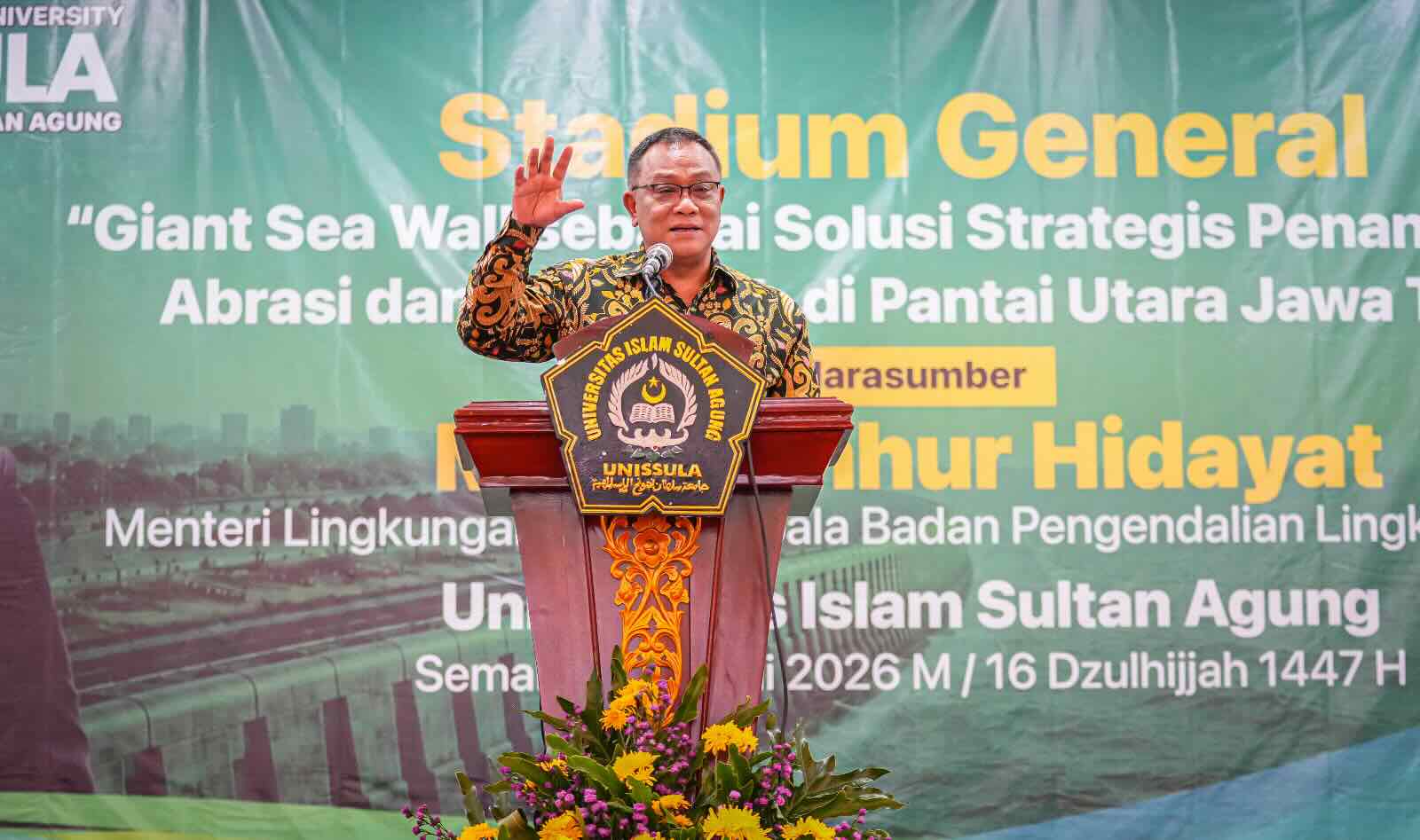
Speaking during a public lecture at Sultan Agung Islamic University (Unissula) in Semarang on 2 June, Jumhur said the northern coastal corridor of Central Java, commonly known as Pantura, is experiencing mounting environmental pressures that threaten residential areas, industrial zones, ports, agriculture, and fisheries that support the region’s economy.
The lecture, titled “Giant Sea Wall as a Strategic Solution for Addressing Coastal Erosion and Tidal Flooding on the Northern Coast of Central Java,” focused on the growing challenges facing one of Indonesia’s most economically significant coastal regions.
According to Jumhur, the primary driver of recurring tidal flooding is not only rising sea levels but also rapid land subsidence occurring in several coastal cities.
“The root cause of tidal flooding is not solely the rising sea. The land itself is sinking,” Jumhur said. “Sea levels are rising by approximately 2.1 millimeters per year, while land subsidence in the Semarang-Demak area can reach between 0.010 and 0.150 meters annually.”
He noted that in some locations, the ground is sinking by as much as 10 to 15 centimeters each year, creating a much greater threat than sea-level rise alone and requiring urgent intervention.
While acknowledging the strategic value of the proposed Giant Sea Wall project in protecting economic activities and coastal settlements, Jumhur stressed that large-scale engineering structures should not be viewed as a stand-alone solution.
He warned that continued excessive groundwater extraction, weak spatial planning enforcement, and degradation of coastal ecosystems could undermine the effectiveness of the infrastructure over time.
To address these challenges, the Ministry is promoting a hybrid coastal defense approach that combines physical infrastructure such as sea walls, pumps, and polders with ecosystem-based measures, including mangrove restoration, estuary protection, groundwater management, and stricter land-use planning.
“Mangroves are a natural fortress,” Jumhur said. “Mangrove forests can reduce wave heights by between 13 and 66 percent over a distance of 100 meters, while also restoring fish habitats and supporting the livelihoods of coastal communities.”
The minister emphasized that environmental safeguards must remain central to any future coastal protection project. He said all Giant Sea Wall developments must undergo rigorous Strategic Environmental Assessments (SEA/KLHS) and Environmental Impact Assessments (EIA/AMDAL).
According to Jumhur, the review process must be based on scientific evidence, ensure transparent public participation, and protect the interests of fishermen, aquaculture operators, women in coastal communities, and other vulnerable groups.
“Giant Sea Walls can form part of the solution for protecting Pantura, but they must not become the only solution,” he said. “The Ministry of Environment emphasizes a hybrid approach in which physical infrastructure is integrated with groundwater control, mangrove restoration, spatial planning, strict environmental assessments, and protection of coastal communities.”
The ministry believes that combining engineered infrastructure with nature-based solutions will not only strengthen protection against coastal hazards but also help preserve economic activities and livelihoods that depend on healthy and productive coastal ecosystems.
As Indonesia continues to face the impacts of climate change, coastal erosion, and land subsidence, officials say integrated and science-based coastal management will be critical to safeguarding both environmental sustainability and long-term economic resilience along Java’s northern shoreline. (*)