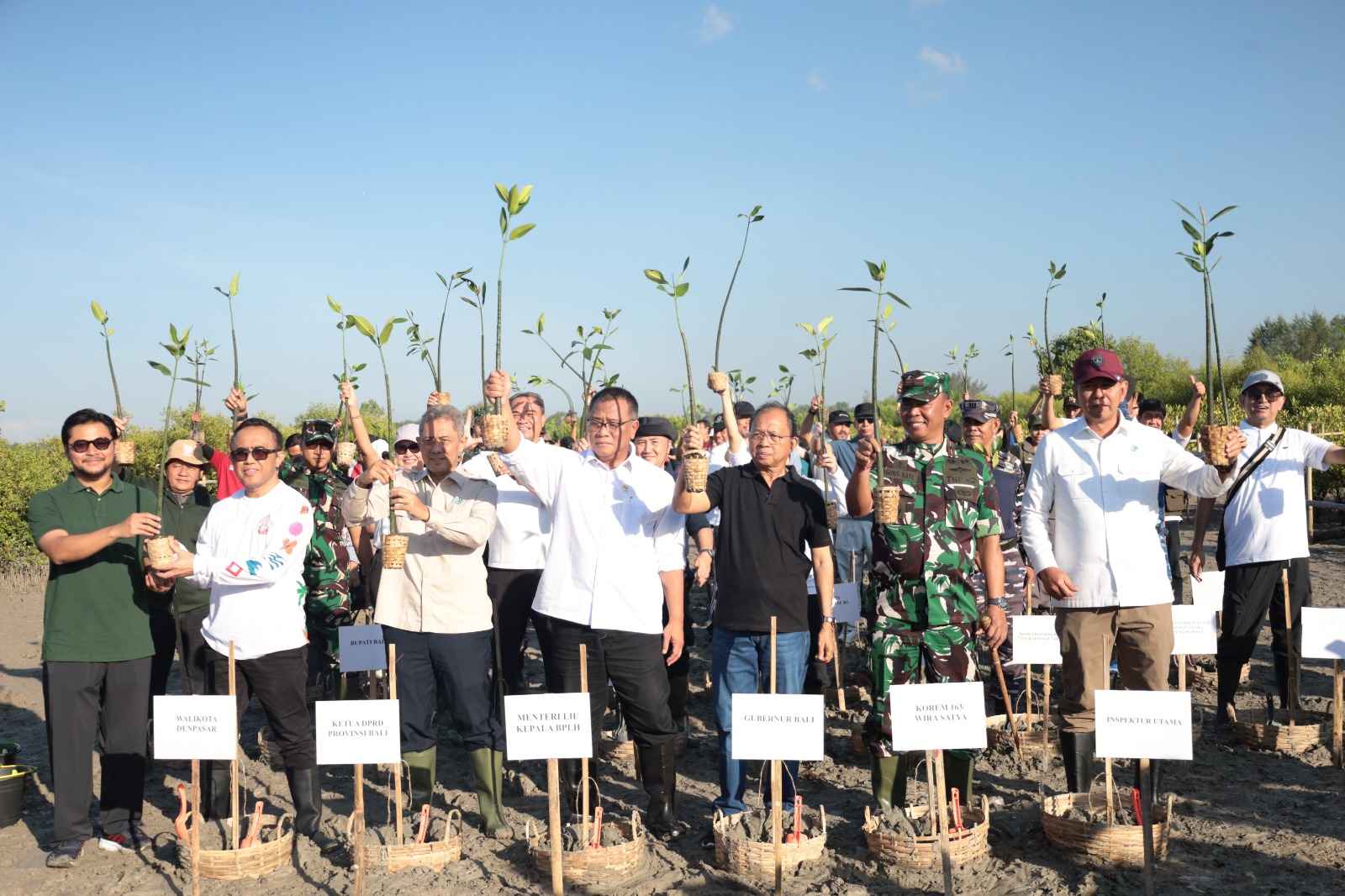
Enviro News Asia, Badung — Indonesia’s Ministry of Environment/Environmental Control Agency (KLH/BPLH) is intensifying efforts to achieve the national target of planting two billion trees, with Environment Minister and Head of the Environmental Control Agency Moh Jumhur Hidayat leading a mangrove planting initiative at Arboretum Park in Tanjung Benoa, Bali, on Tuesday.
The initiative represents not only a commitment to restoring Indonesia’s coastal ecosystems but also an effort to establish Bali as a national model for environmental ethics and ecosystem rehabilitation.
Arboretum Park itself stands as a testament to successful ecological restoration. The 12-hectare area, once degraded and affected by widespread vegetation loss due to environmental pressures, has been fully rehabilitated and is now home to approximately 300,000 trees representing 12 mangrove species, serving as a crucial natural barrier against climate impacts.
“Today, we are planting mangroves not merely to green coastal areas, but to send a message that environmental degradation can be reversed through collective will and public participation. Bali has proven that this is possible,” Minister Jumhur said.
He emphasized that Bali’s success should serve as a model for the rest of the country.
“Mangrove restoration is not simply about planting trees. It is about ensuring that coastal ecosystems recover and continue to deliver ecological, social, and economic benefits in a sustainable manner as part of Indonesia’s two-billion-tree initiative,” he said.
Highlighting the vulnerability of small islands to coastal erosion and climate change, KLH/BPLH considers mangroves a strategic priority for protecting shorelines. Indonesia currently possesses approximately 3.45 million hectares of mangrove forests, accounting for around 23 percent of the world’s total mangrove area.
“Mangroves are our best natural defense. The Ministry of Environment is fully committed to transforming Arboretum Park into a national-scale natural laboratory and education center for mangrove restoration, whose knowledge can be replicated across small islands throughout the archipelago,” Jumhur stated.
Beyond coastal ecosystems, the ministry also praised Bali’s provincial and local governments for their efforts in waste management. Problems that once generated widespread concern have now been addressed through integrated management systems that have enabled several areas in Bali to achieve near-zero waste conditions.
“That is very encouraging, Governor. We now need to sustain these achievements and further improve waste processing, whether by converting waste into fuel or fertilizer. Those processes are currently being developed,” the minister said.
According to Jumhur, maintaining environmental quality would also generate significant benefits for Bali’s tourism industry, as global travelers are increasingly paying attention to environmental responsibility. Regions that demonstrate a strong commitment to sustainability are likely to attract greater international sympathy and higher tourist arrivals.
“Let us become increasingly environmentally responsible, and let the people of Bali serve as an example of environmental ethics for all citizens of Indonesia,” he added.
Responding to the minister’s remarks, Bali Governor I Wayan Koster reaffirmed the province’s commitment to preserving nature based on the local philosophy of Tri Hita Karana, which promotes harmony between humans, nature, and spirituality.
“We call upon all Balinese people to work together toward achieving 100 percent waste segregation. Together and simultaneously, let us create a clean, healthy, beautiful, and sustainable Bali,” Koster said.
Through strengthened collaboration among the central government, regional authorities, and the public, KLH/BPLH expressed confidence that Indonesia’s broader climate restoration agenda and the ambitious two-billion-tree target can be successfully achieved. (*)