

Enviro News Asia, Bandar Lampung – The Lampung Provincial Forestry Office and the Asosiasi Pengusaha Hutan Indonesia (APHI) intensified their collaboration to advance landscape-based Multi-Business Forestry (MUK) as a productive and sustainable forest management model in Lampung Province. The initiative aims to optimize non-timber forest products and accelerate downstream processing of leading regional commodities through partnerships between forest utilization permit holders and Social Forestry groups.
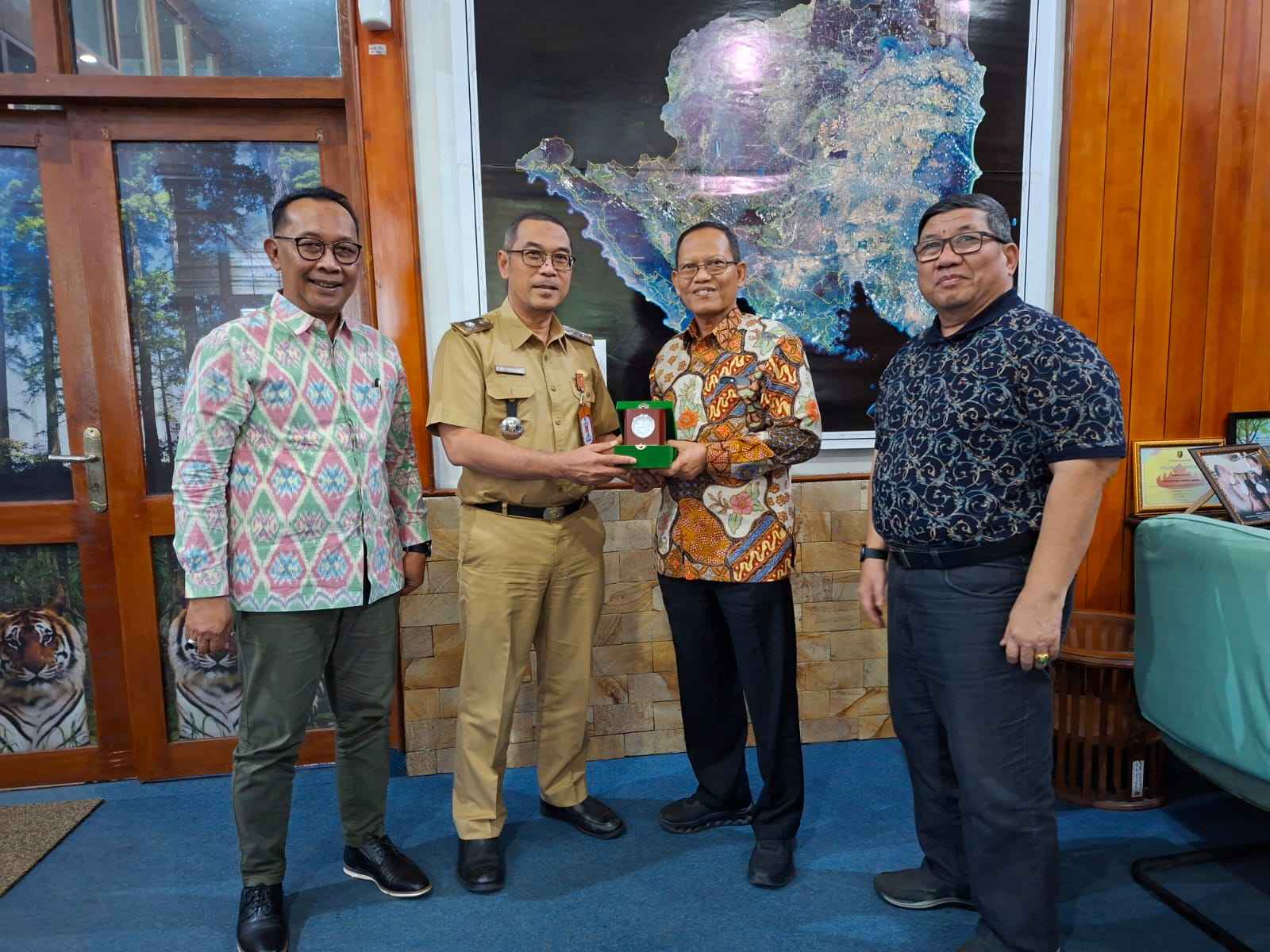
Officials conveyed this commitment during an official meeting held at the Lampung Provincial Forestry Office in Bandar Lampung on Tuesday, 3 March 2026. Representatives from APHI met with the Head of the Lampung Provincial Forestry Office to consolidate strategies and identify priority actions for implementing the landscape-based approach.
Head of the Lampung Provincial Forestry Office, Yayan Ruhyansyah, stated that Lampung holds significant potential for developing Multi-Business Forestry, particularly in non-timber forest commodities. He highlighted coffee, cocoa, cardamom, avocado, nutmeg, candlenut, and jengkol as key products, some of which have entered downstream processing stages under Social Forestry management schemes.
He explained that the province promotes MUK development through agroforestry systems that maintain ecological balance while increasing community income. The office encourages partnerships between Forest Utilization Business License (PBPH) holders and Social Forestry (PS) groups to strengthen value chains from upstream production to downstream processing.
Yayan emphasized that productivity, quality, and product continuity determine the success of MUK implementation. He added that open and well-managed market governance must support the model to ensure market access and competitiveness for MUK products. He further noted that integrated downstream activities within PBPH concession areas, in collaboration with Social Forestry groups, will reinforce sustainable value chains.
The Lampung Provincial Forestry Office has implemented the MUK scheme in three PBPH concession areas. The province also records 451 Social Forestry groups covering approximately 209,000 hectares and involving around 95,000 households.
Meanwhile, APHI Chairperson Soewarso expressed optimism that Lampung’s MUK landscape could serve as a national pioneer model. He pointed out that Lampung’s strong position as a producer of coffee, cocoa, and pepper, supported by adequate road and port infrastructure and solid market access, provides strategic advantages for scaling up the initiative.
Soewarso added that APHI, in collaboration with the Indonesian Chamber of Commerce and Industry (KADIN), seeks to accelerate the implementation of landscape-based MUK as a pilot project. He stressed that successful implementation requires coordinated support from regional governments, business actors, and Social Forestry groups.
Both parties reaffirmed that collaboration between PBPH holders and Social Forestry groups within the landscape-based MUK framework will strengthen the forestry sector’s contribution to regional economic growth while safeguarding forest sustainability. (*)