

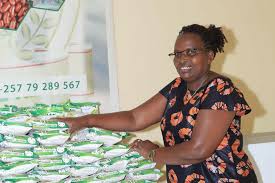
Enviro News Asia, Bujumbura – Totahara, a Burundian enterprise founded by entrepreneur Christella Ndayishimiye, has strengthened nutrition access and job creation by scaling the production and distribution of nutrient-rich bean porridge flour, reaching more than 40,000 families each month. The initiative operates with support from the Swiss Agency for Development and Cooperation (SDC), the Sall Family Foundation, Global Affairs Canada, and the Alliance of Bioversity International and CIAT through the Pan-Africa Bean Research Alliance and partners.
Christella Ndayishimiye launched Totahara after identifying a gap in access to nutritious weaning flour in Burundi. She began producing bean-based composite flour at home to feed her child, and the positive health results encouraged her to formalize the activity into a business. Over time, Totahara grew into one of Burundi’s leading processors of bean composite flour products tailored to women and children.
Through the Kura Porridge Project, Totahara has improved child nutrition and household food security. By 2025, the initiative had supported 1,242 malnourished children. Each month, more than 40,000 families—equivalent to approximately 120,000 people—consume its enriched porridge products. The company distributes its products nationwide in Burundi and exports to the Democratic Republic of the Congo, reflecting steady regional growth.
Totahara maintains a retail network of 253 semi-retail outlets and 122 female retailers, enabling access in underserved communities. The enterprise employs 38 staff members, including 18 women and girls and 20 young men, who manage production, packaging, and distribution. This workforce structure reinforces the company’s dual focus on nutrition improvement and inclusive economic empowerment.
With co-financing from a World Bank-supported program, Totahara is expanding its processing facility. Once operational, the upgraded factory aims to produce up to 220 tons of enriched porridge flour. The expansion plans to supply 6,000 children in 50 schools, create 76 additional jobs—prioritizing women and youth—and connect more than 30,000 farming households to stable markets.
Despite its progress, Totahara has faced operational challenges. Rising demand has required improvements in production efficiency, packaging systems, and market coordination. Expanding beyond local markets has also necessitated stronger business planning and closer linkages with grain producers. The company and its partners are addressing these constraints to unlock further growth and strengthen market activation for sustainable impact. (*)