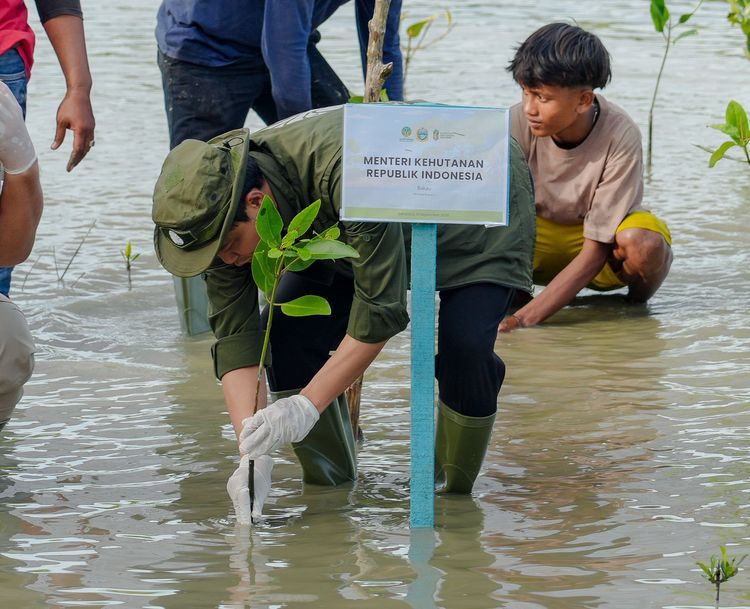
Enviro News Asia, Indragiri Hilir – The Ministry of Forestry of the Republic of Indonesia is accelerating mangrove rehabilitation in Riau through the Mangroves for Coastal Resilience (M4CR) program. According to the 2024 National Mangrove Map, Riau has 231,438 hectares of mangroves with a restoration potential of 12,234 hectares. The rehabilitation serves as a strategic step to address coastal erosion, seawater intrusion, and climate change impacts while strengthening the socio-economic resilience of coastal communities.
Head of the Indragiri Rokan Watershed Management Agency (BPDAS), Arif Adi Suhastyo, said mangrove rehabilitation is not just about planting trees but a long-term investment in coastal resilience and community welfare. One priority site is Kuala Selat Village in Indragiri Hilir Regency, Riau Province, which lost 1,600 hectares of coconut plantations due to erosion following mangrove loss.
Head of the Mandah Forest Management Unit (UPT KPH), Joko Yuni Purwanto, noted that Kuala Selat is a clear example of the impacts of mangrove degradation. Thousands of hectares of coconut plantations have been damaged, disrupting the local economy. Through M4CR, the ministry and local communities are working to restore ecosystem functions while creating new economic opportunities.
To date, communities have planted more than 5.3 million mangrove seedlings on 1,683 hectares of land. The rehabilitation target is 5,858 hectares by 2027. Given Kuala Selat’s location directly facing the sea, the program is crucial to protecting the coast from erosion.
The M4CR program in Riau involves 1,128 community members from 56 groups, including 378 women actively engaged in nurseries, group management, and mangrove-based enterprises. Active community participation has been key to success, fostering a sense of ownership of the restored areas.
Monitoring conducted in September 2025 showed that over 70 percent of community groups achieved a seedling survival rate above 75 percent. However, challenges remain, such as tidal fluctuations, erosion, animal disturbances, unsustainable fishing practices, and waste that hinders seedling growth.
A total of 27 groups in Riau have received business support and institutional assistance. The program is part of the national target to rehabilitate 41,000 hectares across four provinces by 2027, contributing to Indonesia’s commitments to global climate action. (*)