Enviro News Asia, Jakarta — Indonesia continues to reinforce institutional capacity at the regional level to accelerate mangrove rehabilitation as part of its broader environmental and climate resilience agenda.
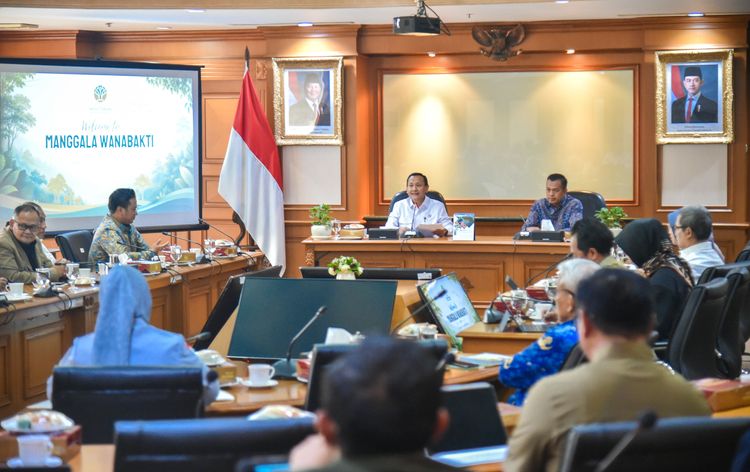
The Ministry of Forestry, through the Directorate General of Watershed Management and Forest Rehabilitation, convened the 2026 National Coordination Meeting of Regional Mangrove Working Groups (KKMD) in Jakarta on Tuesday. The forum aimed to strengthen local institutional frameworks for mangrove management, evaluate KKMD performance in 2025, identify field-level challenges, and formulate strategies to enhance the role of KKMD nationwide.
Director General of Watershed Management and Forest Rehabilitation Dyah Murtiningsih emphasized that KKMD plays a strategic role as a cross-sectoral coordination hub for mangrove management at the regional level. She stressed that strong local institutions are a decisive factor in ensuring the success and sustainability of mangrove rehabilitation efforts.
“KKMD must go beyond being a discussion forum and serve as a driver of collaboration and an accelerator of concrete action in the regions,” Dyah stated. She underlined that effective institutional arrangements help ensure program consistency, improve facilitation effectiveness, and sustain rehabilitation activities at the site level.
Dyah further highlighted the importance of coordination to prevent overlapping programs and to align regional rehabilitation initiatives with national policies. She also underscored the need to strengthen monitoring, evaluation, and data-based reporting systems to ensure that rehabilitation activities deliver measurable environmental and social benefits. According to her, institutional strengthening must be accompanied by enhanced human resource capacity, supported by professional and integrity-driven personnel.
Meanwhile, Director of Mangrove Rehabilitation at the Ministry of Forestry Nikolas Nugroho Surjobasuindro noted that strengthening KKMD would directly improve the quality of mangrove rehabilitation implementation on the ground. He explained that a solid KKMD structure supports all stages of rehabilitation, from planning and planting to maintenance and evaluation, in line with established technical standards.
Nikolas added that stronger coordination among KKMDs would facilitate the synchronization of funding sources, including state budget allocations, non-state funding, and development partner cooperation. Such synergy, he said, would make rehabilitation programs more targeted, sustainable, and capable of generating economic benefits for coastal communities.
He also emphasized the importance of community-based approaches, stating that local community involvement is a critical determinant of rehabilitation success. According to him, KKMD should function as a platform to strengthen participation and empowerment of coastal communities, while fostering collaboration among central and regional governments, the private sector, academia, civil society organizations, and local communities.
Through the 2026 National Coordination Meeting, stakeholders committed to strengthening coordination, aligning regional action plans with national mangrove policies, and improving the quality of monitoring and reporting. The forum also provided an opportunity for provinces to share best practices in participatory mangrove management. With reinforced regional institutions, the Ministry of Forestry expressed optimism that Indonesia’s mangrove management will become more effective, inclusive, and resilient in addressing climate change challenges. (*)