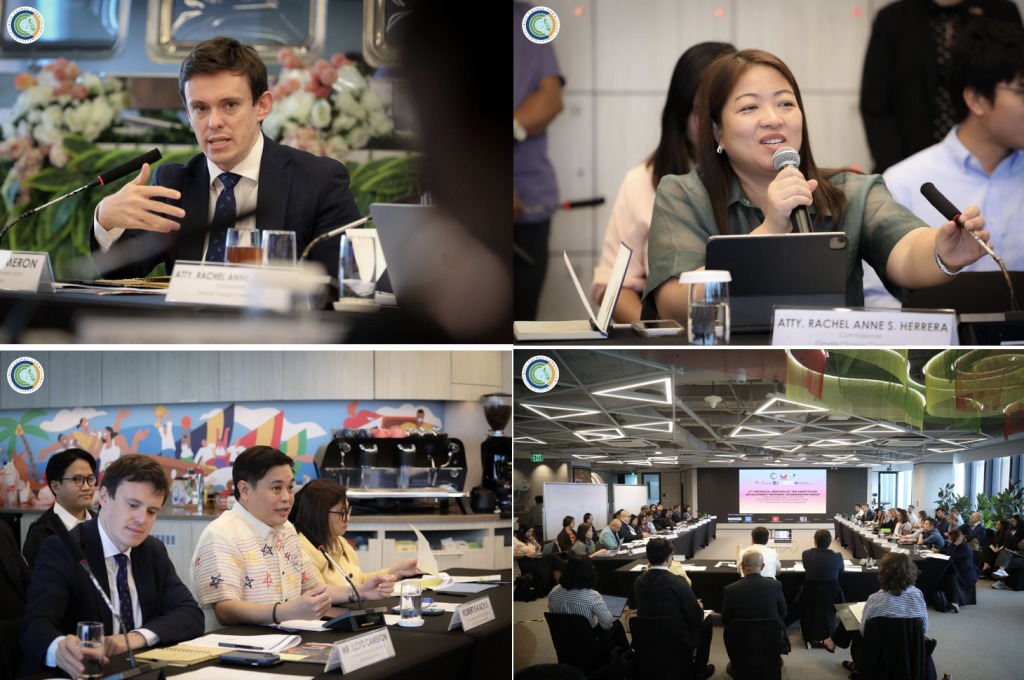
Enviro News Asia, Taguig — The Philippine government, through the Climate Change Commission (CCC), together with the British Embassy Manila as co-chair, convened the second technical-level meeting of the Philippines Adaptation Development Partners’ Coordination Group (DPCG) on Friday, focusing on strengthening the country’s climate adaptation efforts, particularly at the local level.
The meeting built on commitments made during the group’s first technical-level session held on September 8, 2025. The DPCG serves as a platform for aligning resources, knowledge, and actions among government agencies, development institutions, and international partners, helping avoid duplication of effort and strengthening the country’s coordinated response to climate risks.
Officials present took stock of progress on earlier commitments, aligned support behind priority adaptation initiatives, and endorsed key workstreams to guide the group’s second year of implementation.
In his opening remarks, CCC Vice Chairperson and Executive Director Robert E.A. Borje stressed the need for a systems-based approach to adaptation, warning that fragmented support across sectors and institutions risks producing fragmented outcomes. He noted that communities, local governments, and vulnerable sectors continue to face mounting climate risks, including extreme heat, water stress, sea level rise, and intensifying weather disturbances.
British Embassy Manila Economic and Climate Counsellor Lloyd Cameron pointed to progress made since the Philippines’ first National Adaptation Plan (NAP) was developed, noting that adaptation has gained recognition as a central pillar of climate action alongside mitigation efforts, with continued multilateral, bilateral, and international collaboration remaining key to the group’s work.
The Department of Environment and Natural Resources (DENR), the DPCG’s other co-chair, represented by Undersecretary Analiza Rebuelta-Teh, reaffirmed the group’s role in aligning partner-supported initiatives with the NAP. She said the group’s focus is shifting toward translating priorities into coordinated, risk-informed, and locally implementable investments across partners and national systems.
A central focus of the meeting was accelerating the localization of adaptation action through the Adaptation Investment Learning Course (AILC), a joint initiative of the CCC, DENR, the Local Government Academy (LGA), and the British Embassy Manila. The LGA reported that the course’s pilot phase had trained local government and planning practitioners from seven provinces, strengthening their capacities in climate risk assessment, adaptation planning, and the development of evidence-based project pipelines.
CCC Commissioner Rachel Anne S. Herrera updated participants on the National Adaptation Plan Gender Action Plan (NAP-GAP), an initiative to mainstream gender, disability, and social inclusion considerations across adaptation planning rather than treating them as separate interventions. She said regional consultations and a national validation workshop are planned ahead of the plan’s finalization this year.
Participants also reviewed outcomes from the recently concluded ASEAN Climate Week 2026, which underscored the need to move from adaptation ambition to delivery, strengthen enabling environments for adaptation finance, scale up ecosystem-based approaches, and improve institutional coherence across sectors and levels of governance.
To support the group’s priorities, participants endorsed continued work on several NAP-aligned frameworks, including the Monitoring, Evaluation, Accountability, and Learning (MEAL) system, Adaptation Communications (AdComms), and the NAP-GAP, alongside efforts to institutionalize a practical adaptation monitoring system to support evidence-based planning, transparency, and reporting obligations under the Paris Agreement.
Development partners reaffirmed their support for the Philippines’ adaptation priorities, including NAP implementation, climate finance mobilization, resilience measurement, capacity building, and adaptation reporting. The group also endorsed a process for expanding DPCG membership and confirmed its priority workstreams for the coming year: adaptation finance, localization, adaptation monitoring and reporting, gender-responsive planning, and strengthened partner coordination.
In closing, the co-chairs said the success of the National Adaptation Plan would depend on sustained collaboration among government agencies, development partners, local governments, civil society, academia, and the private sector, describing the meeting’s outcomes as another step toward translating adaptation priorities into concrete action for vulnerable communities nationwide. (*)