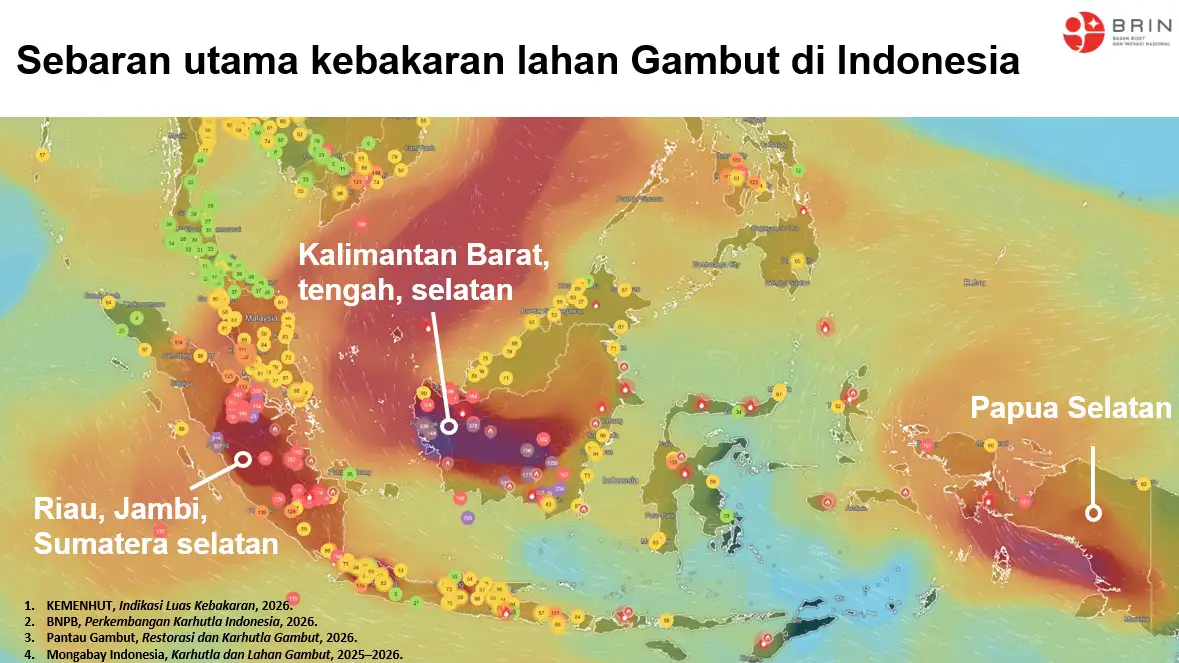
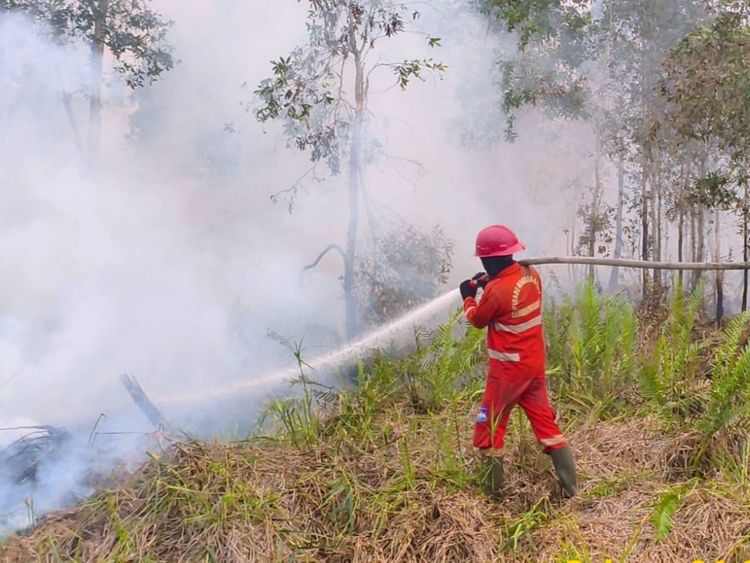
Enviro News Asia, Jakarta – Preventing forest and land fires requires strong and continuous cross-sector collaboration. At a coordination meeting held in Jakarta on Wednesday (09/17), the Ministry of Environment/Environmental Management Agency (KLH/BPLH), the Indonesian Forestry Business Association (APHI), and the Indonesian Palm Oil Association (GAPKI) reaffirmed their commitment to strengthening their respective roles in building a sustainable ecosystem for forest and land fire prevention. The meeting was also attended by representatives from the Ministry of Forestry and the Ministry of Agriculture.
KLH/BPLH Director of Land Fire Control, Dasrul Chaniago, emphasized the crucial role of the state in facilitating fire prevention.
“The government is committed to implementing policies and programs that empower communities. Preventing forest and land fires is not only about law enforcement but also about providing economic alternatives that encourage communities to move away from slash-and-burn practices,” he said.
Dasrul added that synergy among stakeholders must be built consistently. “Discussions, sharing experiences, and exchanging best practices are the first steps in strengthening partnerships among stakeholders,” he noted.
APHI Chairman, Soewarso, highlighted the important role of the forestry sector.
“APHI is ready to support the government through partnerships with communities living near forests. This collaboration not only prevents fires but also improves community welfare through environmentally friendly empowerment,” he explained.
He stressed that direct community involvement is key to success.
“By adopting no-burn farming systems, communities can preserve land sustainability while earning a steady income. This proves that fire prevention can go hand in hand with improving livelihoods,” Soewarso added.
Meanwhile, GAPKI Head of Environment and Forestry, Nyoman Suyasa, underscored the strategic role of the plantation sector.
“GAPKI is committed to strengthening the capacity of communities around plantations so they can protect land from potential fires. Partnership programs and economic empowerment are integral parts of our long-term prevention strategy,” he stated.
Nyoman also revealed that forming Fire-Aware Community Groups (MPA) or Fire-Aware Farmer Groups (KTPA), accompanied by economic empowerment guidance through Corporate Social Responsibility (CSR) programs, has been implemented in various regions.
“The principle is that by improving community livelihoods, environmental awareness—especially regarding fire prevention—will also increase,” he said.
The coordination meeting underscored that preventing forest and land fires is not solely the government’s responsibility but requires the active participation of businesses and local communities. The synergy achieved is expected to create a permanent and sustainable forest and land fire prevention system. (*)