Enviro News Asia, Surabaya – Surabaya has officially been designated as the pilot city for the implementation of the Sustainable Energy Transition in Indonesia (SETI) project. The designation was made by Germany’s Federal Ministry for Economic Affairs and Climate Action (BMWK) through Indonesia’s Ministry of Energy and Mineral Resources (ESDM). The project in Surabaya focuses on applying energy efficiency and renewable energy measures in the building sector.
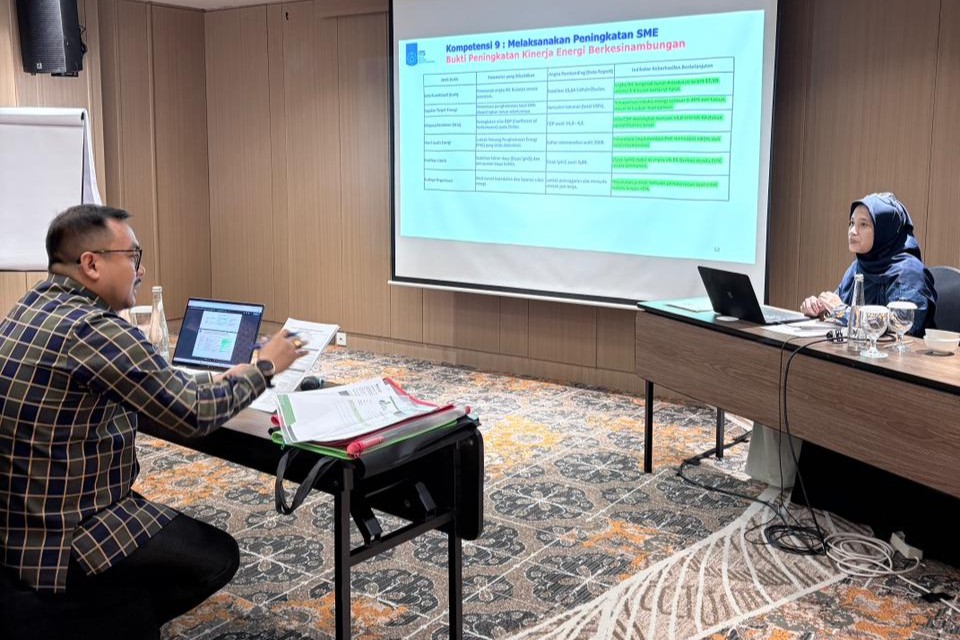
Fabby Tumiwa, Executive Director of the Institute for Essential Services Reform (IESR), explained the reason behind Surabaya’s selection. “The Surabaya City Government is considered capable of reducing greenhouse gas emissions in buildings. SETI has been operating in Surabaya since the beginning of this year. We are conducting a baseline energy consumption study on 295 buildings. The results will serve as a guideline for future energy savings and operational cost reductions,” he said during the Seminar on Energy Efficiency and Renewable Energy in Buildings at the ITS Graduate Auditorium, Tuesday (September 16, 2025).
Fabby added that the field study on energy efficiency and renewable energy would be completed by the end of September and presented in October 2025. “SETI will continue to support stakeholders to make Surabaya a leader in the decarbonization of the building sector,” he emphasized.
Irvan Wahyudrajad, Head of the Surabaya City Regional Development Planning, Research, and Development Agency (Bappedalitbang), stressed that energy efficiency is more than just rhetoric. According to global data, the building sector accounts for around 40% of energy-related emissions by 2030. “This aligns with Surabaya’s vision: Transforming Surabaya into an Advanced, Humane, and Sustainable Global City. Sustainability is our key motivation,” he stated, representing Mayor Eri Cahyadi in the official release of the Surabaya City Government.
As a concrete step, the Surabaya City Government has adopted the Compact City concept to bring public services closer, reduce mobility, and cut energy consumption. The Green Building regulation has also been enforced. “Every building must meet standards for energy efficiency, water conservation, air quality, eco-friendly materials, and waste management,” Irvan explained.
The application of green building principles has been carried out in various facilities, including the Joyoboyo Intermodal Terminal (TIJ), the Bappedalitbang building, solar panels in government offices, schools, and traffic lights. Surabaya also operates the Benowo Waste-to-Energy Plant (PSEL), the first of its kind in Indonesia.
Irvan highlighted the importance of cross-sector collaboration. “These achievements are only possible through collective action—engaging universities, media, the private sector, communities, and the public. The city government is open to innovation and dialogue on energy efficiency,” he noted.
He also mentioned the involvement of younger generations in Surabaya’s long-term planning. “The Mayor hopes this seminar will bring widespread benefits. Even the city’s 20-year Long-Term Development Plan (RPJP) and Medium-Term Development Plan (RPJM) involve Gen Z,” he concluded.
With this designation, Surabaya is expected to become a model city in Indonesia for accelerating clean energy transition and reducing carbon emissions in the building sector, in line with national climate targets and global commitments. (*)