Enviro News Asia, Aceh — Academics from Universitas Gadjah Mada emphasized the importance of a social-based approach in forest management amid growing public scrutiny following recent flash floods in Aceh, North Sumatra, and West Sumatra.
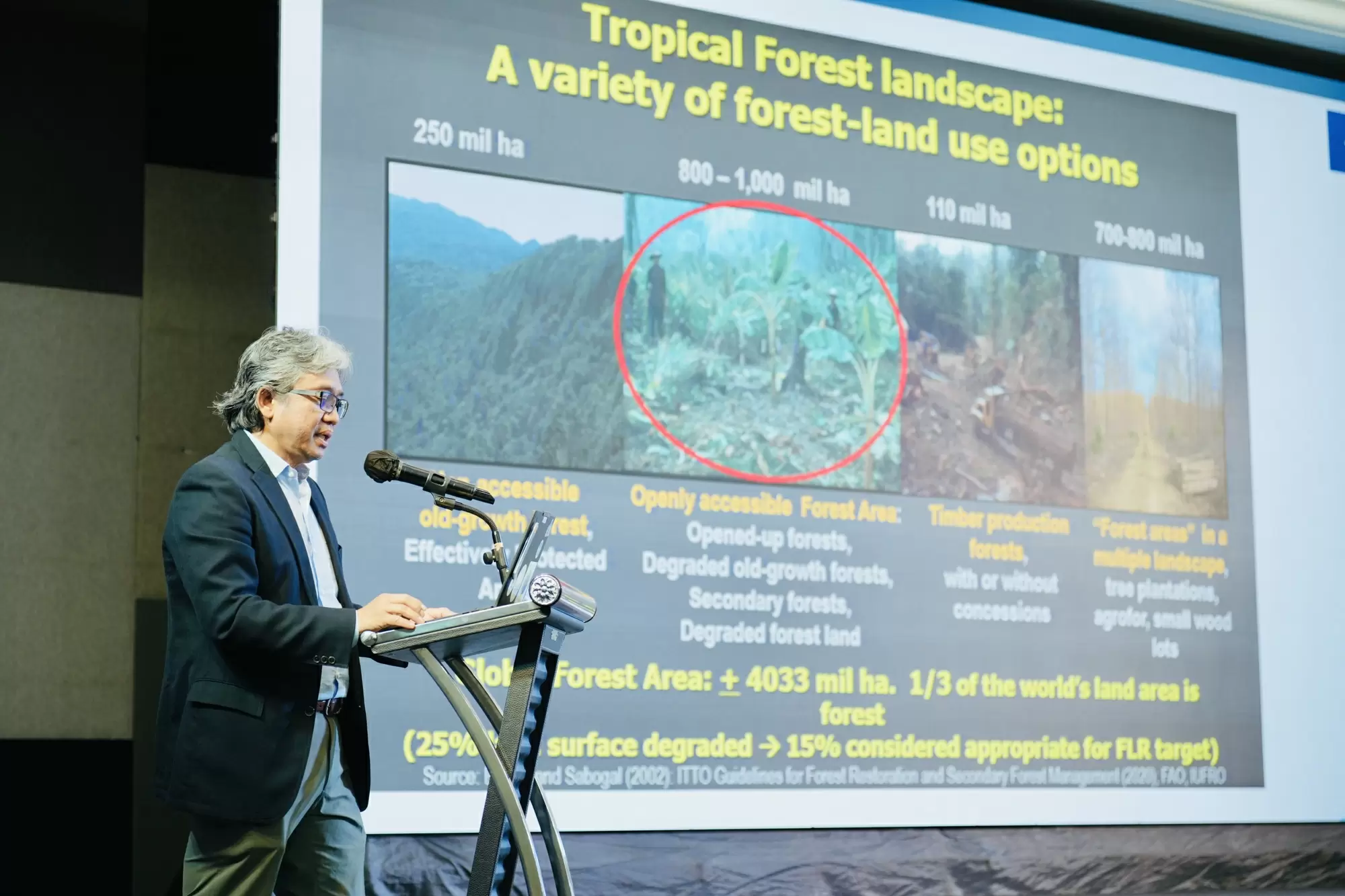
Speaking at the Sylva Indonesia Workshop 2026, UGM highlighted that forestry challenges are increasingly interconnected with poverty, food security, and disaster risks affecting communities living around forest areas. The forum underscored the need for the government to shift its role from a sole regulator to a facilitator by strengthening cross-sector collaboration and community participation.
Indonesia’s Directorate General of Watershed Management and Forest Rehabilitation stressed the importance of integrated watershed management from upstream to downstream. The approach focuses on increasing water absorption, controlling erosion, strengthening protection functions, and regulating land use activities to maintain natural hydrological systems.
The government also outlined its strategy for rehabilitating degraded land through a combination of vegetative restoration and civil engineering measures. A landscape-based approach is applied to ensure ecosystem integration, including coastal and wetland areas, supported by long-term planning and large-scale nurseries to encourage community involvement.
Agroforestry was promoted as a key solution to balance conservation objectives with local economic needs. The model enables communities to cultivate economically valuable tree species while maintaining soil stability and water infiltration, reinforcing conservation awareness without undermining livelihoods.
Officials further emphasized that forest governance must uphold forest conservation, sustainable development, and community welfare. Social forestry schemes were highlighted as a mechanism to provide communities with legal access to forest management while strengthening stewardship and long-term protection.
The Sylva Indonesia Workshop 2026, hosted by Universitas Gadjah Mada from January 12 to 15, gathered forestry students from universities across Indonesia to exchange ideas and formulate policy recommendations for sustainable forest governance.
UGM academics concluded that participatory and socially inclusive forest management is essential to enhance climate change mitigation, disaster resilience, and long-term food, energy, and water security. (*)