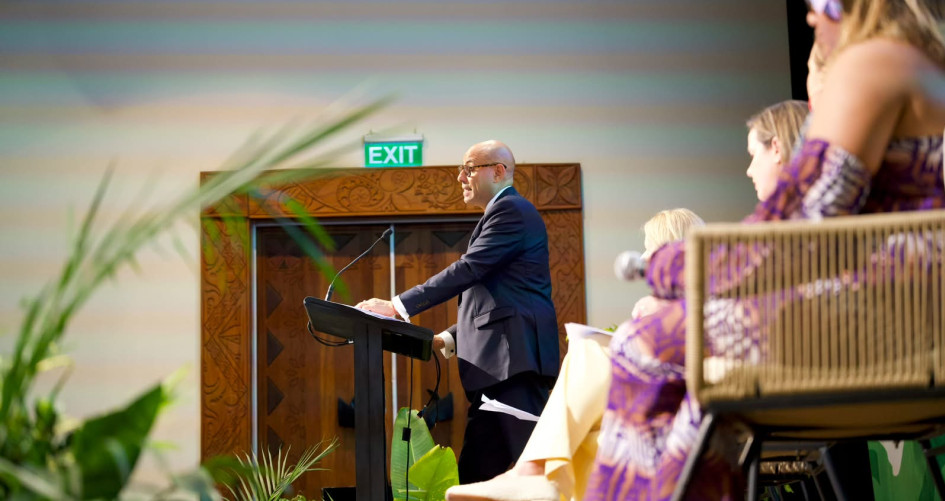
Enviro News Asia, New York — United Nations Secretary-General António Guterres has launched the Global Grids Accelerator to help accelerate investment in electricity infrastructure across Africa and Southeast Asia and turn national and regional energy priorities into operational projects.
The initiative was launched in New York on September 23, ahead of the 2026 UN Climate Summit. It focuses on electricity grid priorities identified by governments and brings together policy expertise, project preparation, financing and implementation support.
The initiative addresses a growing infrastructure challenge in the global energy transition. Renewable energy capacity is expanding rapidly, but electricity grids in many countries are struggling to keep pace with the generation capacity needed to connect and distribute clean power.
More than 2,500 gigawatts (GW) of renewable energy projects are currently waiting for grid connections worldwide, according to the initiative. The figure is equivalent to nearly twice the total electricity generation capacity of the United States.
Global investment in electricity grids currently stands at around US$450 billion annually and needs to increase by about 50 percent by 2030 to keep pace with rising electricity demand and renewable power additions.
The International Energy Agency estimates that more than 80 million kilometers of electricity grids will need to be added or refurbished by 2040, roughly equivalent to the entire global grid currently in operation.
Guterres said stronger grids are essential to expanding electricity access, improving energy security and supporting economic growth in developing countries.
The initiative does not establish a new financing institution. Instead, it aims to coordinate existing policy, technical, financial and implementation resources around priority grid investments identified by countries and regional institutions.
Focus on Africa and Southeast Asia
In Africa, the Global Grids Accelerator will build on existing continental, regional and national programs, including the Continental Power System Master Plan, the African Single Electricity Market, the Programme for Infrastructure Development in Africa, Mission 300 and National Energy Compacts.
The initiative will work with African governments, the African Union Commission, development banks and other regional and international partners to advance priority grid investments and regional interconnections.
In Southeast Asia, the initiative will support efforts under the ASEAN Power Grid and work with ASEAN member states, the ASEAN Secretariat, the ASEAN Centre for Energy, development banks and other partners.
The focus includes regional interconnections and cross-border electricity trade, as well as infrastructure required to expand reliable and affordable electricity access.
Singapore, which will chair ASEAN from January 2027, said resilient and interconnected grids would be important for strengthening regional energy security and supporting ASEAN’s transition toward a low-carbon economy.
The country also highlighted the need to address regulatory barriers and develop frameworks for cross-border infrastructure, including submarine power cables.
Coordinating UN Support
The UN Development Programme (UNDP), UN Office for Project Services (UNOPS) and Sustainable Energy for All (SEforALL) will convene the Global Grids Accelerator.
They will work with the UN Economic and Social Commission for Asia and the Pacific (ESCAP), UN Economic Commission for Africa (ECA), UN Industrial Development Organization (UNIDO), UN Conference on Trade and Development (UNCTAD), UN Global Compact and other UN entities.
The partners will provide policy, technical, financing and implementation expertise based on the priorities identified by participating countries and regions.
Development banks and international organizations, including the African Development Bank, Asian Development Bank, Asian Infrastructure Investment Bank, European Investment Bank, World Bank, Climate Investment Funds, International Renewable Energy Agency, International Energy Agency and OECD, will also be engaged.
Investors, utilities, technology companies and industry groups will participate according to the requirements of individual projects.
Turning Grid Plans Into Investment
The initiative’s organizers said one of the main challenges is not the availability of grid technology but the ability to turn long-term energy plans into bankable projects with access to affordable finance and implementation capacity.
UNDP Administrator Alexander De Croo said electricity grids underpin hospitals, businesses, employment and industrial development, while many clean energy projects remain between national planning and investment pipelines.
UNOPS Executive Director Jorge Moreira da Silva said project delivery, procurement, infrastructure development and project management would be critical to converting energy transition plans into reliable electricity infrastructure.
The Asian Development Bank said the ASEAN Power Grid and other regional connectivity initiatives could help strengthen energy security, support renewable energy integration and expand cross-border electricity trade.
The African Development Bank said the Global Grids Accelerator could reinforce Mission 300, which aims to provide electricity access to an additional 300 million people in Africa by 2030.
Green Industrialization and Energy Access
The Global Grids Accelerator also links electricity infrastructure with industrial development.
UNIDO said future grids need to strengthen resilience, reduce dependence on energy imports and create opportunities for local value creation. The organization plans to work with governments, regional institutions and utilities to connect grid development with industrial strategies and investment pipelines.
The initiative is expected to establish an initial set of country and regional priorities and identify the technical, financial and institutional capabilities available to support them.
Partners will also establish milestones leading to the 31st session of the Conference of the Parties to the UN Framework Convention on Climate Change (COP31) in Antalya and into 2027.
The Global Grids Accelerator is intended to help developing countries expand electricity access, integrate renewable energy, strengthen regional power connectivity and support green industrial development by accelerating investment in modern and resilient electricity networks. (*)