Enviro News Asia, Jakarta — Environmental awareness should go beyond social media posts and online comments. For Muhammad Akbar and fellow students of Universitas Pembangunan Nasional “Veteran” Jakarta (UPNVJ), protecting the environment requires direct engagement with communities and concrete action on the ground.
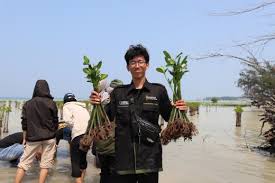
Akbar, a Political Science student and Deputy Head of Community Environment Affairs at the UPNVJ Student Executive Board (BEM), was among ten students who participated in the planting of 500 mangrove seedlings on Pari Island, Thousand Islands, on 8 June.
Before arriving on the island, Akbar and his colleagues conducted preliminary research to understand local environmental conditions, including coastal erosion and the role of mangroves in protecting shorelines.
“Before coming to Pari Island, we conducted basic research on the condition of the island and its coastline. We wanted to understand whether coastal erosion was occurring and how mangroves could help protect the coastal area,” Akbar said.
The students viewed the planting initiative not as a ceremonial activity but as part of a long-term effort to protect Pari Island from erosion and the impacts of climate change.
Learning Directly from Coastal Communities
The group arrived on Pari Island on 7 June, one day before the planting activity, to prepare the site and engage with local residents. They spent the night on the island, using the opportunity to learn about the daily lives of coastal communities and hear first-hand accounts of environmental challenges.
“We arrived on Sunday to make preparations. We also took time to interact with local residents and discuss the current condition of Pari Island,” Akbar explained.
Through these conversations, students gained deeper insights into issues affecting the island, including coastal erosion, changes in shoreline conditions, and the impacts of the climate crisis on local livelihoods.
“We learned that the coastal environment in the Thousand Islands is facing serious challenges. Climate change and erosion are affecting the lives of local communities,” he said.
Adapting to Nature’s Rhythm
The experience also presented practical challenges. Besides the long sea journey, students had to adjust their schedule to the changing tides.
According to Akbar, many participants were unfamiliar with traveling by boat to the Thousand Islands. Once they reached the site, high tide delayed the planting process, with seawater levels reaching nearly thigh-high.
“We had to adapt our planting schedule to the tidal conditions. In the morning, the tide was still high and the water level reached almost to our thighs,” he recalled.
Together with lecturers and local residents, the students waited until the tide receded around 10 a.m. before beginning the planting activities.
“Fortunately, the water level dropped around 10 a.m., allowing us to start planting. The main challenges were adapting to the tides, wind conditions, and the coastal environment,” he added.
The experience taught participants that environmental conservation requires preparation, understanding of natural conditions, and the ability to adapt in the field.
More Than Planting Trees
For Akbar, the greatest value of the program was not simply planting mangroves but learning directly from the community and understanding how environmental degradation affects people’s lives.
“We did not just plant mangroves. We interacted with the community, learned planting techniques, and understood how coastal erosion occurs and how it affects local residents,” he said.
As a Political Science student, Akbar sees environmental issues as public issues closely connected to policymaking, community participation, and collaboration among stakeholders.
From Awareness to Action
Akbar encouraged young people to begin environmental action within their own communities rather than remaining passive observers.
“My message is simple: start with your immediate surroundings. Many environmental issues across Indonesia need our attention and involvement,” he said.
He stressed that young people do not need to travel far to make a difference.
“Don’t just watch and comment. Get involved in the issues around you. If you cannot travel to another province or island, look first at what you can do in your own area,” he urged.
While acknowledging the role of social media in raising awareness, Akbar emphasized that online advocacy must be accompanied by tangible action.
“We can raise environmental issues on social media, but we also need to step forward and do something meaningful for society and the environment,” he concluded.
Through their involvement on Pari Island, UPNVJ students demonstrated that meaningful contributions begin with understanding local challenges, listening to communities, adapting to circumstances, and working collectively to create change. (www.upnvj.ac.id)