Enviro News Asia, Jakarta — Indonesia’s Vice Minister of Forestry Rohmat Marzuki reaffirmed the importance of strengthening accountable, transparent, and integrity-based forestry governance as the foundation for sustainable forest management and the country’s long-term development agenda toward Indonesia Emas 2045.
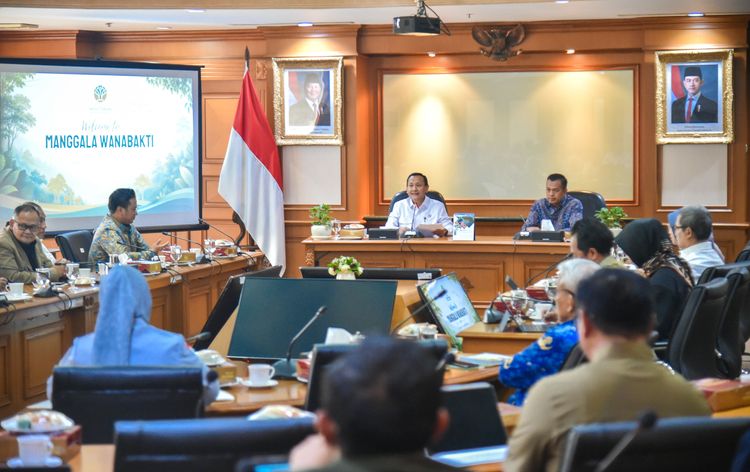
Speaking at the closing session of the 2026 Planning and Supervision Coordination Meeting (Rakorenwas) in Jakarta on Tuesday (10/2), Rohmat emphasized that risk-based governance must guide all forestry planning and implementation processes to ensure effectiveness and prevent irregularities from the outset.
“Future forest management must be carried out through strong and integrity-driven governance, supported by effective oversight so that every program delivers tangible benefits to communities and the environment,” he stated.
During the coordination meeting, held under the theme “Strengthening Central–Regional Forestry Governance Toward Indonesia Emas 2045,” participants received comprehensive briefings on the forestry development direction under the 2025–2029 National Medium-Term Development Plan (RPJMN), budget policies for the forestry sector, and priority programs for 2026. The forum also reinforced understanding of fraud risk mitigation and governance safeguards in forest resource utilization.
Rohmat highlighted the strategic importance of implementing the One Map Policy and a Decision Support System (DSS) to consolidate forest utilization strategies. These instruments, he said, are crucial to maintaining balance between national development, ecological resilience, and community welfare.
He urged all participants to translate the outcomes of the meeting into concrete actions in their respective regions and to integrate risk management consistently into forestry planning, implementation, and supervision.
“Strong synergy between the Ministry of Forestry and regional governments is the key to achieving integrity-based and sustainable forestry development,” he stressed.
The Vice Minister also announced that the Ministry has prepared a National Forestry Plan (RKTN), which must be discussed participatively with provincial governments and regional stakeholders before being formalized through regional regulations as a reference for spatial planning revisions.
Addressing climate change, Rohmat warned that its impacts are increasingly evident.
“Climate change is no longer theoretical. Cyclones and extreme rainfall—once considered unlikely in equatorial regions—are now occurring in Indonesia. Forestry planning must therefore adopt a watershed-based landscape approach,” he explained.
He called for unified vision across all technical implementation units (UPT), emphasizing integrated watershed-based planning under the spirit of general forestry.
On the management of forested areas within Other Land Use Areas (APL), Rohmat stressed the need for stronger coordination with regional administrations, particularly in upstream and water catchment areas to minimize flood and landslide risks.
Regarding critical land rehabilitation, he underscored risk-based prioritization, focusing on steep slopes near settlements and water catchment zones. He encouraged funding support from regional budgets, revenue-sharing schemes, and private sector corporate social responsibility (CSR) initiatives.
The Vice Minister also supported regional proposals to upgrade protected forests into conservation areas, including forest parks (Tahura) and national parks, alongside strengthening conservation villages in buffer zones.
Social forestry development remained a key priority. Rohmat called for stronger collaboration with local governments to implement Integrated Area Development schemes and improve market access for forest farmer groups, many of whom remain in extreme poverty categories.
On forest and land fire control, he emphasized shared responsibility among all technical units.
“Forest and land fire management is not solely the responsibility of Manggala Agni or law enforcement units. Prevention must become the priority, supported by coordination with the military and police at the field level,” he concluded.
Rohmat closed the meeting by expressing appreciation to participants, speakers, and organizers, and expressed hope that the forum’s outcomes would contribute meaningfully to Indonesia’s future forest governance. (*)