Enviro News Asia, Jakarta – The Ministry of Forestry (Kemenhut) held a commemoration for the World Day to Combat Desertification and Drought (WDCD) 2025, observed annually on June 17, on Wednesday (July 9, 2025).
The event, held at the Manggala Wanabakti Building in Jakarta, carried the theme “Restore the Land. Unlock the Opportunities”, emphasizing the importance of land restoration as a gateway to various economic, social, and ecological opportunities.
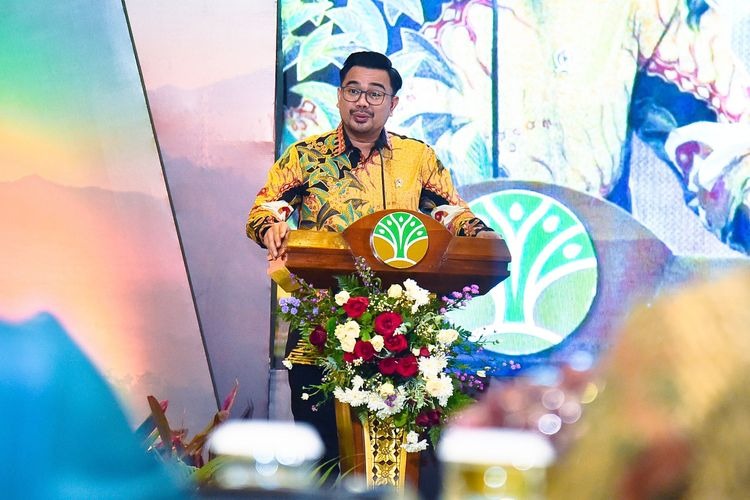
“This year’s WDCD theme is highly relevant to the focus of the UN Decade on Ecosystem Restoration (2021–2030) and aligns with national development priorities, especially in promoting national self-sufficiency in food, energy, water, and green economy,” said Deputy Minister of Forestry Sulaiman Umar Siddiq, as conveyed in an official statement from the Ministry of Forestry.
As the National Focal Point of the United Nations Convention to Combat Desertification (UNCCD), the Ministry of Forestry held a series of talk shows as Indonesia’s contribution to raising awareness of the importance of forest and land restoration.
Forest restoration is considered vital as a catalyst for sustainability, peace, and inclusive development.
In his speech, the Deputy Minister explained that the Ministry prioritizes site-based approaches that offer ecological, economic, and social benefits.
Indonesia currently has around 120.5 million hectares of forest area, or about 63% of its total land area, but still faces the challenge of restoring 12.7 million hectares of degraded land.
Since 2017, a moratorium on new permits has been implemented on approximately 66 million hectares of natural forest and peatlands.
Indonesia also targets achieving a net sink condition in the forestry sector by 2030 through the FOLU Net Sink 2030 program, which includes strategies such as preventing deforestation, conserving and managing forests sustainably, protecting and restoring peatlands, and enhancing carbon absorption.
From 2015 to 2024, Indonesia has rehabilitated over 2 million hectares of forest and land.
The implementation of integrated forest fire management has also yielded positive results, with a 19.6% decrease in the area affected by forest and land fires compared to 2019, which recorded around 488,000 hectares.
The Indonesian government is developing forest and land restoration-based economic strategies financed through global and national funding sources.
Besides multilateral funding mechanisms such as GEF, GCF, CIF, REDD+, ITTO, AFOCO, and bilateral cooperation with partner countries, Indonesia also utilizes the Reforestation Fund (Dana Reboisasi/DR) collected from timber utilization in state forest areas.
This fund supports reforestation and rehabilitation programs, including critical land restoration, reforestation, forest fire prevention, and social forestry programs.
The Ministry also promotes a Multi-Business Forestry policy—an approach to forest management that encourages product diversification, increased investment, and job creation.
At the same time, the social forestry program continues to be developed to improve community welfare, with land access reaching over 8 million hectares by 2024.
Director General of Watershed Management and Forest Rehabilitation (PDASRH) at the Ministry of Forestry, Dyah Murtiningsih, stressed the need for collaboration between government and communities in restoring forests and land.
“There are three steps to prevent land degradation,” said Dyah.
First, raising awareness among all stakeholders to ensure that development activities do not harm the environment.
Second, encouraging all parties to participate in forest rehabilitation, both through vegetative and civil engineering methods.
Third, fostering commitment from all stakeholders. (*)