Enviro News Asia, Jakarta — Indonesia’s Minister of Manpower, Yassierli, urged graduates of Universitas Pembangunan Nasional “Veteran” Jakarta (UPNVJ) to focus on developing practical skills and adaptability rather than relying solely on academic qualifications as they enter an increasingly competitive labor market.
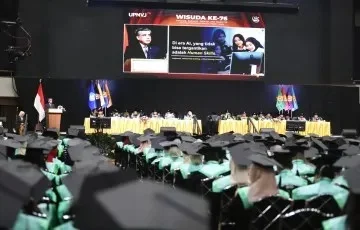
Speaking during UPNVJ’s 76th Graduation Ceremony in Jakarta on Monday, 18 May 2026, Yassierli said the global workforce is undergoing rapid transformation driven by artificial intelligence (AI), digitalization, green economic transition, and shifting demographic trends.
“Industries and businesses today are no longer focused merely on where someone studied or what degree they hold. What matters most are skills,” Yassierli told graduates, lecturers, university officials, parents, and invited guests.
According to the minister, companies are increasingly implementing skills-based recruitment systems. He cited data showing that 73 percent of professional recruiters now prioritize competencies and practical capabilities over educational backgrounds alone.
Yassierli emphasized that university graduates must continuously improve their competencies in order to remain relevant in the evolving employment landscape. While academic education remains important, he noted that adaptability, critical thinking, and problem-solving abilities are now becoming decisive factors in career success.
He also highlighted the growing influence of artificial intelligence in reshaping the global labor market. Based on available data, around 78 percent of companies currently expect job applicants to possess at least a basic understanding of AI technologies.
“Artificial intelligence is no longer an issue of the future. It has already become part of today’s industrial requirements,” he said.
Despite concerns about automation replacing routine jobs, Yassierli stressed that technological advancement will simultaneously create many new employment opportunities. He referred to projections indicating that approximately 92 million jobs may disappear globally by 2030 due to automation, while a significantly larger number of new occupations are expected to emerge.
The minister cited professions such as social media managers and data scientists as examples of careers that barely existed two decades ago but are now considered essential in the digital economy.
“There is research from LinkedIn showing that 80 percent of jobs experiencing significant growth today did not exist 20 years ago,” he explained.
Yassierli further underlined that human-centered competencies will remain irreplaceable despite technological progress. Skills such as judgment, relationship building, empathy, communication, and critical thinking are expected to remain highly relevant in the coming years.
“People first, and technology is merely an enabler,” he stated.
During his address, Yassierli also encouraged graduates to adopt a lifelong learning mindset. He warned against becoming complacent after obtaining a university degree and stressed the importance of continuous upskilling and reskilling.
“Our journey in developing competencies does not end once we obtain a diploma,” he said.
In addition, the minister outlined several government initiatives aimed at preparing Indonesian human resources for future labor market demands. These include expanded vocational training and internship programs designed to provide graduates with direct industrial experience.
One of the government’s flagship programs targets 100,000 internship participants, offering monthly allowances equivalent to the regional minimum wage for six months.
“This year, we also received budget allocations to provide vocational training for more than 300,000 people,” Yassierli added.
He expressed optimism that Indonesian graduates would view labor market transformation as an opportunity rather than a challenge, emphasizing that success will belong to those who continue learning, adapting, and developing their competencies. (www.upnvj.ac.id)