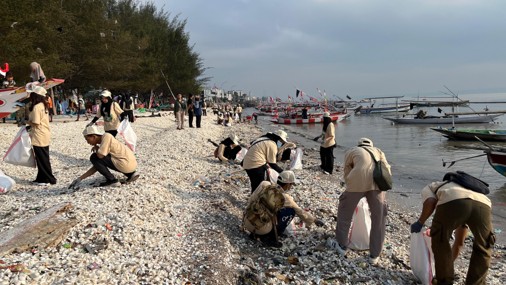
Enviro News Asia, Hanoi — The Global Plastic Action Partnership, in collaboration with the National Plastic Action Partnership Viet Nam, released a new report revealing that approximately 80 percent of ocean plastic waste originates from land-based sources.
The report, titled “Plastic Pollution – Biodiversity Assessment,” was launched with support from the Government of Canada and technical input from GreenU, aiming to examine the connections between plastic pollution, biodiversity, ecosystems, and local livelihoods in Vietnam.
Researchers found that plastic waste primarily travels from urban areas, industrial zones, and production sites into rivers and canals, which act as “conveyor belts” carrying waste into marine ecosystems. The study estimates that around 1,531 tonnes of plastic leak into the environment daily, totaling more than 558,000 tonnes annually.
The report highlights that microplastics are now widespread across rivers, estuaries, mangroves, coral reefs, and coastal sediments. These particles have entered the food chain and have been detected in seafood such as fish, shrimp, and mollusks, posing potential risks to human health.
The study also identified environmental and economic “hotspots” by integrating plastic leakage data with Key Biodiversity Areas and socio-economic indicators. High-risk regions include the Red River Delta, the Mekong Delta, the central coast, and the Southern Key Economic Region, where ecosystems are highly vulnerable and waste generation is significant.
Plastic pollution has caused severe ecological impacts, including wildlife entanglement, ingestion of plastic debris, chemical contamination, and habitat degradation. Coral reefs exposed to plastic are nearly 20 times more likely to develop disease, while mangroves experience reduced carbon absorption due to plastic accumulation.
According to Jeet Kar, the findings reflect a broader shift in understanding plastic pollution as a systemic issue affecting biodiversity, ecosystem services, and human livelihoods, rather than merely a waste management problem.
The report proposes three key actions to address the issue: reducing plastic emissions at the source, promoting green transitions in sectors such as fisheries and tourism, and strengthening ecosystem conservation and restoration through science-based and community-driven approaches.
Officials emphasized that coordinated efforts among governments, businesses, and communities are essential to effectively tackle plastic pollution while supporting biodiversity conservation and climate resilience. (*)