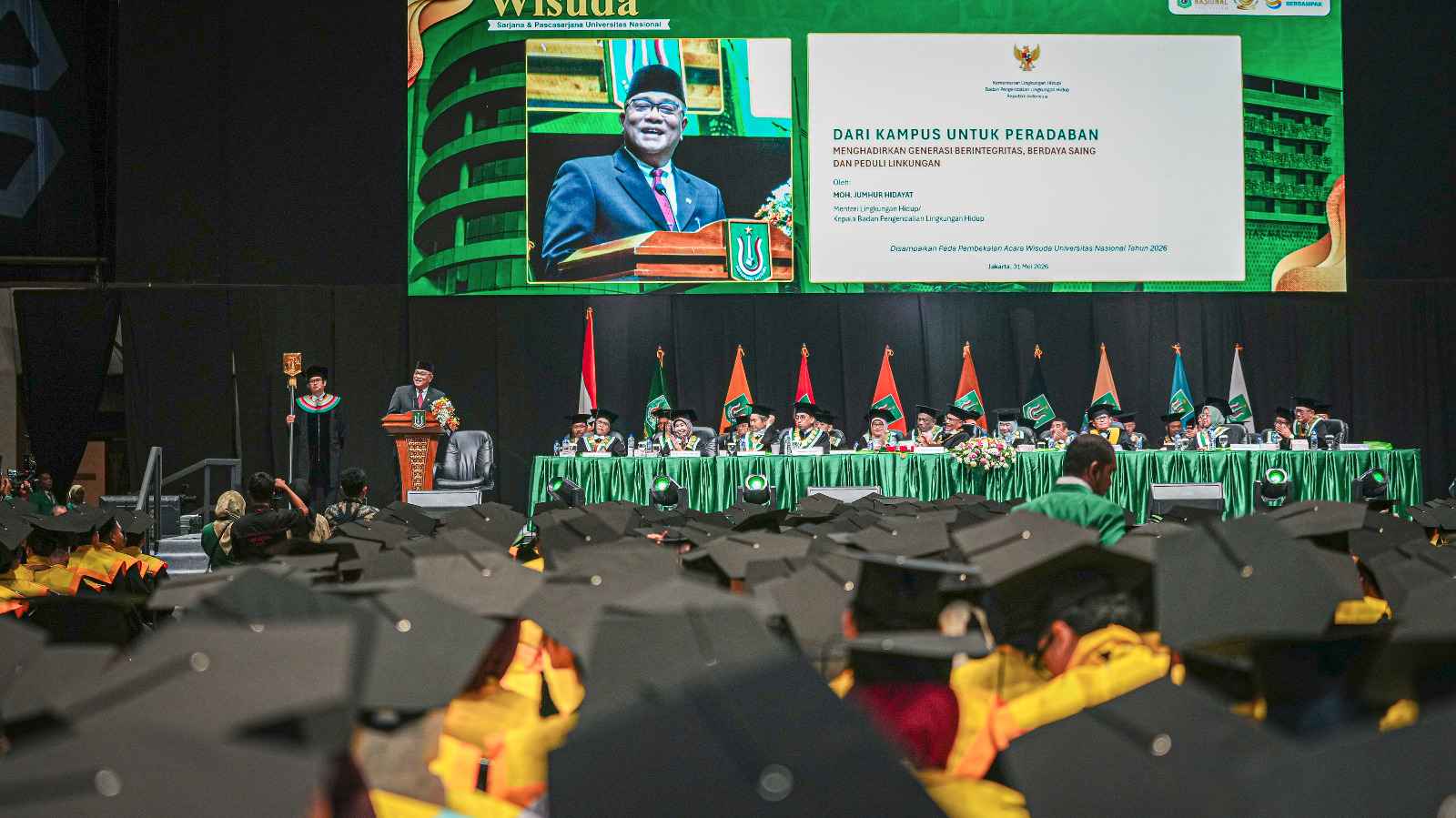
Enviro News Asia, Jakarta — Indonesia’s Minister of Environment and Head of the Environmental Control Agency (KLH/BPLH), Moh Jumhur Hidayat, has emphasized that the transition toward a green economy will create significant opportunities for millions of green jobs across the country. Speaking at the graduation ceremony of Universitas Nasional (UNAS) on 31 May, he called on young Indonesians to prepare themselves as green talents capable of addressing environmental challenges while driving sustainable economic growth.
The Minister highlighted that the world is currently facing a triple planetary crisis consisting of climate change, biodiversity loss, and environmental pollution. He noted that these challenges have evolved beyond environmental concerns, affecting economic development, social welfare, public health, and humanitarian conditions worldwide.
“Indonesia stands on the front line of global environmental risks. However, this situation should not lead to pessimism. Instead, Indonesia possesses a strong moral legitimacy to become an important part of global solutions,” Jumhur stated.
He underscored the crucial role of young people in responding to these challenges. Referring to a survey conducted by the Indonesian Nature Defenders Volunteers (RIMBA), he said that more than 80 percent of Indonesia’s Generation Z demonstrate concern for environmental issues.
“Generation Z is the generation of solutions. Our task now is to transform that concern into concrete action—from awareness to movement, from concern to innovation, and from discussion to solutions,” he said.
Jumhur explained that President Prabowo Subianto’s Asta Cita development vision places ecological sustainability as one of the key foundations for achieving the Indonesia Emas 2045 agenda. As a result, the transition to a green economy must be accompanied by efforts to create inclusive and equitable employment opportunities.
According to the Minister, future labor markets will increasingly demand sustainability-oriented professions, including renewable energy specialists, modern waste management experts, environmental engineers, biodiversity researchers, green urban planners, carbon analysts, circular economy specialists, and green entrepreneurs.
He stressed that the expansion of green jobs is essential to ensuring an inclusive transition in which no generation is left behind in benefiting from and contributing to sustainable development.
“The transition toward a green economy is expected to create millions of new jobs. However, we must ensure that these green jobs are decent jobs that provide labor protection, welfare, and fair opportunities for society. The future of the global economy is not only digital but also green. Future jobs are green jobs,” Jumhur emphasized.
The Minister also highlighted Indonesia’s strategic position within the global environmental agenda. With the world’s third-largest tropical forest area, extensive mangrove ecosystems, exceptional biodiversity, and the second-longest coastline globally, Indonesia plays a critical role in shaping the future of the planet’s environmental sustainability.
“If Indonesia succeeds in protecting its forests, conserving peatlands and mangroves, managing waste effectively, safeguarding rivers and oceans, and developing a circular economy, the country will not only protect itself but also make a major contribution to the future of the Earth,” he said.
As part of this transformation, the government aims to achieve 100 percent waste management coverage by 2029 through strengthening the circular economy and transforming material management systems. Innovations such as Refuse Derived Fuel (RDF), Waste-to-Energy Power Plants (PSEL), pyrolysis technology, and other modern waste management approaches are being promoted to convert waste into valuable economic resources.
Through this initiative, the Ministry of Environment and the Environmental Control Agency are encouraging young people to become agents of change in environmental protection and green economic transformation. With the growing potential of green jobs, younger generations are expected not only to seek employment but also to create innovative solutions that contribute to a competitive, sustainable, and prosperous Indonesia. (*)