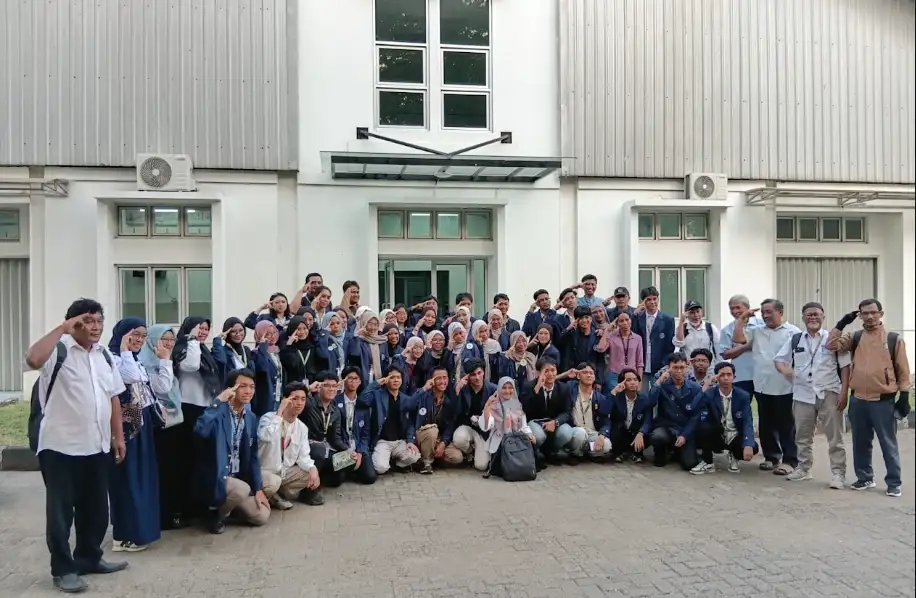
Enviro News Asia, Cibinong — The National Research and Innovation Agency (BRIN) introduced its latest agricultural and aquaculture research and innovations to students of IPB University through AGVENTURE 2026 (Agricultural Conversation Through Excursion). The program was held in collaboration with the International Association of Students in Agricultural and Related Sciences (IAAS) LC IPB under the theme “Beyond the Mud: Farming as the Backbone of Global Stability.”
The program provided students with insights into modern agricultural innovation, urban farming, agribusiness opportunities, and the application of research to support sustainable agriculture, aquaculture, and national food security.
Fahrurrozi, Head of BRIN’s Research Center for Freshwater Aquaculture, emphasized that the sustainability of agriculture and fisheries requires applied research and innovation while encouraging young people to become future researchers and innovators.
BRIN presented several high-yield crop innovations, including rice varieties such as Sidenuk, Tropiko, Mustaban, Pareng BRIN 1, and Pablas BRIN 1, with production potential of up to 10 tons per hectare. Some varieties also offer tolerance to salinity and disease. The agency also introduced high-productivity soybean varieties, including Mutiara 1, Mutiara 2, Kemuning 1, Kemuning 2, BRINusa, and BRINara, as well as hybrid corn varieties HJBRIN 101 and HJBRIN 103, which have production potential of up to 12 tons per hectare.
In horticulture, BRIN highlighted research on improved seeds for garlic, shallots, and chili to support the development of new cultivation areas. Plantation research includes molecular markers for detecting Black Pod Disease in fine-flavor cocoa, rubber varieties tolerant to Tapping Panel Dryness, and carbon stock assessments in cinnamon plantations.
BRIN also presented livestock research covering poultry, ducks, sheep, animal feed, mesenchymal stem cells, sensor- and Internet of Things-based farming technologies, and livestock vaccine development.
Aquaculture innovation was another major focus of the program. Huria Marnis explained BRIN’s integrated tilapia farming system, which combines solar panels, a mini Recirculating Aquaculture System, and Internet of Things technology. The system is designed to improve production efficiency, reduce energy consumption, and enable more precise farm management.
BRIN has also developed hybrid catfish technology, salt-tolerant tilapia to support the revitalization of ponds along Java’s northern coast, as well as integrated rice-fish farming and aquaponics systems. These technologies aim to improve productivity while increasing the efficiency of land and resource use.
“Freshwater aquaculture research is not only focused on increasing production, but also on developing adaptive, efficient, and sustainable technologies that respond to community needs and support national food security,” Huria said.
Students were also introduced to BRIN’s marine aquaculture research, including gamat sea cucumber cultivation for pharmaceutical applications, science-based super-intensive shrimp farming, industrial-scale amphipod production as natural feed for shrimp larvae, and milkfish larval rearing technology.
In food processing, BRIN showcased innovations such as cassava-based analog rice, spirulina-based cheese, probiotic-enhanced chocolate, and canned traditional food products.
Beyond the presentations, participants visited BRIN’s Genomics Laboratory and Freshwater Aquaculture Raiser facility. The visits gave students direct exposure to research infrastructure, laboratory facilities, and modern aquaculture technologies, allowing them to observe how research is developed and translated into innovations with potential applications for communities and businesses.
Through AGVENTURE 2026, BRIN sought not only to showcase research achievements but also to strengthen the regeneration of Indonesia’s research talent. Direct interaction between students and researchers is expected to encourage young people to pursue research careers, broaden their understanding of technology applications in agriculture and aquaculture, and create opportunities for closer collaboration between BRIN and universities.
The initiative highlights the importance of connecting research institutions with higher education to develop innovative solutions for sustainable agriculture, fisheries, and national food security. (*)