Enviro News Asia, Pekanbaru — Community empowerment should become a key component of Indonesia’s efforts to prevent and control forest and land fires, particularly as recurring fires can threaten public health through deteriorating air quality and smoke exposure.
The Riau Chapter of the Indonesian Forest Concessionaires Association (APHI) said stronger enforcement against land clearing by burning should be accompanied by greater community capacity, practical alternatives to burning, and stronger village-level fire prevention institutions.
APHI Riau Chairman Muller Tampubolon said communities should be positioned as an important part of fire prevention efforts rather than being treated only as recipients of government intervention.
“Fire prevention will become more effective when communities are positioned as a key part of the solution. They need knowledge, capacity, equipment and economic alternatives that enable them to manage land without burning,” Muller said.
He said village-based initiatives such as Desa Makmur Peduli Alam (DMPA), Desa Bebas Api and Masyarakat Peduli Api should be strengthened and expanded according to local conditions.
Such programs can raise awareness of fire risks, promote land preparation without burning, strengthen community fire-prevention groups and involve residents in patrols, early detection, reporting and initial firefighting.
Muller said preventing fires at an early stage was important because large-scale forest and land fires can produce smoke that affects communities and disrupt daily activities.
“Prevention cannot rely solely on firefighting. Building community resilience and providing practical alternatives are equally important so economic activities can continue without the use of fire,” he said.
APHI welcomed Presidential Instruction No. 11 of 2026, which strengthens enforcement of the prohibition on land clearing by burning and provides a more coordinated framework for forest and land fire prevention and control.
The instruction also seeks to prevent central and local government policies from being interpreted as legalizing land burning and requires local-wisdom-based exceptions to be applied strictly and proportionally.
According to APHI, such exceptions may only be implemented after emergency response, alert and emergency transition periods have been officially declared over by regional authorities.
Amid heightened fire risks associated with El Niño, Muller said consistent implementation of the policy was important to ensure that government agencies, businesses and communities followed the same prevention and response measures.
APHI and its members have pledged to support the implementation of the instruction and continue coordinating with central and local governments.
Muller also called for stronger dialogue with local communities to build a shared understanding of the risks and impacts of land clearing through burning.
He said community engagement should be consistent, participatory and adapted to local socioeconomic conditions. Restrictions on burning, he added, should be accompanied by education, assistance and support for safer and more productive land-management practices.
PBPH Support for Fire Control
APHI also recognized forest-utilization business license holders (PBPH) that have implemented standard operating procedures for forest and land fire prevention and control within their operational areas.
Their responsibilities, Muller said, should not be limited to protecting their own concessions. PBPH companies have also worked with the National Disaster Management Agency (BNPB), Indonesian Military (TNI), National Police (Polri), Manggala Agni, local governments and other stakeholders in preventing, controlling and suppressing fires in surrounding areas.
“PBPH efforts are not limited to their operational areas. Under various circumstances, APHI members also provide personnel, equipment, patrols and firefighting assistance in surrounding areas to prevent fires from spreading and causing greater impacts on communities,” Muller said.
APHI is encouraging stronger multi-stakeholder cooperation involving government institutions, security forces, firefighting teams, businesses, academics and local communities.
The organization considers coordinated patrols, early detection, rapid response and firefighting essential to reducing the scale of forest and land fires and limiting their environmental and public-health impacts.
Muller also called for objective and proportional law enforcement assessments that take into account the prevention and control measures undertaken by PBPH companies, both within their operational areas and when assisting with fires in surrounding areas.
Such assessments, he said, should be based on field evidence, compliance records, prevention and response measures, and applicable laws and regulations.
APHI expects the implementation of Presidential Instruction No. 11 of 2026 to strengthen prevention at the local level while improving emergency response and protecting communities, forests and the environment.
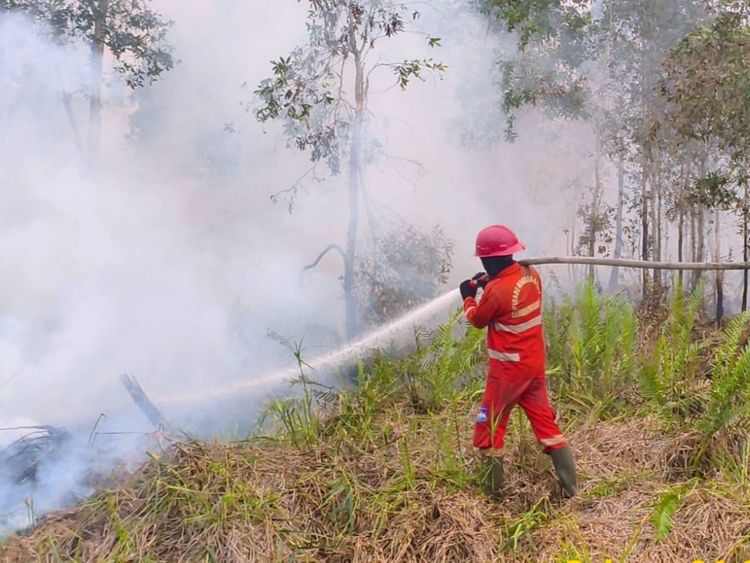
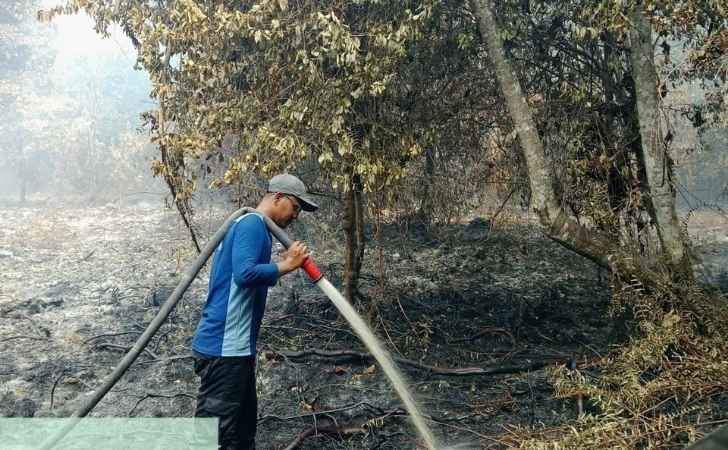
Photo caption: Firefighters work to suppress a forest and land fire in Riau as authorities and communities strengthen prevention efforts to reduce environmental and public-health risks.
SEO keywords: Riau forest fires, Indonesia forest fires, karhutla, public health, smoke pollution, air quality, fire prevention, APHI Riau, community empowerment, Inpres 11 2026. (*)