Enviro News Asia, Jakarta — Forest and land fire hotspots with high confidence have fallen sharply in Central and West Kalimantan, although Indonesia recorded a slight increase in the national total as authorities continue to strengthen fire-control operations across priority provinces.
Data from the Ministry of Forestry’s SiPongi monitoring system showed 592 high-confidence hotspots nationwide as of September 13, 2026, at 9:20 p.m. local time. The figure increased from 567 hotspots recorded a day earlier.
The decline was particularly significant in Central Kalimantan, where high-confidence hotspots fell from 197 to 89. West Kalimantan also recorded a sharp decrease, from 91 to 14 hotspots.
Among six priority provinces monitored for forest and land fire control, Central Kalimantan recorded 89 high-confidence hotspots, followed by South Sumatra with 49, South Kalimantan with 28, Jambi with 17, West Kalimantan with 14, and Riau with zero.
The latest figures were generated from satellite observations by NASA’s Terra and Aqua satellites, as well as SNPP and NOAA-20.
The Ministry of Forestry said the improvement in Central and West Kalimantan reflects progress in ongoing fire-control operations. However, authorities are maintaining heightened vigilance in South Kalimantan and Jambi, where hotspot numbers increased.
South Kalimantan recorded 28 high-confidence hotspots, up from seven the previous day, while Jambi recorded 17 after reporting no high-confidence hotspots a day earlier.
The ministry stressed that a satellite-detected hotspot represents a surface-temperature anomaly and does not automatically indicate an active fire. A single fire can also generate multiple hotspot detections.
For that reason, every satellite indication must be followed by ground verification and assessment of actual conditions.
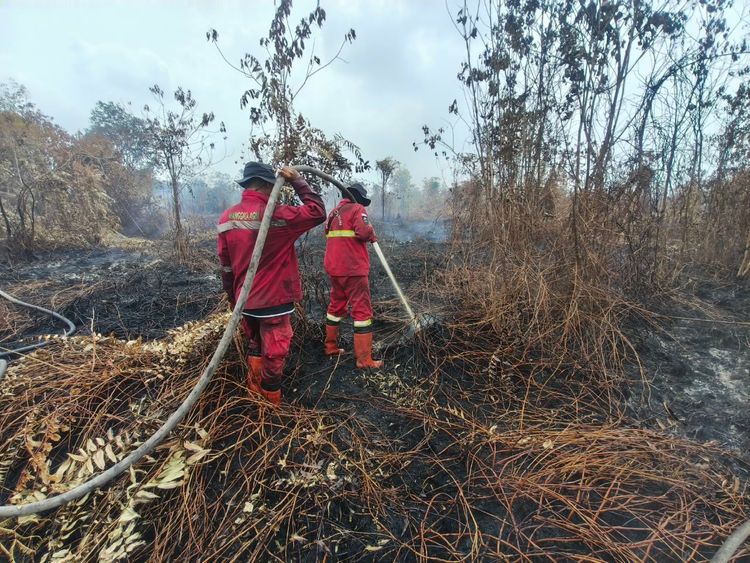
Manggala Agni under the Ministry of Forestry, together with the Indonesian Military, National Police, National Disaster Management Agency, Meteorology, Climatology and Geophysical Agency, regional disaster agencies, local governments, communities, businesses and other stakeholders, continues to conduct patrols and ground checks.
The response includes direct firefighting, firebreak operations, mopping up, and cooling measures to prevent fires from reigniting.
The authorities are also continuing aerial operations, water bombing and weather modification operations where meteorological conditions allow.
The latest developments come as dry-season conditions continue to create fire risks in parts of Indonesia. The BMKG has warned that smoke remains present in several areas, although localized rainfall remains possible.
The combination of dry conditions, high temperatures and readily combustible vegetation remains a major factor in determining fire risk.
The government has also urged communities in areas affected by deteriorating air quality to reduce outdoor activities and wear masks when going outside. Children, pregnant women, older people and those with respiratory conditions are advised to take additional precautions.
Authorities continue to urge the public not to clear or open land using fire. Residents who detect smoke, fire or suspected land burning are encouraged to report the incident immediately so that response teams can verify and act at an early stage. (*)