
Enviro News Asia, Jakarta — Strengthening the quality of lecturers is a key element in enhancing the quality and competitiveness of higher education. Through Masterclass Batch 5, themed “Lecturer Career Roadmap: Assessing Scientific Linearity for Functional Academic Promotion” on Friday (18/09/2026), the Association of Indonesian Communication Science Higher Education Providers (ADPIKI) encouraged lecturers to build their academic careers in a planned manner. This involves linking expertise, research, publications, and community service so that academic promotions reflect tangible contributions to scientific advancement and community needs.
The General Chairperson of ADPIKI, Heri Budianto, emphasized the importance of career planning for lecturers by connecting the strengthening of expertise, the quality of publications, and contributions to society, ensuring that academic rank advancements align with the overall quality improvement of higher education.
”Lecturers need to have a clear direction for scientific development right from the start. A career roadmap helps lecturers connect teaching, research, and community service into a consistent and impactful track record,” said Heri.
The event discussed strategies for academic career development through portfolio management, research continuity, and strengthening the relationship between education and area of expertise.
According to Heri, an understanding of the requirements for rank promotion must be coupled with the ability to design academic activities in a targeted manner. Thus, every research, publication, and community service activity can reinforce each other and demonstrate the lecturer’s contribution to their field of study.
He noted that associations play a vital role in providing space for learning, sharing experiences, and building networks to assist lecturers in planning their career paths more strategically.
”Through this masterclass, we aim to strengthen lecturers’ understanding of building high-quality academic portfolios, maintaining integrity, and producing works that benefit both scientific development and society,” he stated.
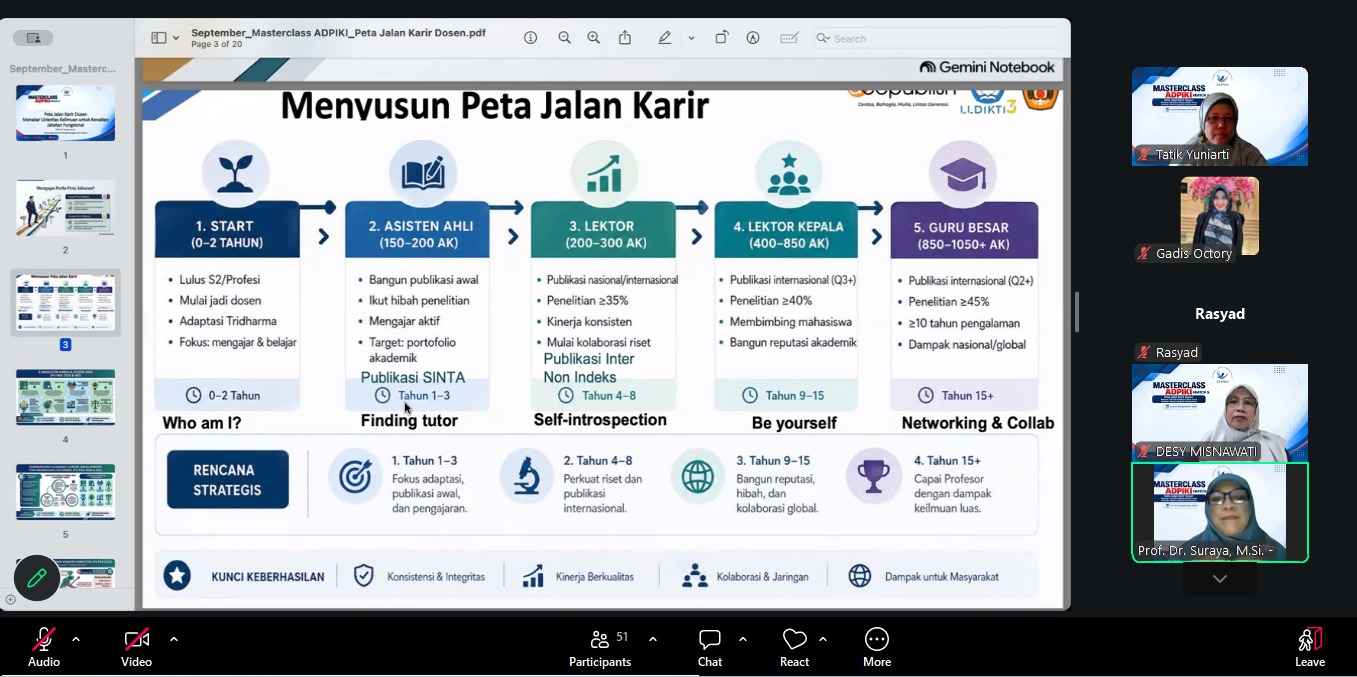
Meanwhile, the Head of ADPIKI’s Lecturer Career Development Department, Prof. Suraya, explained that a career roadmap helps lecturers recognize their academic standing, set development targets, and plan research and publications from an early stage.
According to her, such planning needs to be tailored to career stages—ranging from adapting to the execution of the Tridharma (the Three Pillars of Higher Education), strengthening research and collaboration, to building reputation and academic leadership.
”A career roadmap helps lecturers set priorities. With a clear direction, teaching, research, collaboration, and publications can be planned to support sustainable growth in expertise,” she said.
Prof. Suraya highlighted the importance of scholarly work quality, including relevance, originality, methodological rigor, and the utility of findings. Publication productivity must be accompanied by recognizable contributions to scientific advancement as well as solving societal issues.
She also underscored the importance of community service that aligns with the lecturer’s area of expertise, involves students, and is supported by documentation of outcomes and benefits.
Through this approach, a lecturer’s portfolio can showcase a cohesive relationship between learning processes, knowledge development, and its practical application in society.
On the same occasion, Professor of Legal Communication Science at Universitas Bhayangkara Jakarta Raya, who also serves as Head of the Professional Certification Division of the ADPIKI Central Board, Prof. Aan Widodo, explained that scientific linearity needs to be understood through the interconnectedness of education, expertise, scientific work, and the impact of the Tridharma.
According to Aan, lecturers must be able to demonstrate a common thread linking their educational background with their research focus, publications, teaching, and community service.
”Linearity must be evident in the continuity of ideas. Doctoral education serves as the foundation for developing a long-term research agenda, which is then strengthened through publications, teaching, and community service that move in mutually supportive scientific directions,” he said.
He explained that linearity possesses both administrative and substantive dimensions. The administrative dimension concerns the completeness and compliance of documents, whereas the substantive dimension demonstrates the expertise and scientific contributions built through an academic track record.
Aan advised that completing doctoral education should be followed by developing dissertation findings into a long-term research agenda. This development can occur through new contexts, approaches, or problems while remaining connected to the scientific core.
”Research topics may evolve, but the connection between works should remain clear. That is how expertise grows and becomes recognizable through consistent contributions,” he stated.
He cited the example of expanding the study of courtroom communication into expertise in legal communication, covering virtual trials, trial journalism, judicial transparency, and legal communication through social media.
The discussions in the masterclass reinforced the importance of positioning a career roadmap as a guideline for improving lecturer quality. The continuity of expertise, academic integrity, collaboration, and Tridharma contributions serve as the foundation to support career advancement while strengthening the overall benefits of higher education for society. (*)