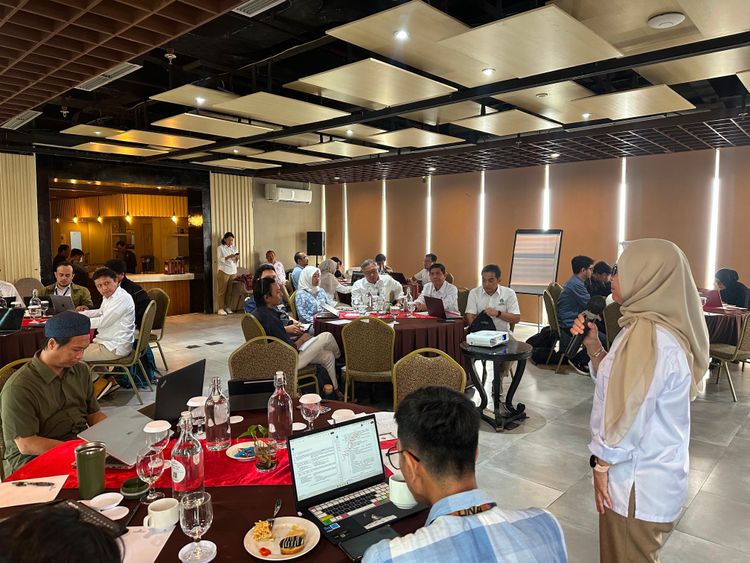


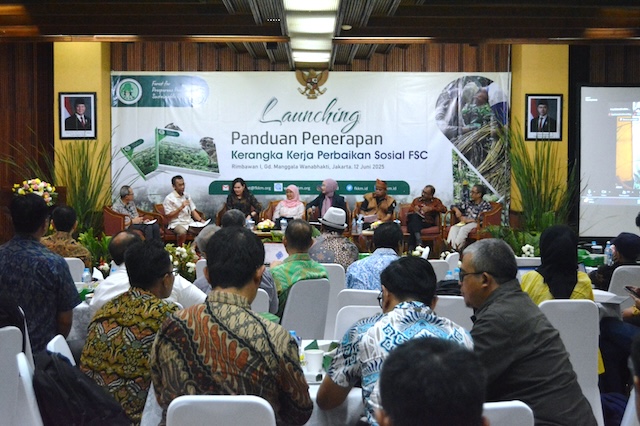
Enviro News Asia, Jakarta — The Forum Komunikasi Kehutanan Masyarakat (FKKM) officially launched the Implementation Guide for the FSC Social Remedy Framework in Jakarta on Wednesday (12 June 2025).
The FSC Remedy Framework is one of the Forest Stewardship Council’s strategic new policies, designed as a systematic mechanism to address past environmental and social harm caused by forestry activities—particularly in areas affected by natural forest conversion or where community rights were impacted.
Director General of Sustainable Forest Management at the Ministry of Forestry, Laksmi Wijayanti, emphasized that a healthy forestry business ecosystem plays a vital role in ensuring fair and sustainable forest utilization that delivers tangible benefits for both local communities and future generations.
She explained that the government is committed to improving forestry governance, including by fostering a collaborative and innovative business environment.
According to her, large and small enterprises must complement, not compete with, one another.
“A healthy business ecosystem creates economic opportunities while also safeguarding the livelihoods of forest-dependent communities,” she stated in a video message.
Hartono Prabowo, Technical Director of FSC Indonesia, explained that the Remedy Framework enables companies affected by FSC’s conversion policy—especially those related to the 1994 cutoff date—to regain eligibility for certification through a series of restorative actions, both ecological and social.
“Remedy is not about returning to the past, but about building a better future,” he said.
Chairman of the Indonesian Forest Concessionaires Association (APHI), Indroyono Soesilo, added that the FSC Remedy Framework opens up opportunities for plantation forest developers to obtain certification, which was previously hindered by conversion policies.
“This guide provides a relevant and practical interpretation of the global FSC document, while also encouraging the resolution of tenure conflicts and the expansion of rehabilitation areas,” he explained.
According to Indroyono, forest certification serves as a tool to harmonize economic, social, and environmental interests. He believes the guide is essential to strengthening public trust and enhancing the global competitiveness of Indonesia’s forestry products.
“We appreciate the hard work of all parties involved in drafting this guide. May it serve as a key reference in promoting equitable forest governance,” he remarked.
Meanwhile, FKKM Executive Secretary Mangarah Silalahi explained that the guide not only responds to FSC policy from a technical standpoint but was also developed through a participatory and field-based approach.
The guide consists of nine key focus areas, ranging from strengthening social preparation, mapping operational impacts, identifying community rights, to formulating just and accountable remedy actions.
“There are at least two reasons why FKKM supports the Remedy Framework. First, it promotes restoration in affected areas, whether through community partnerships or ecosystem restoration schemes. Second, it serves as a strategic tool for resolving social conflicts and rebuilding relationships between companies and communities,” Mangarah explained.
He stressed that the guide does not belong to a single organization, but is the result of collective knowledge from communities that have long been engaged in and affected by forest management practices. (*)