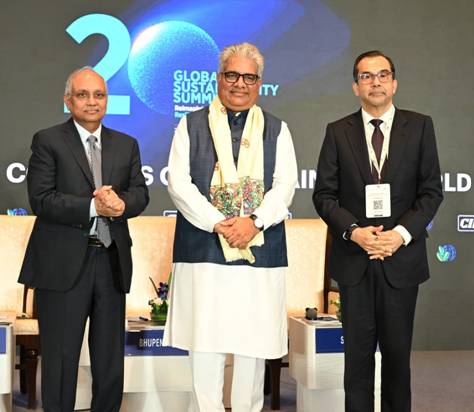
Enviro News Asia, New Delhi – At the 20th Global Sustainability Summit, the Union Minister for Environment, Forest and Climate Change, Shri Bhupender Yadav, emphasized India’s commitment to resilient, regenerative, and responsible development. The event, hosted by the CII-ITC Centre of Excellence for Sustainable Development, convened dignitaries including Shri Chandrajit Banerjee, Director General of the Confederation of Indian Industry (CII), and Shri Sanjiv Puri, Immediate Past President of CII, alongside representatives from over ten countries.
Shri Yadav outlined how India integrates economic progress with environmental conservation, describing sustainability as an evolving lifestyle choice rather than a mere goal. He addressed the challenges posed by global trade tensions, geopolitical conflicts, and investment barriers, urging countries to adopt economy-wide sustainable solutions such as circular economy models, green manufacturing, and nature-positive initiatives.
Under Prime Minister Narendra Modi’s leadership, the ministry recently introduced significant measures to advance sustainability. On August 29, 2025, the Government of India enacted the Environment Audit Rules, 2025, establishing a structured system for environmental audits monitored by a dedicated agency to enhance transparency. These rules are designed to complement existing monitoring systems.
Additionally, Shri Yadav announced a revised methodology for the Green Credit Programme, also implemented on August 29, 2025. This update allows private sector participation, mandates restoration commitments, mobilizes private funding for climate initiatives, and facilitates the use of Earned Green Credits to stimulate ecological restoration.
On August 31, 2025, amendments to the Forest (Conservation and Augmentation) Rules, 2023 were introduced to support the National Critical Mineral Mission, 2025. This mission identifies 24 critical and strategic minerals essential for economic growth and national security, simplifying mining approvals within forest areas for both public and private entities.
Shri Yadav also highlighted India’s rapid economic growth paired with leadership in climate action. The country’s achievements include early fulfillment of Paris Agreement targets, accelerated renewable energy deployment, enhanced corporate accountability via ESG frameworks, and the advancement of circular economy practices through a robust Extended Producer Responsibility (EPR) system.
He pointed to initiatives such as expanding forest cover, launching campaigns like ‘Mission LiFE’ and ‘Ek Ped Maa Ke Naam,’ and upcoming plans including the National Adaptation Plan (NAP), which aims to embed climate adaptation strategies into national development through scientific and grassroots approaches.
Shri Yadav called upon global industries and stakeholders to integrate sustainability into their core policies, aligning with India’s vision of resilience, regeneration, and responsibility. He expressed optimism that the summit would foster discussions leading to transformative sustainable growth pathways. (*)