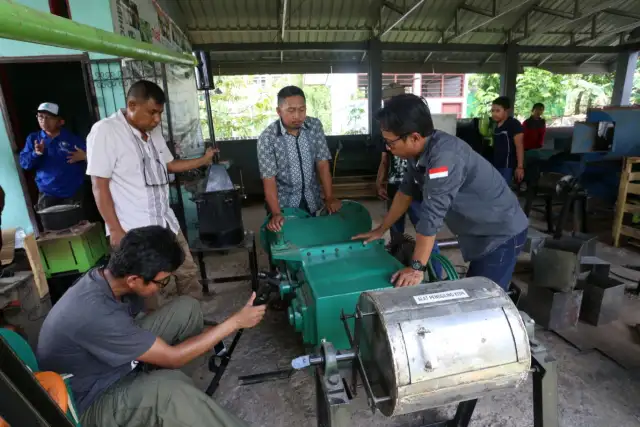
Enviro News Asia, Yogyakarta – National Research and Innovation Agency (BRIN), through its Research Center for Ecology, has highlighted that community-based microhydropower systems (PLTMH) offer an integrated solution to expand access to clean energy while preserving forest ecosystems across Indonesia.
The study, conducted between 2009 and 2019 in 14 forest-adjacent villages across Sulawesi, Kalimantan, and East Nusa Tenggara, found that the success of microhydropower projects depends not only on technical factors but also on strong community participation, institutional capacity, and incentive schemes linked to ecosystem services.
Researcher Hunggul Yudono Setio Hadi Nugroho explained that microhydropower plays a strategic role in linking energy needs with forest conservation efforts.
“Microhydropower not only provides clean energy but also serves as a tangible incentive for communities to protect forests as vital water sources that sustain the system,” he stated.
Within the framework of Community-Based Sustainable Forest Management (CBSFM), microhydropower acts as a bridge connecting energy, water resources, and sustainable forest governance. In addition to supplying household electricity, the energy generated also supports productive economic activities at the village level.
The research revealed that in several locations, microhydropower systems remain operational even after the introduction of the national electricity grid by Perusahaan Listrik Negara (PLN), as they are considered more cost-efficient and supportive of micro-enterprises.
However, the development of microhydropower in Indonesia still faces challenges, including limited hydrological data, suboptimal technical design, and weak local management capacity. Non-participatory development approaches also risk reducing community ownership of such infrastructure.
The study found that successful projects typically involve communities from the planning stage through to long-term management and are supported by strong local institutions.
As a solution, BRIN promotes the Payment for Watershed Ecosystem Services (PWES) approach, which integrates water, energy, and forest management into a single incentive-based system. This model positions communities not only as beneficiaries but also as active managers and stewards of natural resources.
The Water-Energy-Food (WEF) Nexus approach is also applied to ensure the interconnection between energy, water, and food systems, supporting rural resilience and livelihoods.
Based on these findings, BRIN recommends strengthening community participation, improving technical and institutional capacity, adopting data-driven planning, and integrating cross-sector policies in energy, water, and forestry.
The agency emphasized that microhydropower should be positioned not merely as an energy solution but as a socio-ecological transformation tool that promotes rural independence and sustainability. (*)