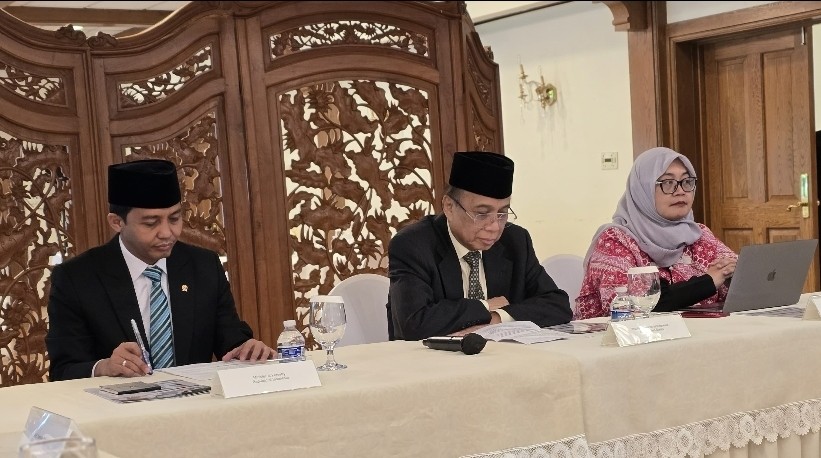
Enviro News Asia, Washington DC — The Government of Indonesia and national forestry industry stakeholders strengthened trade diplomacy on sustainable forest products with the United States through a business forum titled “Navigating U.S. Market Access for Indonesian Forest Products: Trade, Legality, and Sustainability” held in Washington DC on 14 May 2026.
The forum brought together government representatives, forestry industry associations, and business actors from both countries to discuss market opportunities, timber legality, sustainability standards, and strengthening supply chains for Indonesian forest products in the global market.
The Indonesian Ambassador to the United States stated that trade relations between Indonesia and the United States continue to expand, particularly in the forestry sector, which plays a strategic role in supporting sustainable economic growth and bilateral trade.
He noted that the United States remains one of the main export destinations for Indonesian forestry products, including plywood, pulp and paper, processed wood products, furniture, and other value-added commodities.
“Indonesia continues to strengthen its position as a supplier of legal and sustainable forest products through the implementation of the Timber Legality and Sustainability Verification System (SVLK), which is the world’s first mandatory national timber legality system,” he said.
He added that global market trends increasingly demand transparency, traceability, and responsible supply chains, making collaboration between governments and industry players more essential than ever.
Meanwhile, Director General of Sustainable Forest Management at the Ministry of Forestry, Laksmi Wijayanti, explained that Indonesia has established a national forestry governance framework integrating legality, sustainability, traceability, and independent verification through the SVLK system.
According to her, SVLK continues to evolve in response to international regulatory developments and market requirements, including those of the United States.
“SVLK helps buyers and importers understand product origins, ensure compliance, and strengthen confidence in Indonesia’s forestry supply chain,” she stated.
Laksmi added that Indonesia possesses strong potential to support global forestry trade, with approximately 123.9 million hectares of forest area, including around 67 million hectares designated as production forests.
She also emphasized that Indonesia is continuing to transform its forestry business model through multi-business forestry approaches, regenerative agroforestry, forest rehabilitation, community economic empowerment, environmental services, and carbon trading initiatives.
During the forum, representatives of the Indonesian Forestry Community Communication Forum (FKMPI) described the United States market as a strategic opportunity for Indonesian forestry products.
FKMPI noted that Indonesia’s wood product exports to the United States reached approximately USD 1.94 billion in 2025, accounting for around 15 percent of Indonesia’s total global wood product exports.
The organization highlighted that Indonesia has a comprehensive forestry industry supply chain, ranging from logs, plywood, pulp and paper, to furniture and downstream forest products.
“Indonesia is ready to respond to U.S. market demand for legal and sustainable tropical wood products, including support for manufacturing industries and the recreational vehicle (RV) sector in the United States,” the forum stated.
FKMPI also emphasized the importance of strengthening cooperation between the Indonesian Government, U.S. timber industry associations, and business actors from both countries to expand market access and reinforce sustainable forestry trade diplomacy.
In addition, industry stakeholders expressed hope that trade barriers such as countervailing duty (CVD) and anti-dumping policies on several panel and paper products could be discussed more constructively within the bilateral trade cooperation framework.
The forum was supported by the Multi-Stakeholder Forestry Programme Phase 5 (MFP5), a collaboration between the Governments of Indonesia and the United Kingdom aimed at strengthening forestry governance, sustainable forestry business development, and international market recognition for Indonesian forestry products and services.
Through technical support, capacity building, and multi-stakeholder collaboration, MFP5 is expected to help strengthen the policy, institutional, and partnership foundations necessary to support legal, sustainable, and high-integrity forestry trade in the global market. (*)