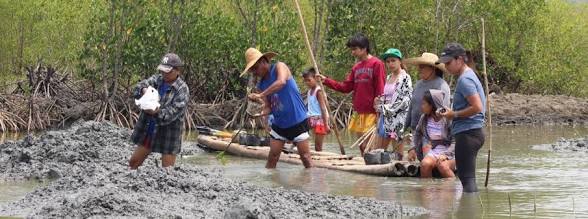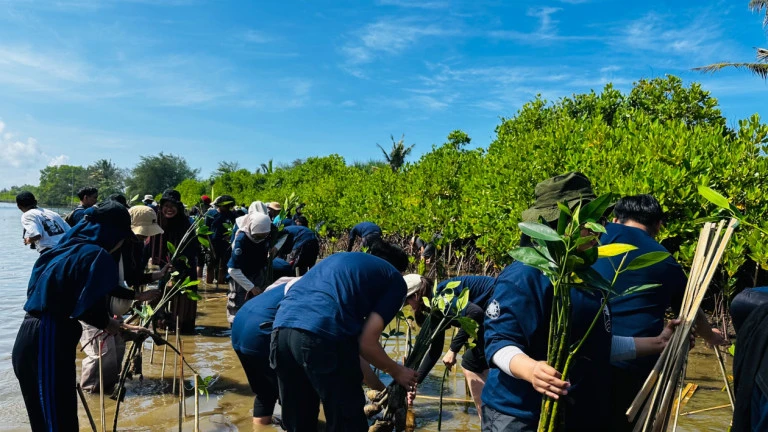
Enviro News Asia, Yogyakarta — Amid growing threats from coastal erosion and climate change along Yogyakarta’s southern coastline, hundreds of students, local residents, and community members joined forces to plant 1,000 mangrove trees in the coastal area of Jangkaran, Kulon Progo, on 24 May 2026.
The initiative, titled “Plant Today, Protect Tomorrow,” was organized by the Graduate Student Association of Universitas Gadjah Mada (UGM) as part of a broader effort to address environmental degradation and strengthen coastal ecosystem resilience.
Approximately 250 participants from diverse backgrounds took part in the restoration activity. Mangrove planting was selected as a practical nature-based solution due to the ecosystem’s ability to absorb significant amounts of blue carbon while serving as a natural barrier against coastal erosion, storm surges, and the impacts of climate change.
For the Graduate Student Association, the initiative represented more than a tree-planting campaign. It was also an investment in the future sustainability of Indonesia’s coastal environments.
Chairperson of the UGM Graduate Student Association, Norol Latifah, emphasized that the event was intended as a broader environmental movement aimed at raising ecological awareness amid the escalating climate crisis.
She cited findings from a 2020 G20 report indicating that global temperatures have already increased by approximately 1.4 degrees Celsius and could rise by as much as 3.9 degrees Celsius by the end of the century if significant mitigation efforts are not undertaken.
“Through the small actions we undertake today, we hope to create a meaningful impact for environmental sustainability in the future. Protecting the environment cannot be achieved by individuals alone; it requires collaboration among all sectors of society,” Latifah said.
She added that the programme aligns with UGM’s commitment to advancing the Sustainable Development Goals (SDGs) by encouraging students to participate in initiatives that generate tangible environmental and social benefits.
“Our hope is that the trees planted today will be cared for collectively and become a lasting environmental legacy for the people of Kulon Progo,” she said.
The initiative received support from local authorities. Deputy Regent of Kulon Progo Regency, Ambar Purwoko, praised the programme as an important contribution to the preservation of coastal ecosystems.
“I would like to express my appreciation to Universitas Gadjah Mada for its concern, participation, and support in protecting nature. Hopefully, Indonesia’s environment will remain preserved and sustainable for future generations,” he said.
Participants and local residents also welcomed the programme. One volunteer noted that the activity provided an important platform for young people to transform environmental concern into direct action.
“We are grateful to have a space where we can contribute to environmental protection. Initiatives like mangrove planting allow us to turn our commitment to nature into meaningful action,” the volunteer said.
Local resident Warso expressed appreciation for the efforts made by participants to support environmental conservation in the village.
“Thank you for visiting our community and caring about the environment here. Hopefully, this small effort will bring significant benefits for the future,” he said.
Secretary of UGM’s Directorate of Student Affairs, Musthofa Anshori, described student participation in environmental restoration activities as a concrete example of the university’s commitment to the principles of higher education, particularly community engagement and public service.
The mangrove restoration initiative reflects the growing role of academic institutions in promoting climate action and ecosystem conservation while fostering collaboration between students, local communities, and government stakeholders. (*)