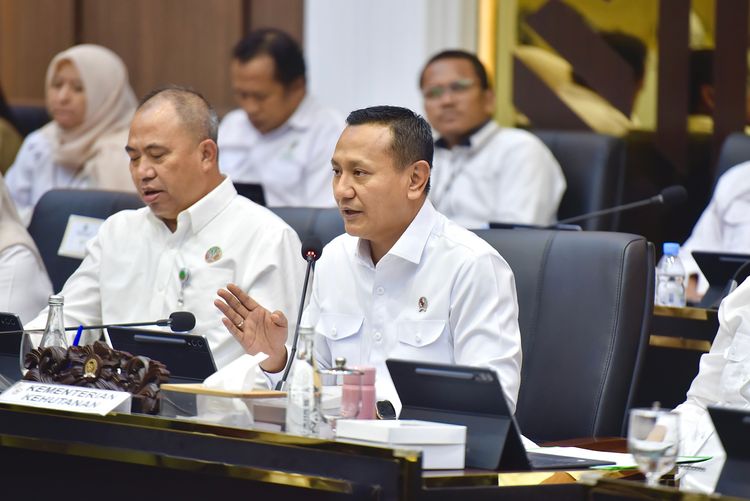
Enviro News Asia, Jakarta — Indonesia’s Ministry of Forestry has submitted recommendations on the Fourth Amendment to Law No. 41 of 1999 on Forestry during a meeting with the House of Representatives’ Legislative Body (Baleg DPR RI), as part of efforts to harmonize and refine the draft legislation.
Deputy Minister of Forestry Rohmat Marzuki emphasized that updating the Forestry Law is essential to address major legal, policy, and governance developments that have significantly transformed forest management since the original law came into force more than two decades ago.
“Article 33 of the 1945 Constitution stipulates that the earth, water, and natural resources contained therein are controlled by the state and utilized for the greatest prosperity of the people. To fulfill this constitutional mandate, forest management must maintain a balance between economic, social, and environmental functions,” Rohmat said.
He stressed that state control over forests should not be interpreted as state ownership of all forest areas. Rather, it constitutes the legal authority to regulate and manage forest resources, determine forest status, issue utilization permits, and safeguard ecological and social functions for the benefit of society.
According to the ministry, strengthening the legal framework governing state control over forests is necessary to provide greater legal certainty while ensuring respect for the rights of Indigenous peoples and communities living within and around forest areas.
Rohmat also highlighted the need to incorporate several Constitutional Court rulings into the revised law. These include Constitutional Court Decision No. 45/PUU-X/2011 concerning forest area designation, Decision No. 35/PUU-X/2012 affirming that customary forests are no longer state forests, and Decision No. 95/PUU-XII/2014 regarding the protection of communities residing inside and around forest zones.
During the meeting, the Ministry of Forestry identified unresolved tenure conflicts as one of the sector’s greatest challenges. Overlapping claims involving forest areas, community lands, Indigenous territories, and permits issued by other sectors continue to create legal uncertainties, requiring stronger regulations and accelerated implementation.
The ministry also underscored the importance of strengthening provisions related to environmental services and the carbon economy. When the Forestry Law was first enacted in 1999, issues such as carbon trading, carbon credits, payments for ecosystem services, and nature-based solutions had not yet emerged as major policy concerns.
Consequently, the revised law is expected to establish a clearer legal basis for carbon-related activities and environmental service mechanisms.
Among the key clusters proposed by the ministry are definitions and terminology, state control over forests, forest status and functions, forest inventories, minimum forest area and forest cover requirements, special-purpose forest areas, forest management and social forestry, forest product processing, Indigenous peoples, forest rehabilitation, forestry information systems, forestry financing, and law enforcement.
On financing and law enforcement, the ministry stressed that sustainable forest management requires adequate and long-term funding. It also proposed strengthening the authority of Forest Rangers, Forestry Supervisory Officials, and Forestry Civil Investigators to combat illegal logging, forest encroachment, illicit timber trade, illegal land transactions, and unauthorized exploitation or trading of forestry carbon services.
“The revision of the Forestry Law should become a momentum to strengthen legal certainty over forest areas, accelerate the resolution of tenure conflicts, reinforce the recognition of Indigenous communities, support the carbon economy, and ensure that forest management remains oriented toward sustainability and public welfare,” Rohmat concluded. (*)