Enviro News Asia, South Tanggerang — Indonesia and South Korea are strengthening cooperation in smart farming research through the development of Smart Greenhouse technology designed to address the specific challenges of tropical agriculture.
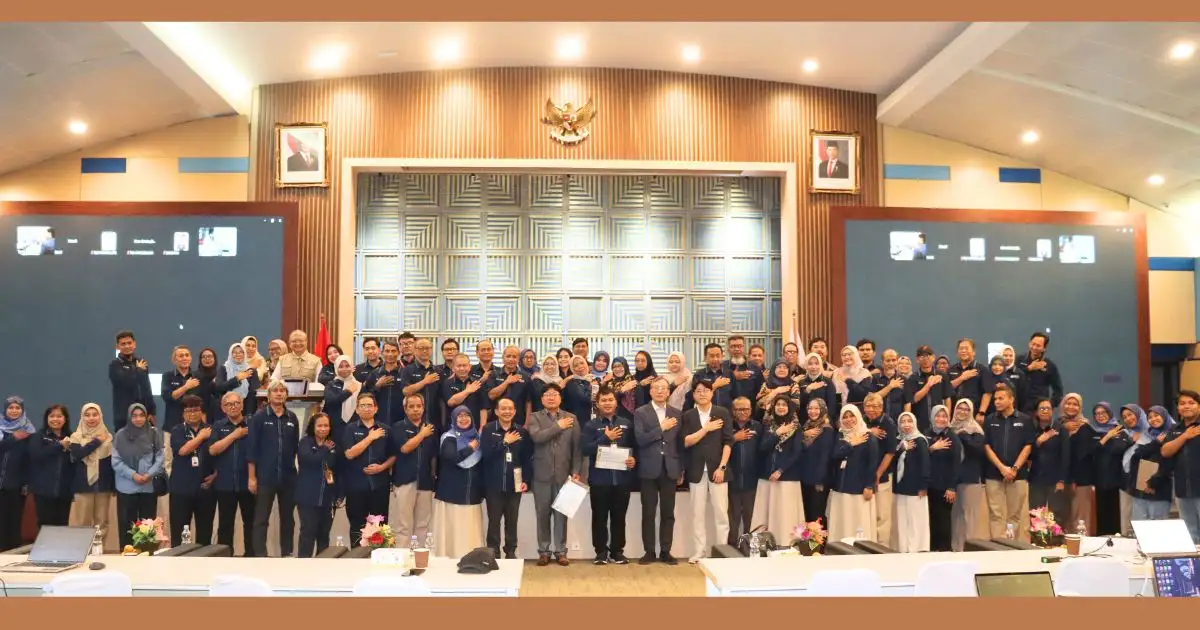
The collaboration between the National Research and Innovation Agency (BRIN) and the Korea Institute of Science and Technology (KIST) was highlighted during the BRIN-KIST ODA International Seminar, held at the B.J. Habibie Science and Technology Park in Serpong, South Tangerang, on August 13, 2026.
Head of BRIN’s Research Center for Sustainable Industrial and Manufacturing Systems, Nugroho Adi Sasongko, said the cooperation under the Official Development Assistance (ODA) program extends beyond the construction of Smart Greenhouse facilities. It also focuses on strengthening human resources, transferring knowledge and developing technologies adapted to Indonesia’s tropical conditions.
According to Nugroho, the BRIN-KIST Smart Greenhouse facility in Cibinong represents a concrete outcome of Indonesia-Korea research cooperation. However, the success of the partnership should not only be measured by the availability of infrastructure, but also by the development of knowledge, data, experience and research networks that support the technology.
He emphasized that the partnership should prioritize capability transfer rather than simply transferring hardware. Korean expertise in Controlled Environment Agriculture is expected to be combined with Indonesia’s experience and knowledge of tropical climates to develop smart farming technologies that are both advanced and suitable for local conditions.
Head of BRIN’s Research Organization for Energy and Manufacturing, Cuk Supriyadi Ali Nandar, explained that the Smart Greenhouse integrates modern technologies, including environmental sensors, the Internet of Things (IoT), artificial intelligence (AI), automated fertigation, environmental control systems and data-based crop management.
The integration of these technologies is expected to improve agricultural productivity, resource efficiency, crop quality and sustainability. However, Cuk stressed that technologies developed in Korea cannot simply be transferred to Indonesia without adaptation and localization.
The Smart Greenhouse is therefore expected to serve as a collaborative research platform for Indonesian and Korean researchers. The facility will support joint research, technology development, human-resource capacity building and the creation of new projects that can contribute to Indonesia’s agricultural development.
Director General of KIST Gangneung, Kim Joosun, said the Korean Smart Greenhouse has developed into a living laboratory for joint research between Indonesia and South Korea. The facility enables researchers to collect data, directly evaluate crops and develop smart agriculture technologies suited to Indonesia’s tropical environment.
Kim highlighted BRIN’s strengths in tropical agricultural research, its extensive research network and its understanding of Indonesia’s agricultural priorities. KIST, meanwhile, contributes expertise in smart farming systems, high-efficiency cultivation and applied research.
Combining these capabilities, he said, could produce technological solutions that are not only advanced but also relevant to local needs and capable of being scaled up.
The two institutions are committed to continuing their partnership based on science, innovation, mutual respect and shared benefits. The cooperation is expected to strengthen Indonesia’s capacity to develop smart agricultural technologies while supporting more efficient and sustainable food production in tropical environments. (*)