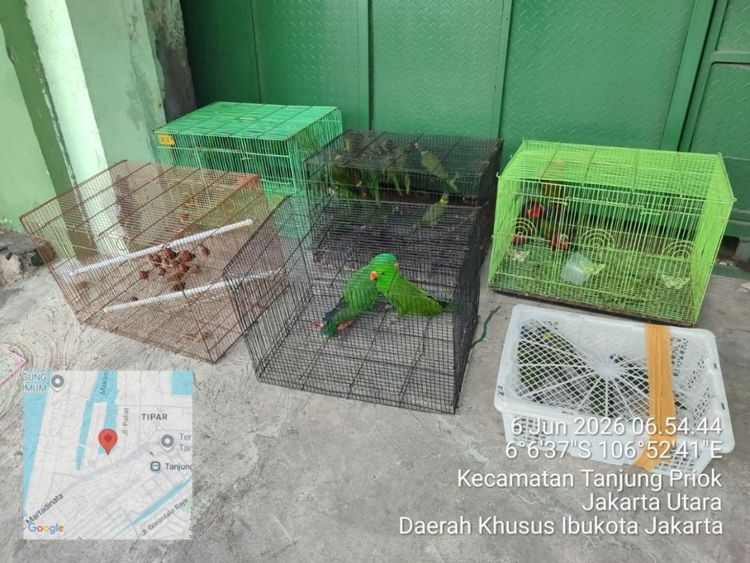
Enviro News Asia, Jakarta — A joint task force comprising personnel from the Directorate General of Forestry Law Enforcement, the Criminal Investigation Agency (Bareskrim) of the Indonesian National Police, and the Indonesian Military Police Command (Puspom) has successfully disrupted an illegal wildlife trafficking operation at Tanjung Priok Port in Jakarta. Conducted on 6–7 June 2026, the operation resulted in the seizure of 100 protected animals originating from Papua that were allegedly destined for the illegal wildlife trade.
The animals have been evacuated and placed under the care of the Wildlife Rescue Center (PPS) operated by the Natural Resources Conservation Agency (BKSDA) at Tegal Alur, Jakarta, where they are receiving veterinary treatment and health assessments.
The operation was launched following intelligence gathering and monitoring activities that uncovered indications of protected wildlife being transported by sea to Jakarta. Based on the findings, the joint team carried out enforcement measures at Tanjung Priok Port to prevent the animals from entering illegal distribution channels.
Authorities confiscated various species of protected and endemic Papuan birds, including four Eclectus Parrots (Eclectus roratus), two Sulphur-crested Cockatoos (Cacatua galerita), 19 Black-capped Lories (Lorius lory), six Black Lories (Chalcopsitta atra), 14 Victoria Crowned Pigeons (Goura victoria), three Magnificent Fruit Doves (Ptilinopus magnificus), 19 Crimson Finches (Neochmia phaeton), two Pesquet’s Parrots (Psittrichas fulgidus), three Brown Lories (Chalcopsitta duivenbodei), and 28 Rainbow Lorikeets (Trichoglossus haematodus). The rescue operation aimed not only to preserve the animals’ lives but also to support the ongoing legal investigation.
During the operation, investigators questioned two individuals identified by their initials BI and ZF, both reportedly members of the security apparatus. Several of the animals were found without valid ownership or transport permits. Authorities are also tracing the shipment routes and identifying parties involved in organizing and profiting from the illegal trade network.
The trafficking and transportation of protected wildlife constitute criminal offenses under Law No. 5 of 1990 on the Conservation of Biological Resources and Their Ecosystems, as amended by Law No. 32 of 2024. Under Article 40A paragraph (1) letter d, offenders face imprisonment ranging from three to fifteen years and fines ranging from Category IV to Category VI.
Director of Forestry Criminal Enforcement Rudianto Saragih Napitu emphasized that the case is being handled with careful attention to both evidence preservation and animal welfare.
“We have two priorities that must progress simultaneously: ensuring the proper care of the animals and maintaining the integrity of the evidence. These animals are living evidence, which means they require immediate and well-documented treatment. At the same time, we are securing documents, witness statements, and tracing the distribution chain. This enables us to identify who played which role—from shippers and receivers to intermediaries. The investigation will proceed in stages and will not stop with those directly transporting the animals,” Rudianto stated.
Director General of Forestry Law Enforcement Dwi Januanto Nugroho stressed that wildlife trafficking has evolved into a sophisticated criminal enterprise that exploits logistical networks and requires a broader enforcement approach.
“The pattern is transregional and potentially transnational. Therefore, we are applying a multi-door and inter-agency approach. Financial investigations are being strengthened in cooperation with the Financial Transaction Reports and Analysis Center (PPATK), while cases with international links may be pursued through global cooperation mechanisms, including Interpol. This operation demonstrates effective coordination among institutions. At the same time, surveillance in habitats and poaching hotspots will continue to be reinforced to prevent illegal hunting at its source,” he said.
The Ministry of Forestry reaffirmed that combating wildlife trafficking remains a strategic national priority aimed at safeguarding Indonesia’s biodiversity, particularly irreplaceable endemic species. The government will continue to strengthen oversight at transportation hubs, intensify law enforcement efforts, and dismantle criminal networks by targeting those who profit from the illegal trade.
The ministry also called on the public to help curb demand by refraining from purchasing, keeping, or trading protected species and by reporting suspected wildlife trafficking activities. According to the ministry, protecting wildlife is not solely the responsibility of law enforcement agencies but also reflects the nation’s commitment to preserving its forests and natural heritage for future generations. (*)