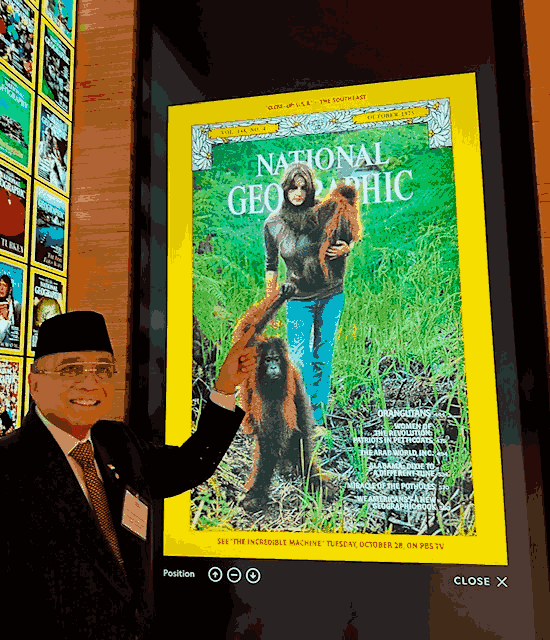
Enviro News Asia, Washington D.C. – Tuesday marked a significant moment in the United States capital as a new museum officially opened its doors: the National Geographic Museum, not merely an exhibition space but a showcase of the power of photography, film, and video in telling the story of the world.
The National Geographic name needs little introduction. For more than a century, the iconic yellow-bordered magazine has served as a global reference for stories of exploration, science, culture, and nature. Founded in 1888 by the National Geographic Society, whose co-founders included Alexander Graham Bell, inventor of the telephone, it is renowned for the extraordinary quality of its reporting and photography.
The opening was attended by US government officials, members of Congress, scientists, artists, and foreign diplomats, including Indonesian Ambassador to the United States Indroyono Soesilo. Indonesia’s presence at the event was fitting, given National Geographic’s long and deep relationship with the archipelago.
For Indonesia, National Geographic is far more than an international media outlet — it is a strategic partner in telling Indonesia’s story to the world. Since the Indonesian edition launched in 2005, stories about the country’s nature, culture, and people have reached an ever-wider global audience. Across all editions, the magazine reaches around 9.5 million copies per month in more than 60 countries and 30 languages.
Indonesia has frequently been a centrepiece of that coverage. Major stories have ranged from the discovery of Homo floresiensis on Flores and the grandeur of Borobudur Temple to the life of President Sukarno and the orangutans of Tanjung Puting. Critical issues including climate change, plastic pollution, and Bali’s traditional Subak irrigation system have also formed part of the global narrative on Indonesia.
The impact has been considerable. National Geographic’s coverage has helped strengthen Indonesia’s image on the world stage, advancing cultural diplomacy, promoting knowledge-based tourism, and raising global awareness of conservation issues at home, while opening opportunities for Indonesian researchers, photographers, and environmentalists to appear on an international platform.
Behind National Geographic’s iconic images lies a long and demanding process. World-class photographers working in Indonesia must contend with extreme terrain, unpredictable weather, and the need for deep research, often chasing fleeting moments of light at sunrise or sunset in locations such as Kawah Ijen in East Java, Gua Jomblang in Yogyakarta, and Lake Semayang in East Kalimantan.
One of the most striking examples is the documentation of birds of paradise in Papua. Capturing all 39 species required photographers to spend up to eight months in the field, illustrating that working in Indonesia is not simply about photographing beautiful scenery, but about understanding a complex ecosystem.
Journalists and photographers must also build relationships with local communities, going beyond taking pictures to immerse themselves in community life, documenting indigenous peoples, conservation efforts, and the human-nature relationship in areas including Lake Toba in North Sumatra, Lore Lindu in Central Sulawesi, Sungai Utik in West Kalimantan, and Lake Sentarum, also in West Kalimantan.
For video production, the human dimension runs even deeper. Supported by technology such as drones and digital cameras, the resulting stories are not only visually stunning but narratively powerful, connecting Indonesia’s landscapes with sustainability issues and the daily lives of its people.
Ambassador Indroyono Soesilo expressed high appreciation for National Geographic’s work in Indonesia, noting that its coverage makes a significant contribution to strengthening Indonesia’s image in the world while promoting the country’s culture, tourism, and conservation message.
Ultimately, Indonesia is not merely the subject of a photograph. It presents itself as a source of world stories, rich in scientific, cultural, and visual terms, that continues to inspire and draw global attention. (*)