

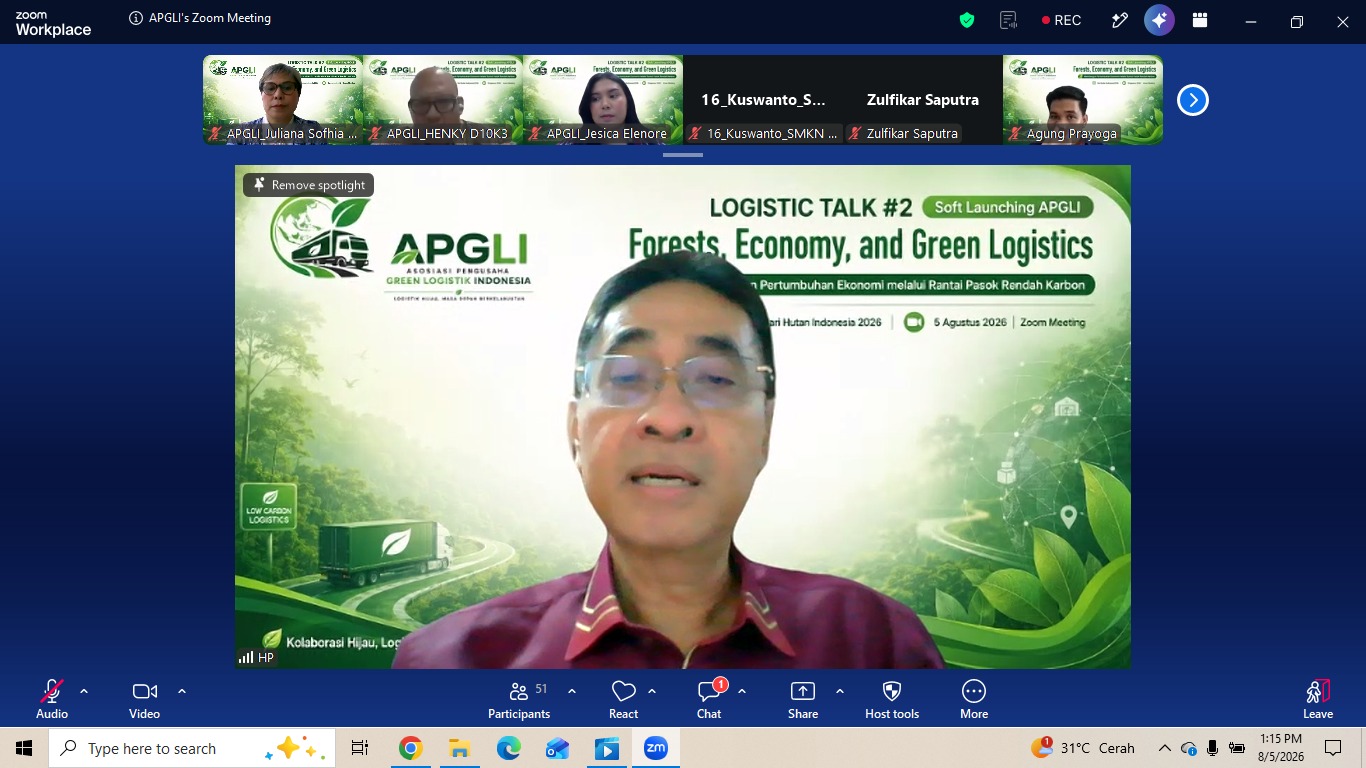
Enviro News Asia, Jakarta – Green logistics transformation is emerging as a key strategy to integrate economic growth, supply chain efficiency, environmental protection, and Indonesia’s climate commitments. The issue was highlighted during the Green Logistics Talk #2 and the soft launching of the Indonesian Green Logistics Entrepreneurs Association (APGLI) in Jakarta on Wednesday.
The discussion featured climate and carbon expert as well as University of Indonesia lecturer Mahawan Karuniasa, supply chain management expert and Vice Rector of the Indonesian Logistics and Business University (ULBI) Agus Purnomo, and Indonesian Logistics and Forwarders Association (ALFI) Vice Chairman Rifka Hidayat.
Delivering the keynote address, Senior Policy Analyst at Indonesia’s Ministry of Forestry Agus Justianto emphasized that the logistics sector plays a strategic role in supporting Indonesia’s Nationally Determined Contribution (NDC) and the Indonesia’s FOLU Net Sink 2030 agenda. He said the sector could contribute through energy efficiency, route and cargo optimization, multimodal transportation, the adoption of low-emission vehicles and energy sources, and digitalization to improve supply chain traceability.
“Green logistics is not only an environmental agenda. It is also a business strategy, an efficiency strategy, and a competitiveness strategy,” Agus said.
APGLI Chairwoman Netty Sri Rejeki said the association was established in response to the logistics sector’s growing role in supporting Indonesia’s economy while addressing challenges such as high operational costs, transportation safety, and increasing demand for sustainable business practices.
According to her, green logistics should be translated into practical and achievable actions that can be implemented by companies of all sizes based on their operational capacity.
She explained that APGLI’s roadmap begins with strengthening the organization’s foundation, expanding membership networks, promoting education, and introducing carbon measurement practices. The association will subsequently focus on digital ecosystem development, carbon reporting, green financing collaboration, and positioning Indonesia as a regional hub for green logistics practices.
The Indonesian Halal Logistics Association (AHLI) also expressed support for collaboration with APGLI, noting that green logistics aligns with halal logistics principles, particularly in reducing waste and improving operational efficiency.
Meanwhile, Supply Chain Indonesia (SCI) Founder and Chief Executive Officer Setijadi welcomed APGLI’s establishment as a platform for accelerating the transition toward a greener, more efficient, resilient, and competitive logistics system. SCI plans to collaborate with APGLI through research, policy development, human resource capacity building, public education, and industry forums.
The Green Logistics Talk #2 and APGLI soft launch are expected to strengthen collaboration among government institutions, businesses, academia, and other stakeholders in building Indonesia’s green logistics ecosystem. The initiative is expected to support national climate targets while enhancing supply chain resilience, operational efficiency, and the global competitiveness of Indonesia’s logistics industry. (*)