Enviro News Asia, Chicago — Indonesia and the United States have taken steps to explore research and innovation cooperation on critical minerals and rare earth elements (REE), following an Indonesian delegation’s visit to Argonne National Laboratory in Lemont, Illinois, on August 6.
The visit was aimed at initiating cooperation in minerals-to-materials research and rare earth element separation, as part of Indonesia’s science diplomacy efforts to transform its mineral resources into higher-value, advanced and more sustainable materials.
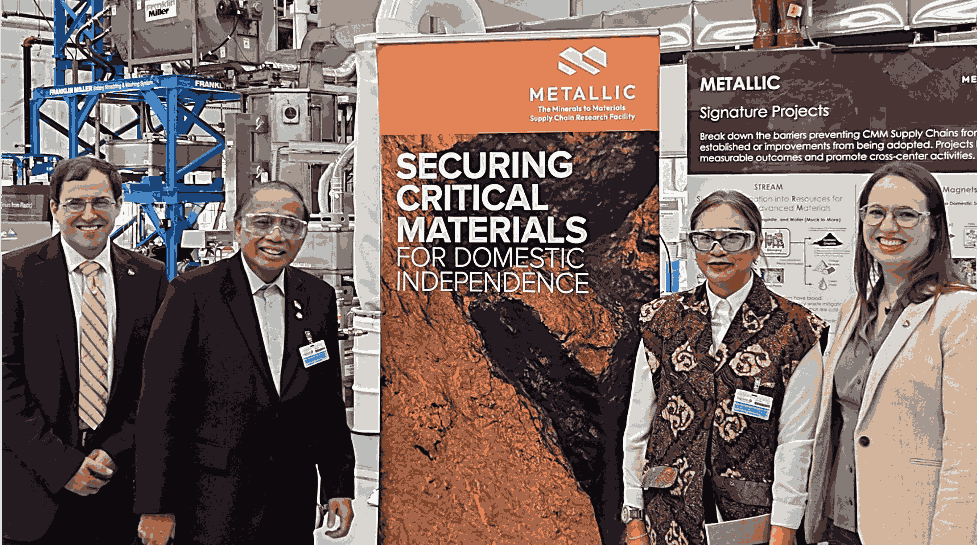
The Indonesian delegation was led by Director General for American and European Affairs at the Ministry of Foreign Affairs Grata Endah Werdaningtyas and included Indonesian Ambassador to the United States Indroyono Soesilo, Consul General of Indonesia in Chicago Trisari Dyah Paramita and other officials. The delegation was received by Dr. Henry Huang, Deputy Director of Argonne National Laboratory, along with Argonne researchers and executives, including Principal Materials Scientist Dr. Albert Lipson.
The meeting opened discussions on combining Indonesia’s mineral resources with Argonne’s expertise in materials processing, supply chain modelling, life-cycle analysis, artificial intelligence and recycling technologies.
Argonne National Laboratory, operated under the U.S. Department of Energy, hosts the Minerals to Materials Supply Chain Facility, known as METALLIC. The facility develops technologies spanning mineral feedstock enrichment, extraction and separation, refining, alloy development and advanced manufacturing. Its work is intended to accelerate the development of technologies for critical mineral extraction and processing while strengthening resilient supply chains.
Indonesia has significant potential in critical minerals, including bauxite, nickel, copper and tin. Bauxite can be processed into alumina and aluminium, while laterite nickel can be transformed into ferronickel, mixed hydroxide precipitate and nickel sulphate for battery applications. Copper can be processed into cathodes, wires and foils for electrification, while tin is used in solder and other materials essential to the electronics industry.
In the laterite nickel processing pathway, high-pressure acid leaching is used to dissolve metals from certain ores before nickel and cobalt are recovered as mixed hydroxide precipitate. These materials can subsequently be refined into battery-grade chemicals.
The mineral resources may also contain rare earth elements as by-products. Bauxite residue, or red mud, can contain REE, while laterite nickel and high-pressure acid leaching residues require further mapping to determine the distribution of rare earth elements. Tin tailings may also contain monazite, xenotime and zircon, which are minerals associated with REE and require safe management of naturally occurring thorium and uranium.
The meeting also resulted in an agreement to explore the establishment of a research consortium involving Indonesia’s National Research and Innovation Agency (BRIN), Universitas Indonesia, Bandung Institute of Technology (ITB), Sepuluh Nopember Institute of Technology (ITS) and mineral industry partners. On the U.S. side, the proposed consortium would involve Argonne National Laboratory, the University of Michigan and the University of Illinois.
The U.S. partners could contribute expertise in materials science, energy, mineral processing and innovation. The University of Michigan has a five-year strategic partnership with Argonne to strengthen research and education, while the University of Illinois operates a Critical Minerals & Materials Center focused on critical mineral resources and related technologies.
The proposed cooperation could cover mineralogical mapping, rare earth element separation testing, pilot-scale process design, techno-economic and life-cycle analysis, as well as researcher and student exchange programmes.
The cooperation is expected to promote greater value addition in Indonesia, stronger environmental governance and meaningful knowledge transfer. It could also support the development of innovative products from mining residues while strengthening Indonesia’s position in critical mineral and advanced materials value chains.
The initiative highlights the potential for Indonesia–U.S. science and technology cooperation to turn mineral resources and mining residues into strategic materials while supporting more sustainable and resilient supply chains. (*)