Enviro News Asia, Bandar Lampung — Forest and land fire prevention must address underlying land management, water management and socioeconomic issues if Indonesia is to prevent recurring fires, Indonesian Forest Entrepreneurs Association (APHI) Chairman Soewarso said.
“Forest and land fires are a consequence, not the root cause. We therefore need to address the underlying issues, from land management and water management to the way communities and their socioeconomic conditions are supported,” Soewarso said during an online public lecture hosted by the Faculty of Agriculture at the University of Lampung on Thursday, September 24.
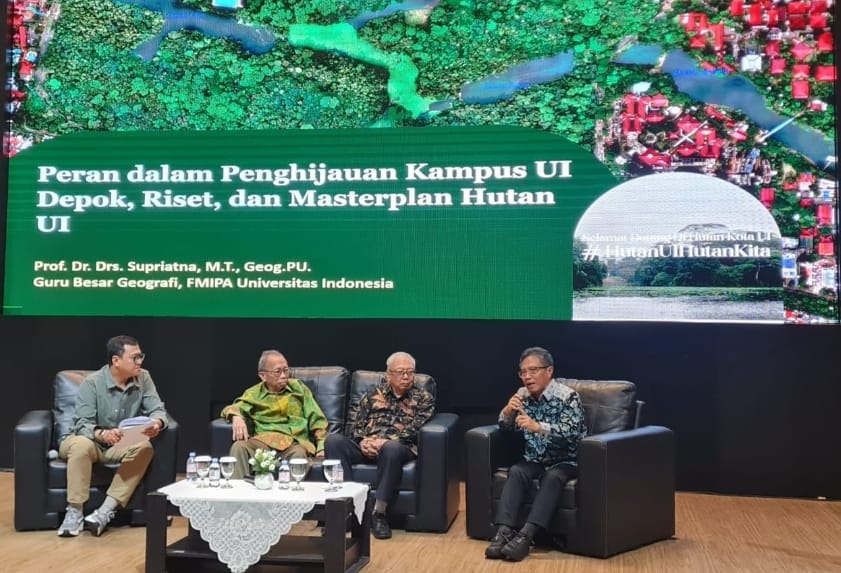
The lecture, titled “Examining the Anatomy of Indonesia’s Forest Fires: Prevention and Response,” was held as part of a series of activities marking a cooperation agreement between the University of Lampung’s Faculty of Agriculture and APHI. The two institutions had previously signed a five-year cooperation agreement.
The event was opened by Kuswanta, Dean of the Faculty of Agriculture at the University of Lampung.
Soewarso said recurring fires in the same locations indicate that fundamental problems remain unresolved. He emphasized that fire management needs to combine technical preparedness with social approaches.
Strengthening firefighting equipment and early-warning systems, he said, should go hand in hand with community empowerment, improved land management and the development of sustainable economic alternatives.
“Fire suppression remains important, but permanent solutions must begin before the fire starts. Prevention needs to become part of development and efforts to improve community welfare,” he said.
Soewarso identified several factors that require attention, including the use of fire for land clearing because it is considered inexpensive and fast, limited public understanding of the impacts of fires, and land tenure conflicts.
Addressing these issues requires approaches tailored to the conditions of individual communities and regions. Education, he said, needs to be accompanied by assistance and alternative economic activities that can reduce communities’ dependence on burning practices.
He also highlighted the importance of water management in peatland areas. Water sources, reservoirs and canal-blocking systems need to be integrated with field monitoring and early-warning systems to maintain suitable moisture conditions and reduce fire risks.
At the operational level, Soewarso called for stronger coordination among government institutions, businesses, communities and law enforcement agencies through information sharing, joint monitoring, and preparedness of personnel and equipment.
Technical measures should also be integrated with community empowerment programs in and around forestry concessions so that local residents can play an active role in fire prevention.
“Successful forest and land fire control should be reflected in risks being identified earlier, decisions being made faster, fires being contained before they grow, and fires not recurring in the same locations,” he said.
Christine Wulandari of the National Forestry Council (DKN), who is also a professor of forest management at the University of Lampung, emphasized the importance of making communities key actors in fire prevention through meaningful participation from program planning to evaluation.
She said the sustainability of prevention efforts depends largely on whether communities understand the benefits of protecting forests while receiving adequate support to manage their livelihoods sustainably.
“Communities need to be involved in identifying problems, designing activities and evaluating their results. Through such involvement, forest and land fire prevention can develop into a shared need,” Christine said.
She said partnerships among government institutions, forestry concession holders, universities and community groups should provide sustained assistance. Such support could include skills development, business development and stronger community institutions.
Christine also stressed the importance of communication that reflects local social and cultural conditions so that fire prevention messages can be understood and applied in everyday life.
“Education becomes more effective when communities have practical alternatives. Prevention messages therefore need to be accompanied by concrete support for livelihoods and land management without burning,” she said.
Improved land and water governance, technical preparedness and community empowerment are complementary elements of forest and land fire prevention. Sustained collaboration among stakeholders is needed to reduce recurring fires while supporting forest conservation and community welfare. (*)