Enviro News Asia, Jakarta — The National Research and Innovation Agency (BRIN) is developing Singkong-APP, a fire-retardant formulation made from cassava starch and ammonium polyphosphate (APP) to help control fires in peatlands.
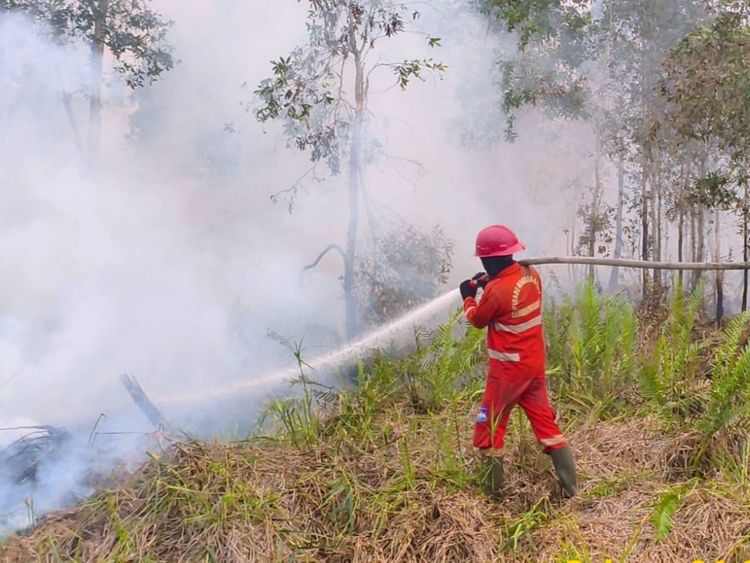
The technology is designed to address the unique characteristics of peat fires, which can smoulder and spread beneath the surface before reigniting when exposed to oxygen. Researchers are therefore seeking methods that can suppress not only visible flames but also residual heat and embers below the surface.
BRIN Researcher Julinton Sianturi said the development of Singkong-APP is based on an effort to understand peat-fire mechanisms at the molecular level. He explained that underground combustion can leave heat and embers beneath the surface, allowing fires to reappear even after surface flames have been extinguished.
The technology uses starch extracted from cassava rather than the entire plant. The starch is combined with APP, while alkyl polyglucoside (APG) is added to reduce viscosity and allow the formulation to be sprayed and penetrate deeper into burning material.
When exposed to heat, APP decomposes into phosphoric acid and ammonia. The phosphoric acid then reacts with cassava starch and, under further heating, forms a carbon-rich layer known as char.
This char layer helps reduce heat transfer, block access to combustible material and restrict oxygen from reaching the burning material. The formulation is intended to form a protective layer around smouldering material as underground fire moves toward the surface.
BRIN initially compared Singkong-APP with water using a simulated burning medium designed to resemble conditions found in peat fires. The test material consisted of dry leaves, twigs, rice husks and sawdust.
The testing process included creating smouldering combustion, spraying the surface, allowing the formulation to penetrate deeper into the material, suppressing residual combustion and monitoring the material after extinguishment.
The Singkong-APP formulation required 65 liters of liquid during the test, compared with 120 liters of water used as the control. Application also took 15 minutes, while the water treatment required 23 minutes and 35 seconds.
The difference remained evident after the formulation penetrated the lower part of the test material. The temperature recorded in the Singkong-APP medium was 46 degrees Celsius, compared with 117.5 degrees Celsius in the water treatment.
After 60 minutes, no active fire points were detected in the material treated with Singkong-APP, while six fire points remained in the material treated with water. Further observation also found no smoke or flames from the Singkong-APP material, whereas combustion remained detectable in the water-treated material.
The findings provide a basis for further development of the technology. However, BRIN emphasized that the tests remain at an early stage and were conducted using simulated materials rather than large-scale field conditions.
The next challenge is to develop pilot-scale production and determine how the formulation can be applied to larger areas of burning peatland.
Another challenge involves the availability of APP. According to Julinton, the material is not yet available domestically in sufficient quantities, prompting the research team to synthesize it using phosphoric acid and urea.
The synthesis process produces toxic ammonia, making laboratory and production safety an important consideration. BRIN therefore plans to develop an appropriate reactor system as the technology moves toward larger-scale production.
Further research will focus on scaling up the formulation and testing its performance under larger and more realistic conditions. Researchers will also continue refining the formulation so it can be sprayed effectively and penetrate deeper into burning material.
The development is expected to provide an additional technological option for managing peat fires, particularly residual underground combustion that can cause fires to reignite after surface flames have been extinguished. (*)