Enviro News Asia, West Kutai — Indonesia’s National Research and Innovation Agency (BRIN), in collaboration with PT Graha Panca Karsa (GPK), is conducting a biodiversity study in a forest concession near Tukul Village, Tering District, West Kutai Regency, to establish scientific baseline data for sustainable post-mining land reclamation.
The research aims to document the ecological condition of the forest before mining activities, providing scientific evidence to guide reclamation strategies that prioritize biodiversity conservation and ecosystem restoration.
Kalimantan, part of Borneo Island, is one of the world’s biodiversity hotspots and is home to numerous endemic plant species that play a vital role in maintaining ecosystem functions. However, baseline ecological data on vegetation composition, forest structure, carbon stocks, and the use of plant resources by local communities remain limited in many mining areas.
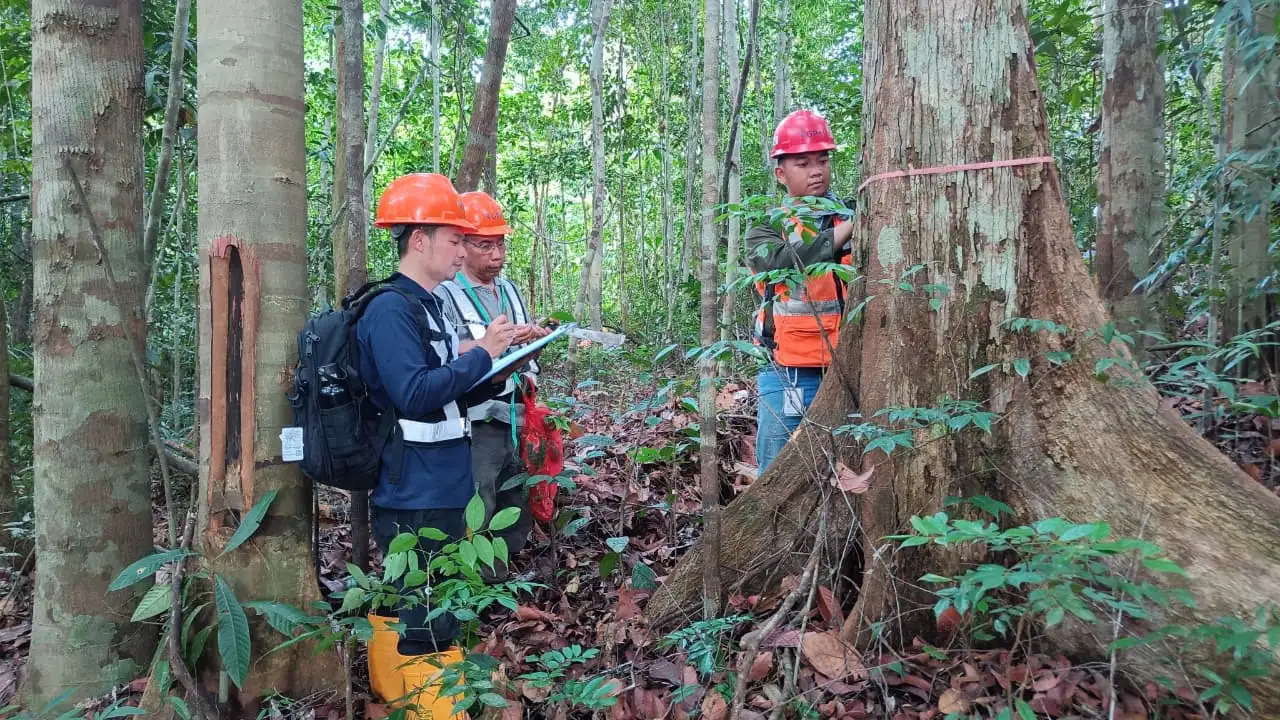
Researchers from BRIN’s Research Center for Biosystematics are conducting vegetation analyses to identify plant species composition, dominance, forest stand structure, and natural regeneration patterns. The team is also measuring environmental factors, including light intensity, temperature, humidity, and soil pH.
The researchers are collecting soil samples to examine their physical and chemical properties and assess nutrient availability that supports vegetation growth. They are also measuring tree diameters and identifying plant species to estimate carbon stocks stored in the forest ecosystem.
As part of the conservation effort, the team has collected seedlings of native plant species from the forest for acclimatization at PT Graha Panca Karsa’s nursery. The seedlings will be used for post-mining land rehabilitation, while selected specimens will be conserved ex situ at Purwodadi Botanic Garden for future research and conservation programs.
BRIN researcher Trimanto said baseline ecological data are essential for developing effective reclamation and ecosystem restoration strategies. He explained that using native plant species could improve reclamation success because the species have naturally adapted to local environmental conditions.
He added that native species-based reclamation not only restores vegetation cover but also contributes to conserving Kalimantan’s unique biodiversity while supporting further scientific research through living plant collections.
In addition to ecological assessments, the research team is documenting local knowledge on plant uses through an ethnobotanical study. The survey identifies plant species that local communities use for food, medicine, construction materials, and cultural practices.
The findings will contribute to future conservation planning, ecosystem restoration, and sustainable forest management. BRIN and PT Graha Panca Karsa said the collaboration demonstrates how scientific research can strengthen biodiversity-based approaches to post-mining reclamation. (*)