Enviro News Asia, Jakarta – Reforming coal pricing policies is considered essential to accelerate the development of renewable energy in Indonesia, as current policies keep coal-based electricity artificially cheap and limit the competitiveness of cleaner energy sources.
Indonesia currently applies the Domestic Market Obligation (DMO) and Domestic Price Obligation (DPO) policies, which cap coal prices for power plants at USD 70 per ton. According to energy experts, this policy has made electricity from fossil fuels cheaper than renewable energy, slowing the country’s energy transition.
Fabby Tumiwa, Chief Executive Officer of the Institute for Essential Services Reform (IESR), explained that the Just Energy Transition Partnership (JETP) framework targets 44 percent of Indonesia’s electricity generation capacity to come from renewable sources by 2030. Achieving this goal requires appropriate policy reforms, including adjustments to coal pricing mechanisms.
Over the past decade, Indonesia has added only around 3 gigawatts of renewable energy capacity between 2014 and 2023, reflecting the limited competitiveness of renewable power in the current market structure.
To support policy reform and strengthen renewable energy development, IESR has been implementing the Green Energy Transition Indonesia (GETI) project in collaboration with the British Embassy Jakarta since October 2024. The project aims to build analytical foundations, strengthen stakeholder consensus, and provide policy recommendations to improve renewable energy competitiveness while also developing the green hydrogen ecosystem.
Fabby noted that several studies conducted by IESR indicate that hydropower-based hydrogen production could achieve competitive costs in Indonesia.
In cooperation with the Ministry of Energy and Mineral Resources of Indonesia, IESR has also initiated studies on green hydrogen production in Kalimantan and Papua. Potential hydrogen hub zones have been identified in Aceh, Semarang, Balikpapan, and Makassar.
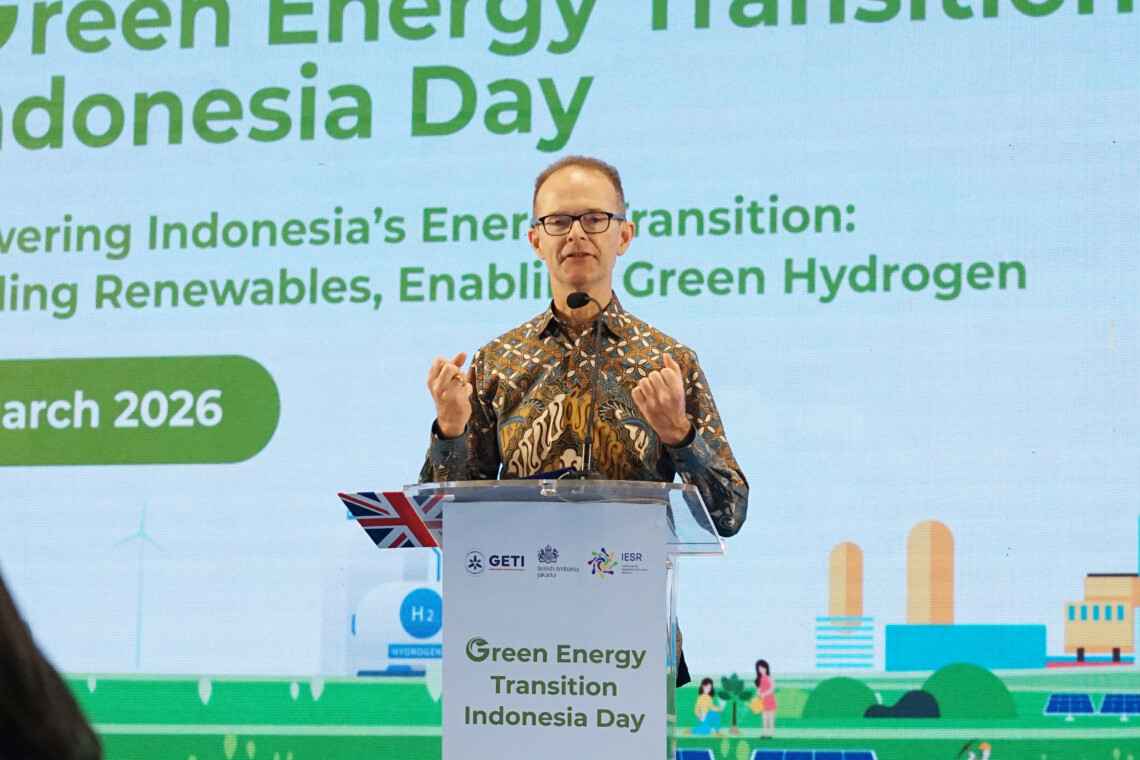
Speaking at the Green Energy Transition Day, Fabby encouraged the government and stakeholders to utilize the analytical results and policy platforms developed through the GETI project as it approaches completion in March 2026.
Meanwhile, Dominic Jermey, the United Kingdom’s Ambassador to Indonesia and Timor-Leste, highlighted that the insights generated through the project are particularly important as Indonesia stands at a crucial moment in the global energy transition.
He noted that the global energy system is undergoing significant changes and that investor interest in clean energy is growing. According to him, Indonesia possesses the scale, resources, and leadership potential to shape the future of clean energy in Southeast Asia.
The ambassador also emphasized that energy transition is increasingly influenced by geopolitical dynamics, especially amid ongoing global conflicts. Reducing dependence on fossil fuels, he said, is important not only for environmental reasons but also for economic independence, stability, and future energy security.
From the government side, Harris Yahya, Secretary of the Directorate General of New, Renewable Energy and Energy Conservation at the Ministry of Energy and Mineral Resources of Indonesia, stated that hydrogen development is a key component of Indonesia’s long-term energy transition strategy.
The government has prepared a hydrogen and ammonia roadmap outlining implementation strategies, action plans, monitoring systems, and evaluation mechanisms to guide hydrogen development in the country.
However, Harris acknowledged that technological development—particularly for green hydrogen—remains one of the main challenges.
He explained that the roadmap is expected to support the development of hydrogen through pilot projects, including applications in transportation and electricity generation combined with solar power and energy storage systems.
Meanwhile, Warih Aji Pamungkas, Head of Technology Implementation at IESR, said modeling of Indonesia’s electricity system using the least-cost system approach with the PLEXOS energy modeling software shows that a more ambitious energy transition scenario could actually reduce overall system costs.
Such a scenario could also lead to greater cumulative emission reductions and allow Indonesia to reach its peak emissions earlier.
However, the scenario would only be achievable if the country accelerates the retirement of fossil-fuel power plants and rapidly expands the adoption of renewable energy and other low-emission technologies. (*)