

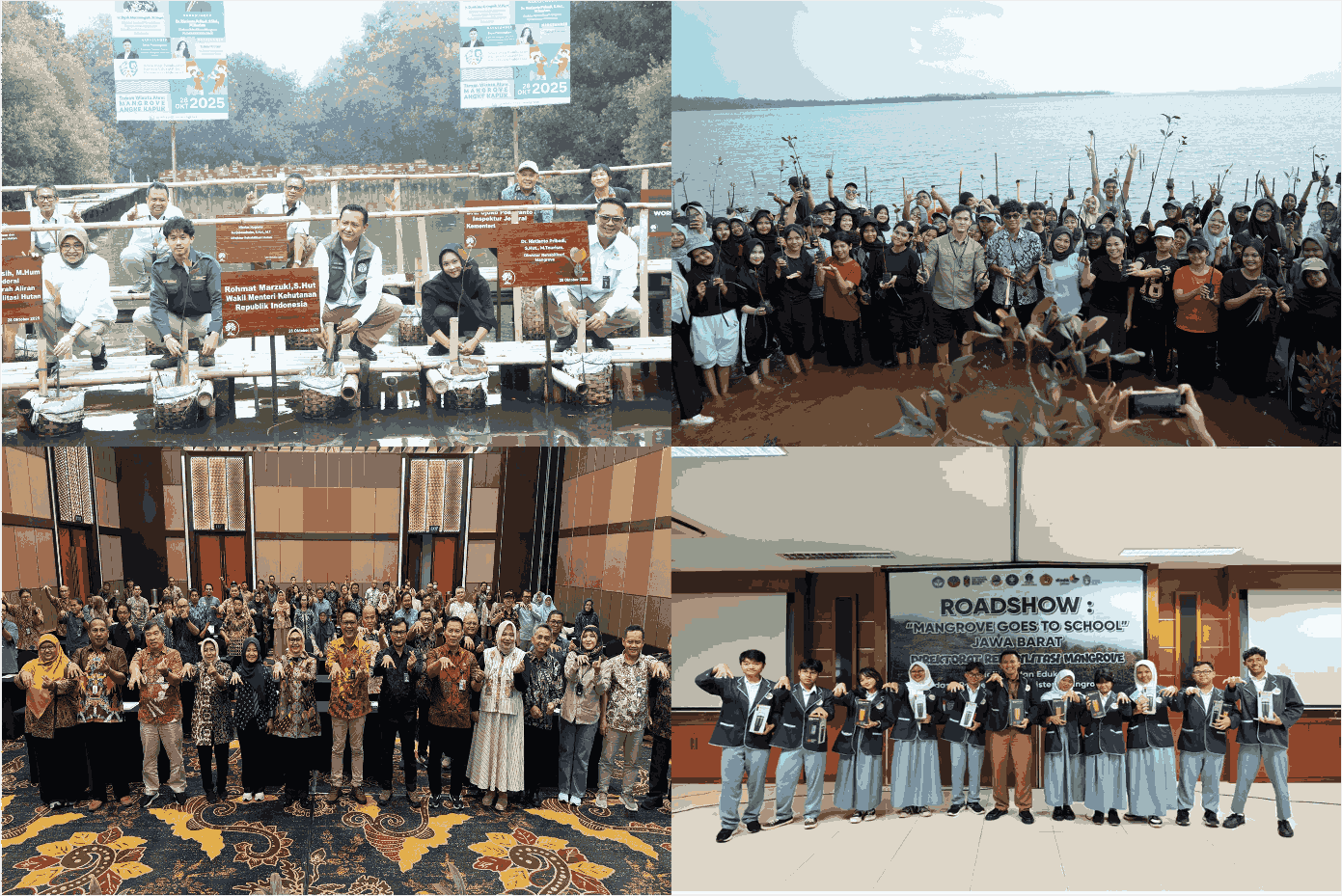
Enviro News Asia, Jakarta — Indonesia’s mangrove rehabilitation program recorded measurable progress throughout 2025, demonstrating concrete ecological outcomes while reinforcing institutional governance to ensure long-term sustainability of coastal ecosystem restoration.
The Ministry of Forestry reported that mangrove rehabilitation activities funded through both state budget (APBN) and non-state budget schemes achieved strong physical results, including expanded mangrove cover that met or exceeded targets in several phases. The progress reflects improved planning quality, field implementation, and maintenance consistency across rehabilitation sites.
Director General of Watershed Management and Forest Rehabilitation, Dyah Murtiningsih, stated that the 2025 achievements indicate a more effective approach to coastal ecosystem recovery. She emphasized that success is no longer measured solely by planting area, but also by sustained maintenance and stakeholder engagement at the local level.
Dyah explained that institutional strengthening has become a central pillar of the mangrove rehabilitation strategy. Throughout 2025, the ministry facilitated the reinforcement of Regional Mangrove Working Groups (KKMD) across 34 technical implementation units. The initiative received support from both national funding and international grants, aiming to ensure that mangrove rehabilitation is conducted in a coordinated, accountable, and sustainable manner across policy, capacity building, implementation, reporting, financing, and partnerships.
She stressed that strong institutions are essential to prevent rehabilitation efforts from ending at the planting stage. According to Dyah, KKMD functions as a cross-sector coordination hub at the regional level, enabling mangrove management to deliver long-term ecological and socio-economic benefits.
The ministry is also promoting multi-stakeholder partnership schemes to expand the impact of mangrove rehabilitation. The approach encourages collaboration with local governments, communities, the private sector, civil society organizations, and international partners as part of Indonesia’s climate mitigation agenda and carbon emission reduction efforts.
Dyah highlighted that mangroves hold a strategic role in national climate policy due to their multiple benefits. Beyond ecological value, mangroves contribute directly to climate change mitigation, strengthening the rationale for broader partnerships to maximize impact.
Meanwhile, Director of Mangrove Rehabilitation Nikolas Nugroho Surjobasuindro said the ministry is gradually developing an integrated mangrove rehabilitation database and mapping system. The data platform aims to improve planning accuracy, monitoring, and program integration at the national level while supporting evidence-based policymaking.
Nikolas underlined that data development remains selective and proportional, ensuring that information systems support, rather than distract from, on-the-ground implementation and capacity building among field operators.
With combined progress in physical rehabilitation, institutional strengthening, and inclusive partnership policies, the Ministry of Forestry expressed optimism that mangrove rehabilitation will continue delivering ecological, social, and climate benefits while reinforcing Indonesia’s contribution to global climate mitigation efforts. (*)