Enviro News Asia, Maluku — Indonesia’s Ministry of Forestry is strengthening the governance of legal, transparent and accountable forest product utilization through an evaluation of access rights to the Forest Product Administration Information System (SIPUHH) and the Non-Tax State Revenue Information System (SIPNBP) for Land Rights Holders (PHAT) in Maluku Province.
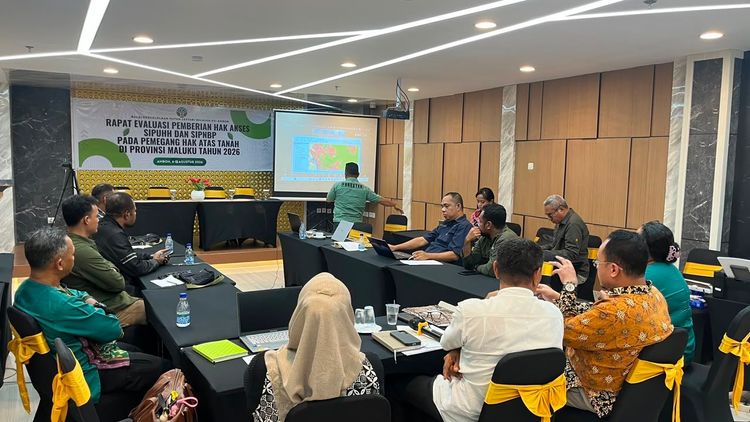
The evaluation meeting, held in Ambon on August 6–7, 2026, was aimed at ensuring that access to forest product administration systems for naturally growing timber is granted in accordance with applicable regulations, while supporting legal certainty and optimizing non-tax state revenue from the forestry sector.
The meeting brought together the Sustainable Forest Management Agency (BPHL) Region XVI Ambon, the Maluku and Papua Regional Forestry Law Enforcement Agency, the Maluku Provincial Forestry Agency, the Environmental Agency, the Land Office, Forest Management Units (KPH), and land rights holders subject to the evaluation. The cross-sectoral participation was intended to produce objective, credible and accountable recommendations.
Forestry Minister Raja Juli Antoni has emphasized that the transformation of forest governance must be based on legal certainty, transparency, accountability and the effective use of information technology.
The evaluation was conducted as a follow-up to Decree of the Director General of Sustainable Forest Management No. 13 of 2026 concerning the Evaluation of SIPUHH and SIPNBP Access Rights for Land Rights Holders. The policy forms part of the ministry’s efforts to strengthen forest governance through orderly, accountable and data-based forest product administration.
Acting Head of BPHL Region XVI Ambon Muhammad Iqbal explained that SIPUHH and SIPNBP access rights are administrative instruments designed to support forest product administration and the fulfillment of non-tax state revenue obligations. They do not constitute timber utilization permits or recognition of land ownership.
He said every evaluation must be conducted objectively and professionally, based on administrative data, technical verification and factual conditions in the field.
During the meeting, the evaluation team comprehensively assessed each application through administrative reviews, verification of land documents, spatial analysis, validation of Land Certificates (SKT), assessment of whether locations fall within Areas for Other Uses (APL), examination of Forest Inventory Reports (LHC), verification of standing timber potential, and assessment of environmental, topographical and slope conditions.
The approach was intended to ensure that every recommendation is supported by a strong technical and legal basis.
Fery Latupeirissa, representing the West Seram Regency Land Office, said the verification found that most documents had met the requirements, although several supporting documents still needed to be completed.
The evaluation also considered the legality of land tenure, the validity of technical data, the sustainability of ecological functions and potential environmental impacts. The process reflects the application of the precautionary principle to ensure that forest product utilization complies with regulations while maintaining forest sustainability.
As a province with significant forest resources, Maluku plays an important role in supporting regional development, supplying forest products and improving community welfare. The government therefore continues to ensure that forest resources are utilized legally, responsibly and sustainably.
Through the evaluation meeting, the Ministry of Forestry is strengthening coordination among the central government, regional authorities and other stakeholders to promote professional, transparent and accountable forest governance.
The evaluation results will serve as one of the bases for decision-making in accordance with applicable authorities and regulations, while supporting stronger forest product legality, increased non-tax state revenue and sustainable forest management in Maluku. (*)