Enviro News Asia, Washington D.C – Summer in Washington, D.C. often brings visitors to monuments and museums, but beyond the iconic landmarks lies another symbol of civilization: institutions that preserve a nation’s collective memory. Across the world, four institutions stand as pillars of modern civilization—national libraries, national museums, national galleries, and national archives. More than repositories of books or artifacts, they safeguard history, knowledge, culture, and identity for future generations.
Indonesia has long recognized the importance of these institutions. Three of them—the National Museum, National Library, and National Gallery—surround Jakarta’s National Monument (Monas), while the National Archives of the Republic of Indonesia is located in South Jakarta. Their placement underscores the role they play in maintaining the continuity of the nation’s intellectual and cultural heritage.
A similar arrangement exists in the United States. Washington, D.C.’s National Mall hosts four comparable institutions: the Smithsonian Institution, the Library of Congress, the National Gallery of Art, and the National Archives. Situated near the White House and the U.S. Capitol, these institutions represent not only centers of governance but also guardians of knowledge and culture.
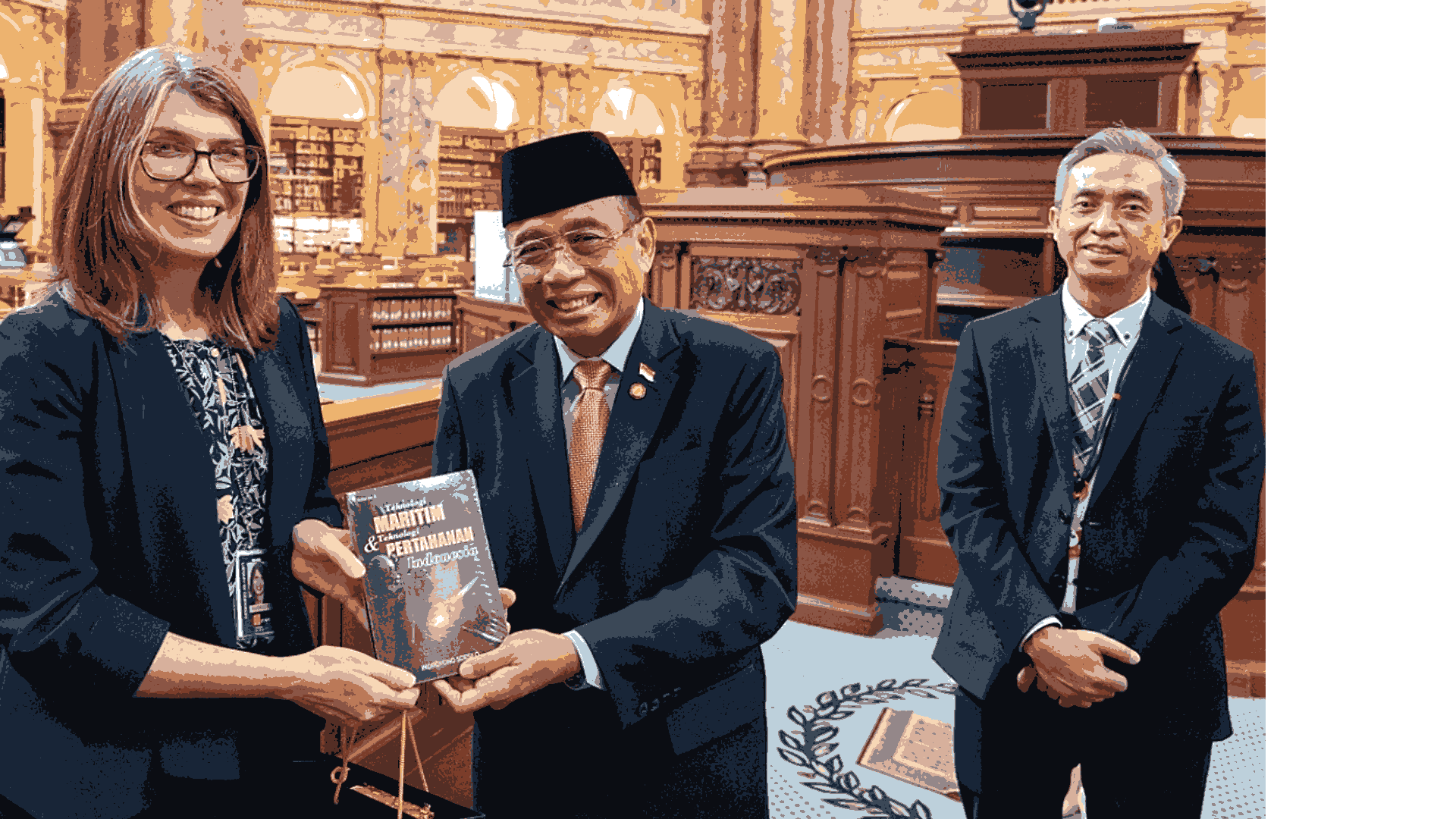
That connection between two centers of civilization was strengthened on June 10, when Indonesian Ambassador to the United States Indroyono Soesilo visited the Library of Congress, accompanied by officials from the Indonesian Embassy and the Education and Cultural Attaché. The delegation was received by Dr. Sarah Rhodes of the Congressional and Intergovernmental Office and representatives of the Copyright Office.
The Library of Congress, widely regarded as the world’s largest library, houses more than 170 million items. Its holdings include nearly 39 million books and printed materials in 470 languages, approximately 73 million manuscripts, millions of photographs, maps, recordings, and archival materials. Stretching across roughly 1,380 kilometers of shelving, the institution adds nearly two million items to its collections annually. Renowned for its architectural grandeur, the library’s marble interiors and artistic details make it one of the most beautiful public buildings in the United States.
Among these vast collections, Indonesia occupies a notable place. Approximately 190,000 items originate from Indonesia, including ancient manuscripts, rare books, audiovisual recordings, and historical sound archives. More than 117,000 Indonesian works have been cataloged in the Asian collections section, covering topics ranging from economics and politics to science, history, and children’s literature.
Indonesia’s presence is also reflected in publications about its leaders. The library contains more than 1,100 books on President Sukarno, 918 works on President Suharto, and numerous publications on President B.J. Habibie. The American Folklife Center additionally preserves recordings and documentation related to Indonesia spanning more than a century, from 1893 to 2009.
One of the most treasured Indonesian holdings is an illuminated Javanese manuscript dating back to 1862, titled Pangkat-pangkat caritanipun serat babad ing Tanah Jawi sedhaya. Richly decorated with illustrations, the manuscript chronicles Javanese history and the spread of Islam, offering both historical significance and artistic value.
During the visit, Ambassador Indroyono Soesilo encouraged stronger cooperation between the Library of Congress and Indonesian libraries, particularly through exchanges aimed at enriching collections. He also presented his book, Maritime Technology and Indonesian Defense Technology (Third Edition, 2018), increasing the number of his publications housed in the library to twenty.
The ambassador further announced that alumni of the Bandung Institute of Technology’s Class of 1973 are scheduled to visit the Library of Congress on July 1, bringing approximately 100 books and atlases as donations. The initiative is intended to strengthen Indonesia’s intellectual and cultural presence on the global stage.
Indonesia’s collections at the Library of Congress represent more than statistics. They signify the country’s place within the world’s landscape of knowledge. Amid millions of volumes and centuries of recorded history, Indonesia continues to tell its story through manuscripts, books, and intellectual contributions.
Ultimately, the significance of libraries, museums, galleries, and archives extends beyond preserving the past. These institutions serve as bridges to the future, ensuring that national identity is nurtured, studied, and shared with the world. (*)