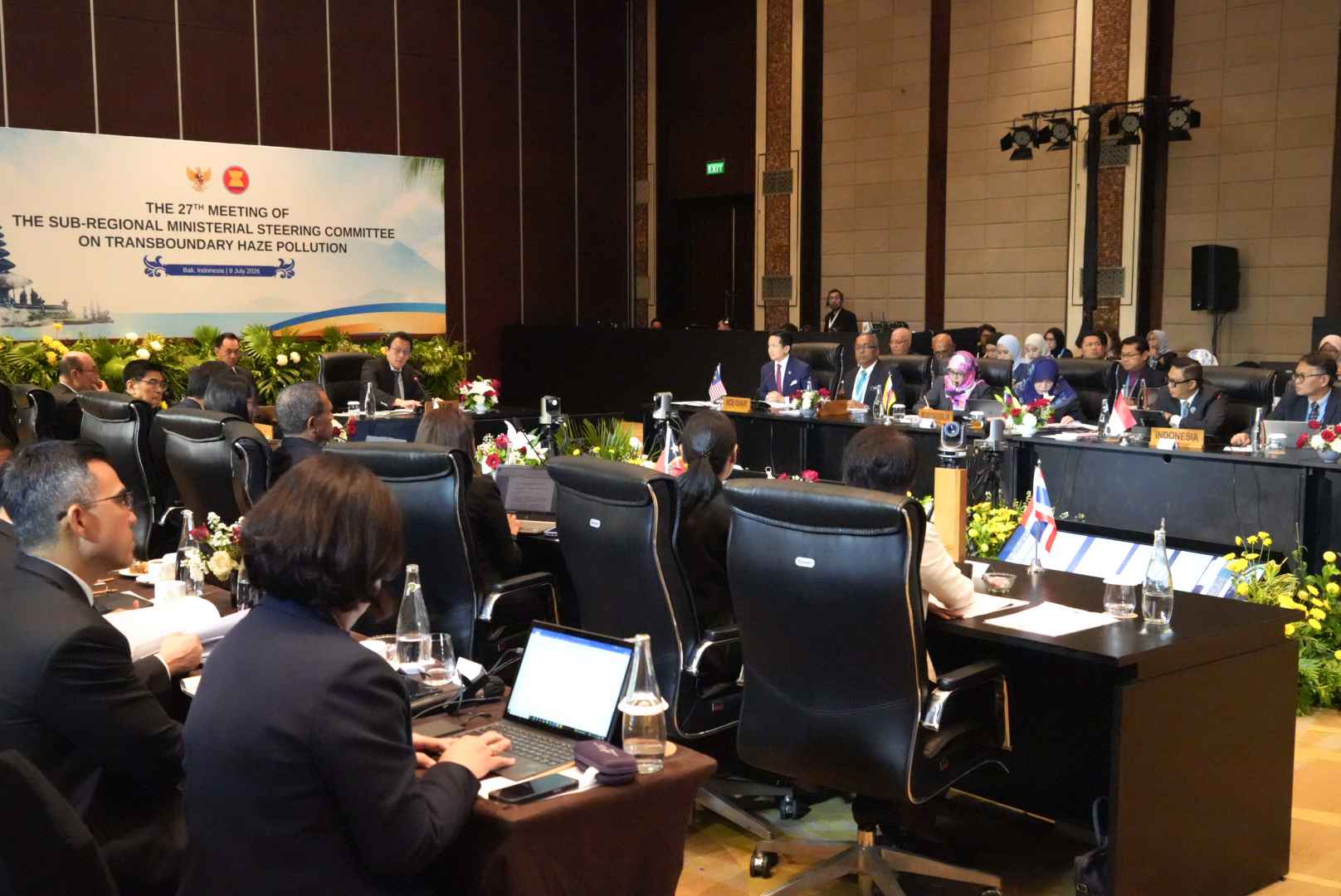
Enviro News Asia, Bali – Indonesia has reaffirmed its leadership in strengthening regional cooperation against forest and land fires (karhutla) and transboundary haze pollution through the 27th Sub-Regional Ministerial Steering Committee (MSC) Meeting on Transboundary Haze Pollution in Bali. The meeting, chaired by Minister of Environment/Head of the Environmental Control Agency (KLH/BPLH) Moh. Jumhur Hidayat, was attended by ministers and delegations from Brunei Darussalam, Indonesia, Malaysia, Singapore, Thailand, Timor-Leste, and the ASEAN Deputy Secretary-General for ASEAN Socio-Cultural Community.
Preceded by the 27th Technical Working Group (TWG) meeting on July 8, the forum reviewed the implementation of the ASEAN Agreement on Transboundary Haze Pollution (AATHP), strengthened regional coordination, and formulated anticipatory steps in the face of growing karhutla risks driven by climate change.
Opening the meeting, Minister Jumhur stressed that climate change demands ASEAN nations strengthen preparedness and collaboration in preventing forest and land fires that could trigger transboundary haze.
“This meeting takes place amid conditions of growing climate variability and changing weather patterns that are continuously increasing the risk of forest and land fires across the region. The potential influence of the El Niño phenomenon is a reminder for ASEAN to remain vigilant and continue strengthening preparedness, coordination, early warning systems, monitoring, and rapid response,” he said.
Indonesia presented its steps to strengthen karhutla control, including the reactivation of the 2026 Karhutla Response Coordination Desk for cross-sector coordination, monitoring, and dry season preparedness, backed by the declaration of emergency standby status in five fire-prone provinces, technology-based integrated patrols, community awareness efforts, and ground and aerial operations through water bombing and Weather Modification Operations.
KLH/BPLH Deputy for Environmental Law Enforcement Rizal Irawan provided updates on the formation of the ASEAN Coordinating Centre for Transboundary Haze Pollution Control (ACCTHPC), noting Indonesia’s progress in national ratification, operational document drafting, and the preparation of office facilities and monitoring technology. Indonesia also expressed readiness to support the early operationalization of the ACCTHPC, including the possible appointment of an Executive Director, while upholding the principle of equitable representation within ASEAN.
The meeting expressed appreciation to Indonesia for its commitment to preparing for the establishment and operationalization of the ACCTHPC, and to Vietnam for submitting its instrument of agreement for the coordination center’s establishment. Delegates also stressed the importance of accelerating ratification by all ASEAN member states to enable the ACCTHPC to become fully operational in strengthening the prevention, monitoring, information exchange, and management of transboundary haze pollution.
Malaysian Minister of Natural Resources and Environmental Sustainability Dato’ Sri Arthur Joseph Kurup stressed that prevention measures must be carried out swiftly and in a coordinated manner.
“Timely prevention measures, including strengthening field monitoring, early intervention in fire-prone areas, and swift response to emerging hotspots, will be critical to minimizing the risk of large-scale fires that could trigger transboundary haze,” Dato’ Sri Arthur said.
ASEAN Deputy Secretary-General for Socio-Cultural Community San Lwin warned that El Niño developments could make this year’s dry season drier and longer than normal, requiring stronger regional action.
“Given current El Niño conditions, this year’s dry season is expected to be drier and longer than normal. We therefore call for stronger and more committed regional measures to address the risks of forest and land fires and transboundary haze pollution,” San Lwin said.
Through the 27th MSC and TWG meetings, ASEAN nations reaffirmed their collective commitment to preventing forest and land fires and transboundary haze, with strengthened regional coordination, early warning systems, monitoring, information exchange, and rapid response identified as shared priorities for building a resilient, haze-free ASEAN. (*)