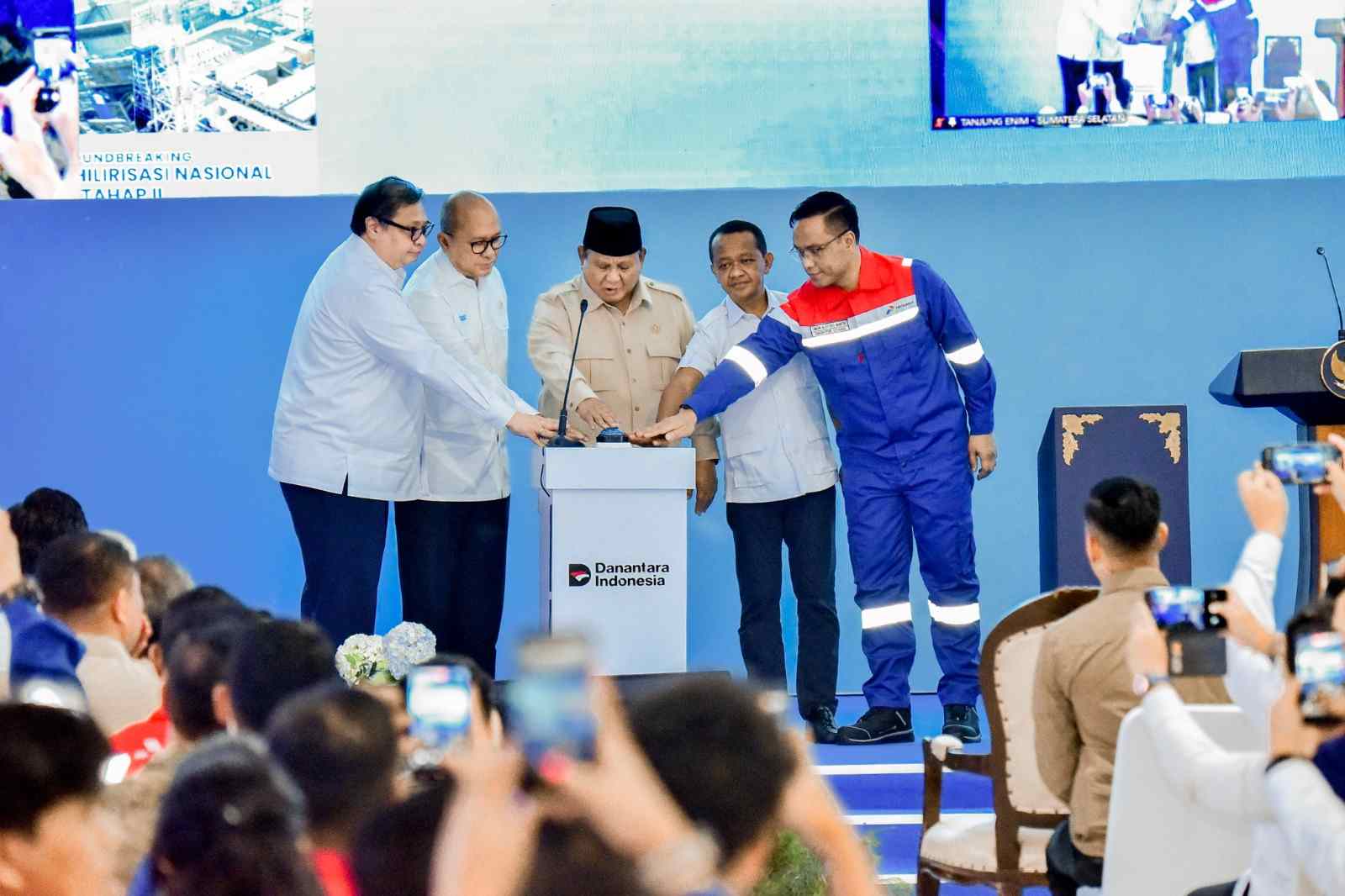
Enviro News Asia, Cilacap — The Indonesian government advanced the implementation of strategic downstream projects following the second-phase groundbreaking launched by President Prabowo Subianto on 29 April 2026 in Cilacap, Central Java. The projects mark the transition from feasibility studies to concrete execution under the national downstreaming agenda.
The initiative follows comprehensive feasibility studies prepared by the Task Force for Downstream Acceleration and National Energy Security, chaired by Minister of Energy and Mineral Resources Bahlil Lahadalia. After completing the studies, the government assigned the execution phase to the Daya Anagata Nusantara Investment Management Agency (Danantara) to develop the projects into national strategic investments.
Bahlil stated that both the first and second phases of groundbreaking demonstrate that the task force’s work has moved beyond planning into real implementation. He explained that the feasibility studies provide a solid foundation to ensure each project is carefully calculated, targeted, and capable of delivering maximum economic benefits.
He added that the task force focuses on strengthening project planning, while Danantara is responsible for ensuring timely execution, investment realization, and measurable outcomes for the public.
The president instructed that downstreaming must serve as a strategic instrument to strengthen national energy security, increase the added value of natural resources, and reduce dependence on imports. He emphasized that Indonesia must shift from exporting raw materials to processing them domestically to maximize benefits for its citizens.
The downstream projects launched across both phases primarily focus on the energy and mineral resources sector. These include alumina and bauxite smelters in Mempawah, biofuel production facilities such as bioaviation fuel and bioethanol, gasoline refineries in Cilacap and Dumai, fuel storage facilities in multiple regions, coal-to-DME processing in Tanjung Enim, and downstream development of nickel, steel, asphalt, copper, gold, and palm-based biodiesel.
During the event, the president urged continuous evaluation of project implementation using advanced technology and precise calculations to ensure efficiency and sustainability.
Chief Executive Officer of Danantara, Rosan Roeslani, stated that the projects will strengthen energy resilience while creating large-scale employment opportunities. He confirmed ongoing coordination with the Ministry of Energy and the task force to accelerate implementation and maximize industrial and economic value.
The government expects that the gasoline refinery projects will reduce national fuel imports by approximately 10 percent, while the DME project will help substitute liquefied petroleum gas imports, which currently account for around 80 percent of domestic demand.
Through these initiatives, Indonesia reaffirmed its commitment to accelerating downstream-based economic transformation, strengthening industrial capacity, and achieving long-term energy independence. (*)