

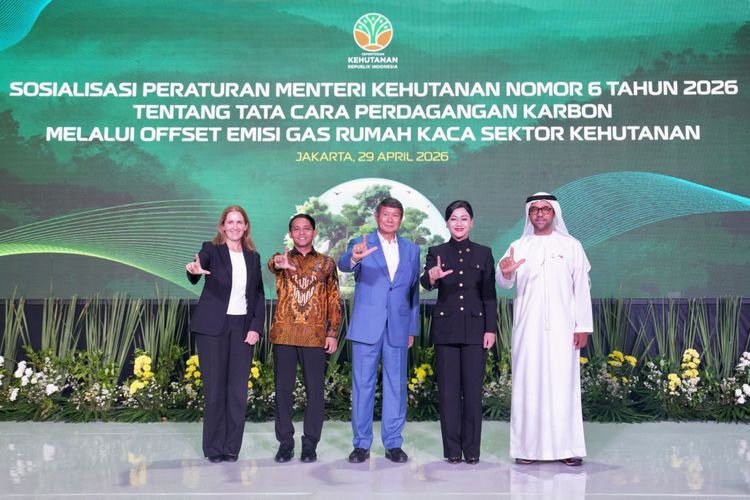
Enviro News Asia, Jakarta — The Ministry of Forestry held a public dissemination of Ministerial Regulation No. 6 of 2026 on Forestry Sector Carbon Trading in Jakarta on 29 April 2026. The event took place at the Manggala Wanabakti Building and aimed to introduce a new regulatory framework that directly involves local communities in carbon management and benefits.
Minister of Forestry Raja Juli Antoni stated that the regulation provides a clear, transparent, and reliable system to support carbon trading in the forestry sector. He explained that the framework covers the entire process, from mitigation activities and carbon measurement to validation, registration in the national system, and the execution of carbon trading.
He added that each stage now has defined timelines, ensuring certainty for businesses and forest-dependent communities. The system integrates all processes into a single accountable mechanism to improve governance and trust.
The minister emphasized that carbon trading must not be exclusive. The regulation ensures inclusive participation by strengthening social forestry schemes, customary forests, and community involvement as equal stakeholders. He noted that indigenous communities and forest farmers who protect ecosystems can now gain direct economic benefits from carbon initiatives, reflecting social justice in the green economy transition.
Presidential Special Envoy for Energy and Climate Hashim Djojohadikusumo welcomed the regulation, describing carbon trading as a strategic tool to incentivize climate mitigation efforts, particularly through emissions offset mechanisms in the forestry sector.
He highlighted that the government is pushing for transparent, accountable, and high-integrity implementation of the regulation to support national emission reduction targets while unlocking climate financing opportunities through international carbon markets.
The dissemination event also served as an open forum for dialogue between the government and stakeholders, including businesses, academics, civil society organizations, and international partners. Participants discussed technical procedures for carbon trading across social forestry areas, conservation zones, and production forests.
Through this regulation, the government reaffirmed its commitment to sustainable forest management while ensuring that economic benefits from carbon trading are distributed fairly and inclusively. (*)