Enviro News Asia, Makassar — Indonesia’s Forestry Ministry has designated approximately 5.67 million hectares of forest areas as potential locations for business permits covering food production, energy, non-timber forest products and environmental services, in addition to timber utilization.
The allocation is part of the 2026 Forest Utilization Direction Map, known as PAPH, for Forest Utilization Business Licensing (PBPH). The area is equivalent to around 85 times the size of Jakarta.
Director General of Sustainable Forest Management at the Forestry Ministry Laksmi Wijayanti said the policy was intended to encourage forest utilization models that maintain forest cover while generating economic value.
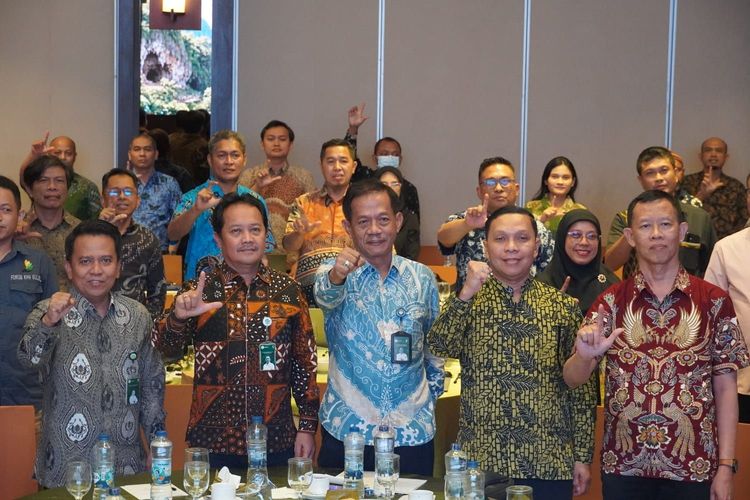
“We want to demonstrate that forests that remain standing can be more profitable than forests that are converted. PAPH is a momentum to correct spatial utilization in the forestry sector,” Laksmi said during the 2026 PAPH socialization event in Makassar on September 24.
The South Sulawesi provincial government welcomed the policy, with Secretary of the Environmental and Forestry Agency Erwin Werianto describing PAPH as a link between forest potential and legal utilization, supported by 24 Forest Management Units operating at the local level.
Aren for Energy, Coffee and Cocoa for Food
The 2026 PAPH includes specific allocations for food and energy security based on a joint assessment with the Ministry of Agriculture.
Around 387,641 hectares have been designated for sugar palm cultivation as a potential bioenergy source, while approximately 68,454 hectares are directed toward agroforestry involving rice, corn, soybeans, coffee and cocoa.
Director of Forest Utilization Planning C. Hendro Widjanarko said sugar palm should not be cultivated through monoculture systems.
“Sugar palm grows well under shade, with around 50 percent forest cover. Therefore, the model is a mixed system. The forest remains protected while its products can be harvested,” Hendro said.
Reforestation Allocation Reaches 902,298 Hectares
In response to the government’s direction to restore degraded forests, the 2026 PAPH allocates approximately 902,298 hectares for forest and land rehabilitation in consolidated areas that are not currently subject to permits.
Permit holders in these areas may develop environmental services, non-timber forest products and carbon-related activities while restoring forest conditions.
Meanwhile, around 1.33 million hectares of protected forests and 1.37 million hectares of production forests included in the moratorium area, known as PIPPIB, may only be utilized without altering the landscape.
Activities in these areas are limited to environmental services and non-timber forest products.
Stronger Licensing Requirements
The 2026 PAPH was established through Forestry Ministerial Decree No. 7253 of 2026 and is publicly accessible through the Forestry Ministry’s SIGAP portal.
The ministry said the map’s geospatial data received an A score, or 100, with complete metadata as part of its quality assurance process.
Director of Forest Resources Inventory and Monitoring R. Agus Budi Santosa said the PAPH thematic geospatial information can be accessed and shared through the SIGAP network as well as used offline.
The Forestry Ministry has also tightened the licensing process. Every application for a Forest Utilization Business License must now include a recommendation from the governor.
Applicants who previously submitted only proof of receipt have a maximum of 90 days to complete the required recommendation.
Laksmi said early involvement from regional governments is important to prevent overlapping forest utilization areas.
PAPH as Basis for PBPH Applications
The PAPH serves as a reference for governors when issuing recommendations for PBPH applications.
Oktripan Arung Langi of the Directorate of Forest Utilization Business Development said the governor’s recommendation represents coordination between the central and regional governments, while applications are processed through the Online Single Submission system at the Ministry of Investment and Downstream Industry.
Since 2025, following Government Regulation No. 28 of 2025, applicants have also been required to take changes to the Indonesian Standard Industrial Classification, or KBLI, into account.
Neisa Artdiyasa of the Investment Ministry said the OSS system provides a conversion mechanism from the 2020 KBLI codes to the 2025 classification, allowing businesses to select codes corresponding to their activities.
Industry Welcomes the New Map
The Association of Indonesian Wood Panel Industries (APKINDO) welcomed the 2026 PAPH, with its chairman Bambang Soepijanto saying the map could open additional sources of raw materials through new permits.
Meanwhile, Indonesian Forest Concessionaires Association (APHI) Chairman Soewarso said the organization would revise its 2019–2045 production forest roadmap to align with the multi-business forestry model.
The Forestry Ministry said PAPH is a dynamic document that will be updated at least once a year. Input from regional governments and businesses will be considered in preparing the 2027 PAPH, with the process scheduled to begin in December 2026. (*)