Enviro News Asia, Jakarta — Indonesia recorded 160 high-confidence forest and land fire hotspots on Oct. 30, 2026, an increase of six from the previous day’s 154, as the Forestry Ministry continued firefighting operations, with Central Kalimantan remaining a key priority.
Data from the ministry’s SiPongi monitoring system showed 13 high-confidence hotspots across six priority provinces for fire control. Central Kalimantan accounted for 12, while South Kalimantan recorded one. West Kalimantan, Jambi, South Sumatra and Riau reported no high-confidence hotspots.
Compared with the previous day, the number of hotspots in Central Kalimantan declined from 17 to 12, while South Kalimantan recorded one after previously reporting none.
The ministry cautioned that hotspot data must be assessed alongside conditions on the ground. Satellite systems operated by NASA Terra/Aqua, SNPP and NOAA-20 detect surface-temperature anomalies, which do not necessarily indicate confirmed fires or the extent of burned areas. All detections require field verification through patrols and ground checks.
According to the Forestry Ministry’s fire-control command post, operations remain concentrated in several locations in Central Kalimantan.
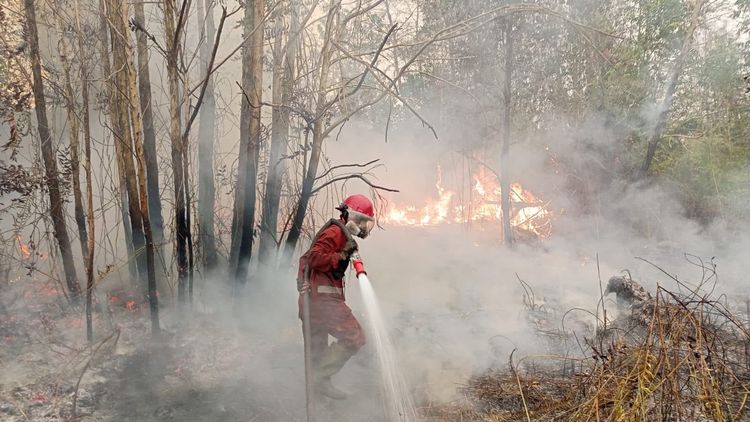
In Sebangau National Park, firefighting continued along the Sungai Koran area and near Tjilik Riwut Kilometer 32 in Palangka Raya. Both locations involve peatland fires requiring further suppression.
In Pulang Pisau, ministry firefighting teams, known as Manggala Agni, continued peatland wetting and patrols at the Tumbang Nusa Special Purpose Forest Area (KHDTK). Suppression operations also continued in Jabiren, Sei Hambawang, Sakakajang and Tanjung Taruna.
Smoke and remaining fire spots were still detected at several locations. Rainfall had not fully extinguished underground peat fires, which can continue burning beneath the surface.
Firefighting operations also continued in Tanjung Puting National Park, particularly in the Sei Sekonyer–Tanjung Harapan area of West Kotawaringin. The fire involved underground peat combustion and had not been fully extinguished by the latest report.
Conditions have improved at several locations in South Kalimantan. Fires in Nusa Indah, Tanah Laut, Batulicin, Tirawan and Tanjung Dewa have been declared extinguished.
However, smoke remained at several points in Landasan Ulin Barat. Fire suppression in the Gunung Batu Kura Protection Forest also faced difficult terrain, preventing teams from reaching all affected locations.
In South Sumatra, the fire in Talang Rimba, Ogan Komering Ilir, was reported extinguished. In Jambi, the fire in Tanjung Village, Muaro Jambi, was also brought under control. At Simpang Datuk, thin smoke remained and continued to be monitored by Manggala Agni and joint response teams.
The ministry warned that improving conditions in some areas should not lead to reduced vigilance. Peat fires can leave embers burning underground even after rainfall or when visible flames have disappeared.
Manggala Agni teams are continuing operations alongside the National Disaster Mitigation Agency (BNPB), Indonesian Military (TNI), National Police, Meteorology, Climatology and Geophysics Agency (BMKG), regional disaster management agencies, local governments, Fire Awareness Communities, businesses and volunteers.
Their activities include patrols, ground checks, firefighting, peatland wetting, ember searches, mop-up operations and cooling.
A total of 61 aircraft remain deployed to support fire control operations. The fleet consists of 24 aircraft for patrols, CASA operations and weather modification, as well as 37 helicopters assigned to water-bombing missions. Aerial operations are being coordinated with ground response efforts according to weather conditions and local requirements.
The Forestry Ministry stressed that the success of fire control should not be measured solely by increases or decreases in hotspot numbers. The priority is to ensure that fires and underground embers are fully extinguished, prevent renewed outbreaks, protect communities and safeguard forests and biodiversity. (*)